
Book Review - The Winter Solstice: The Sacred Traditions of Christmas
You Don't Know Anything About Christmas Till You Read This Book

The Winter Solstice: The Sacred Traditions of Christmas
By John Matthews with contributions from Caitlin Matthews
1998
History
247 pages
Ages 13 and up
You Think You Know Christmas, But You Have No Idea…
I never knew I knew so little about the beginnings of Christmas. I found this book 10 years ago at the Argosy Book Store in midtown Manhattan, which is chock full of antique and rare books as well as maps and posters from years past. I'm always on the lookout for secrets and hidden gems, this book is both. Jam packed with historical references from academia and literature, as well as studies on tradition, cultures, ceremonies and the like, John and Caitlin Matthews have compiled a stunning artifact that has truly changed how I see the holidays. You will be utterly shocked at the confounding statements made herein and backed by historical standings.
Firstly, longer than we have been celebrating the birth of the Christ Child, we have been honoring the birth of The Unconquerable Sun. After fading from the sky for months the sun starts its march northward-reborn. The significance of this time of year has been held in reference for thousands of years, in nearly every region of the planet. More than one child of wonder is said to be birthed during this season, Mithras, Aiona and Attis are just a few alongside Jesus. Our authors do well at describing the usurping of holidays by advancing armies and how it was a common trait of victors through history. To that end, the authors goes out of their way to note the Christ Child is the perfect embodiment of the gifts of the new year. Jesus shows that life never dies; he is a promise of glory and mirth and abundance. I could not imagine a more abundant place than earth, and the promise to bathe in its riches fills me with mirth. I'll take a snow break every year to experience that. You can make your own minds up about correlations once you've reviewed the literature.
Santa is a Platypus
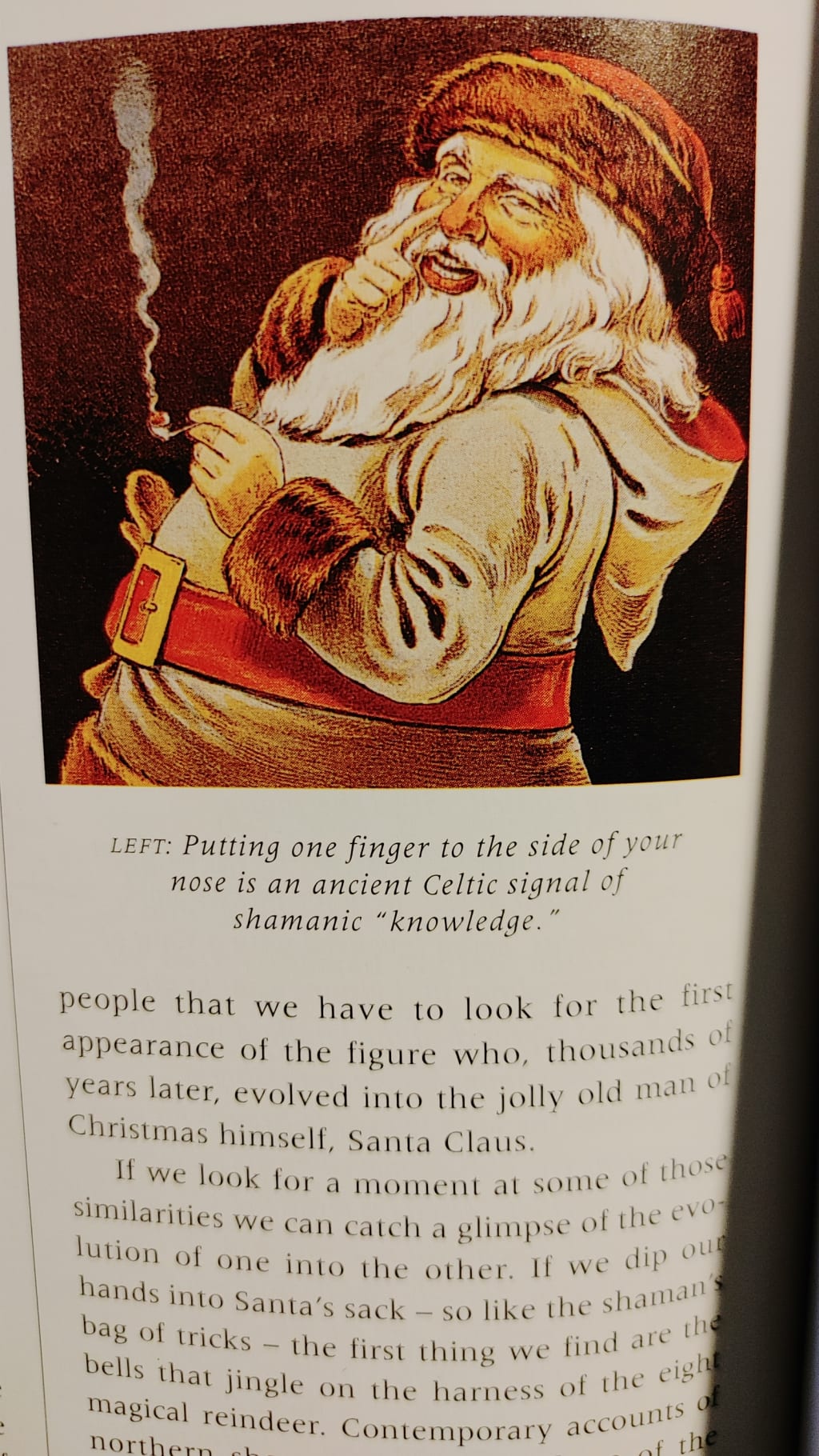
Religious affiliations aside, Santa Claus is the dominant Christmas figure of our time, and his evolution has been weird to say the least. He is a hodgepodge of mysticism, history and commercialism, a true marvel in story telling standards. This book contends the earliest iterations of the gift giver were shamanic individuals that would bring confirmation of the new year and with it, gifts of light and life. The modern notion of Saint Nicholas is a nice way of thinking about gift giving, but if you think too hard about Santa and Saint Nick you will come to the understanding, one of them is lying.
Our traceable history of St. Nick to Saint Nicholas of Patara, a 3rd century bishop in from Turkey, leaves many things to be explained. While it is true Nicholas would sneak into dwellings at night and leave gifts to the poor, he would not want to announce himself with bells. Stockings would be hard to come by for the class of people Saint Nicolas was serving, not to mention he was in the Middle East. Also, not a lot of reindeer hang out in the Mediterranean. So, what gives? Like I said, hodgepodge. We took a bunch of stuff we liked, or had meaning from long ago, and smashed them together. Read the book to discover the details!
Santa’s bells and their jingling ring has specific meaning. Shaman, the former keepers of wisdom, history, medicine and magic, would themselves wear bells when journeying to the lands of meditation and vision quest. The bells were defense against evil spirits, warding off threats so the shaman could do their important work. Spherical in shape to pay homage to the solar entities, the jingle bell creates unseen power when rung.
And the reindeer? Well, to those in the northern climes, this rugged animal was magic. Not only could the Dasher and her family find nourishment just about anywhere-thus great for a pack animal, but they were also generally well mannered. Reindeer were used as a food source; their bones were fashioned for tools and fasteners. Reindeer hides were made into warm coats and coverings to protect against the cold. Even their hooves and entrails were boiled to make glue and torch materials. In many ways, reindeer saw the people of Lapland, Siberia and the like, through the most treacherous time of year. We continue to celebrate them for their durability and other worldly characteristics.
So Much More Solstice/Christmas…
Those are just a few of the tidbits in this trove of goodness, literally thousands more await. Rich with photo references, recipes, songs and games to help you celebrate this most auspicious time of year. They do a splendid job explaining the 12 Days of Christmas, an extended party I think we would do well to revive. There are so many amusements offered you can be sure to find a few to help you celebrate just the way you want. Study up, there will be a quiz:)
Read Next: The Christmas Barn-a winter fable
About the Creator
Jordan J Hall
I write Historical and Speculative Flash Fiction. Nature and society's underbelly are the focus of my work. Read my debut collection of short stories, Mammoth, Massachusetts and check out jordanjhall.com for more.
Keep reading
More stories from Jordan J Hall and writers in Geeks and other communities.
Silver Screen Magic with Mae West
American actress and singer Mae West became a popular film actress during the Great Depression. She started entertaining in vaudeville, then performed on Broadway, and finally went to Hollywood. She signed up with Paramount Pictures and made her debut in the 1932 film “Night After Night.” She also starred in musicals, comedies, and crime dramas. The American Film Institute named her one of the best classic Hollywood actresses.
By Rasma Raisters6 days ago in Geeks
Why The Last Holiday Still Resonates Even 20 Years Later
Plot Summary Georgia Byrd, a kindhearted but shy department store employee, discovers she has a terminal illness. Faced with her mortality, she decides to abandon her mundane life and take a lavish vacation to Europe, determined to live life to the fullest before her passing. Along the way, Georgia embraces adventure, discovers her own courage, and forms unexpected friendships that change her outlook. Amid luxury hotels, fine dining, and breathtaking scenery, she also encounters romance and laughter, learning to cherish every moment. The Last Holiday is a heartfelt story about finding the true joy of life and self-discovery.
By TheScreenAnalyst5 days ago in Geeks



Comments
There are no comments for this story
Be the first to respond and start the conversation.