
The Elegant Game of Washers: Rules, Regulations, & Nomenclature
*Includes the 12 Commandments of Washers*

Naming
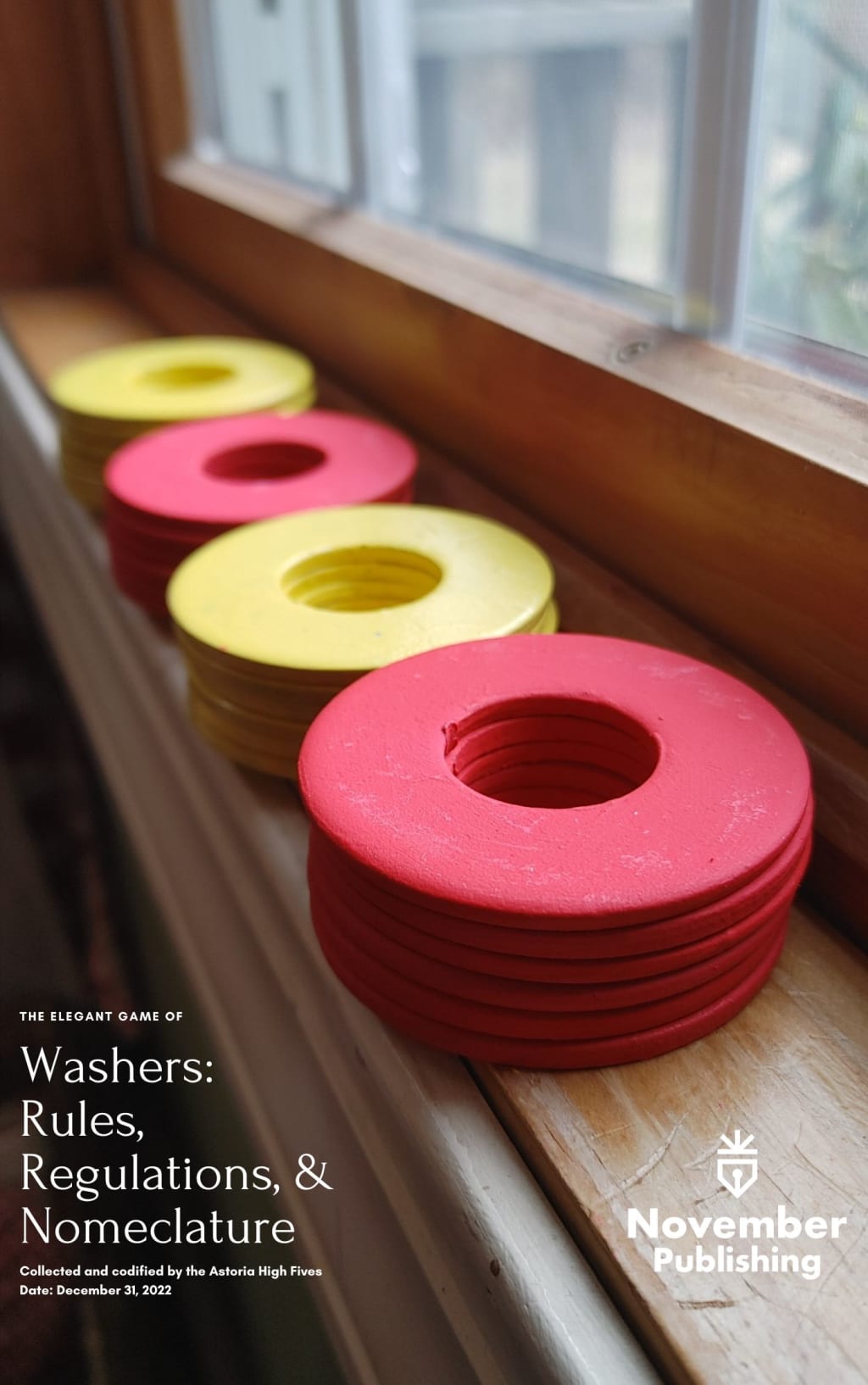
Given the enormous variety of nomenclature that has developed over the years, we have done our best to combine and outline the basic of terms for play.
SCUDFF One whom washes; One who plays Washers.
GUSS or BOX 18” sq box with sides 4” from the ground.
TO GUSS, GUSSING Landing a washer inside the Guss (box).
PIPE or KETTLE 4” diameter Pipe fixed to the center of the Guss.
TO PIPE, PIPED Landing a washer inside the Pipe.
PIT Playing area consisting of two gusses; 15’ for intermediate, 18’ for tournament, 21’ for championship.
DIDDLE Opening toss in each contest; determines who ‘controls the box’. Usually consists of a three-count of some variety spoken by the youngest of the players. Player closest to the center of the box assumes ‘control’; the diddle can also be thrown until one player gusses.
CONTROL OF THE BOX Commands the order of pitching. Determined by the diddle or the last person to score.
BOUT A set of pitches from made by each player at one guss.
ROUND Two bouts (down and back), one complete doubles exchange.
SHOW Washers left in scoring position after the Bout.
OPEN BOX or NO SHOW A show with no scoring washers played.
CHUTE or SHOE Allotted number of washers each player pitches.
GARRETT A ricochet off the top of the pipe.
COVER&PUSH Equally valued shows from each player; no one scores.
RABBIT A washer that enters but doesn’t stay in the box.
SLIPPERY RICK A washer that enters but doesn’t stay in the pipe.
JACK RABBIT When a pitched washer hits and bounces another washer out of scoring position.
THE OLE FRANKLIN PIERCE A washer balanced on the rim of the box, neither in nor out. Both amazing and embarrassing, yet worth Zero points. Named after the 14th (and most attractive) American President, Franklin Pierce. Of which is said, ‘looks great but does nothing.’
CHAPLIN (CHARLIE) A washer left leaning in or out of the box; a Chaplin does not designate score of any kind; it’s merely a moniker for part of a show.
Scoring
To score, a washer must come to rest inside the box, or pipe.
Bout A set of pitches made by each player at one guss.
Show Final position of all washers thrown in a bout.
Turn All washers thrown from one plyers shoe.
Guss (point, lump. etc) A washer left in the guss(or box).
Pipe, Piper or Kettle A washer left in the column.
Top Hat Two washers in the pipe by one player in one show.
Suszanne Three washers in the pipe by one player in one show.
Brick House Four washers in the pipe by one player in one show (impossible to get out from underneath).
Flamin’ George/Renegade Five washers in the pipe by one player in one show
Bachelor One washer in the guss by one player in one turn.
Newlyweds Two washers in the guss by one player in one turn.
Hattrick Three washers in the guss by one player in one turn.
House (Quadbox) Four washers in the guss by one player in one turn.
Pool Party* Five washers in the guss by one player in one turn.
Tater and Beans One in the pipe, two in the guss
Pool Party/1 in the hot tub Five washers scoring/one in the pipe
Perfect plus 1 Reaching 21 in 4 shows. (in solo play only)
Variations of Play
Solo:
A chute of five washers is used to gain 21 points in the fewest rounds possible. Played as practice or for personal title amongst groups of regular players. It has become a standard in measuring the quality of player. The test is simple; how many shows does it take you to gain 21points. A Ten-Show player is mid-level. This of course means the scudff was averaging just over two points per show. Tournaments usually encourage players of less than Seven-Show to improve their game before entering competition.
Singles:
A one-on-one race to 21. The ultimate test of a washer player. Game begins with the diddle and control of the box is assumed. From this point all rules are in effect. Washers in scoring position cancel each other, player left with washers to score assumes control. Play continues until one of the players reaches 21(or the stated goal).
Doubles:
A team race to 21; standard rules to 21 apply. Doubles is played with two players per team. One member from each team takes a box for their ‘home’ and the youngest player calls and throws against their opponent.
• It should be noted washers has a similar structure to many pitching games: bags, quoits, horseshoes to name a few.
• Land washers(Texas Washers) is a game played with similar dimensions and equipment but the pipe is depressed into the soil and there is no guss, only an area of dirt 5’ x 8’, enclosing the pipe with two-by-fours. Points are scored by landing closest to, or in, the depressed pipe.
• Washers has had different incarnations stemming from a loosely tethered past with no one really holding the one and true calling of the game. The rules set here were the ones used for play during the Louisiana Purchase Exposition since they are the best documented in the annals of history. It is clear by word of mouth and simply investigating localities where washers is currently played that rules and styles are not a priority all the time.
• Of the many styles to end the game two are by far most popular. ‘The Sit(Spot On)’, and the ‘No Mercy’. With ‘The Sit’ the player must reach the end score without going over. This forces the players to scrape until the very end while penalizing throws that are not well aimed. This method of play was developed to create hazards where once was prize(the column), mainly to stop the praise of accidental points.
Ex: If Player A has 19 points and their opponent, Player B, has 15 points, Player A needs 2 points to reach 21 and become the victor. If Player A should throw a kettle, regardless of how impressive, it would put them over their goal and therefore penalize them. In ‘The Sit” style of gaming, finesse and restricting your movement are weighed heavier than regular repetition of movement that is lucrative in ‘No Mercy’.
‘No Mercy’ can be one the most embarrassing events in a washer player’s career. It is, as the title suggests, absolute attack with no withdraw. True duels are played to 21 points. Smaller games can be appreciated but hold no relevance in official standing or exchange of title. The only way a title can be exchanged is if the end goal is 21 points, from 21 feet.
+In tournament play ‘Control’ is gifted to the youngest player to expedite gaming.
Twelve Commandments (of Washers)
1) A washer dropped is a washer played
2) Youngest player has the honor
3) Diddle on 3, closest to center earns control
4) Defer to a diddle to settle disputes
5) Only washers in the box after the show, are in scoring position
6) Scoring washers cancel each other; Pipe trumps up to 4 gusses
7) When pitching, feet must remain behind the front of your own box
8) Everyone scores in a Pool Party* & Flaming George = automatic win
9) 21 Points from 21 feet, No Mercy, must win by 2
10) Thou shall not regulate the style, or pattern of a scudff’s pitch
11) Thou shall never have more than one scudff pitching at a time
12) Dimensions and Distances for Game Pieces**
Box Size: 18” x 18” x 4”
Washer size: 1” inside diameter, (about 2.5” outside)
Pipe Size: 4” inside diameter, affixed to center of box (flush top)
Box Distance shall be:
15 feet apart – casual/social
18 feet apart – Tournament
21 feet apart – Championship
*Proper etiquette requires scudffs to stand behind pitcher, out of line-of-sight.
**Light decoration is allowed to all game pieces providing weight and integrity of original form remains intact.
READ NEXT: A Brief History of Washers
About the Creator
Jordan J Hall
I write Historical and Speculative Flash Fiction. Nature and society's underbelly are the focus of my work. Read my debut collection of short stories, Mammoth, Massachusetts and check out jordanjhall.com for more.
Keep reading
More stories from Jordan J Hall and writers in Geeks and other communities.
6 100-Word Movie Reviews
“A Light Beneath Their Feet” (2015), Director: Valerie Weiss, Actors: Madison Davenport, Taryn Manning Mental health movies are important. Beth (Madison Davenport) must decide between attending the college of her dreams and staying home to care for her bipolar mother (Taryn Manning). Valerie Weiss directs a quiet, thoughtful drama that explores the complicated bond between a mother and daughter facing mental health illness. Manning delivers a powerful performance. Davenport and Manning got the roles for their chemistry. The film is unsettling at times and will make you angry. These emotions are okay. Don’t ever take advantage of someone’s mental illness. It’s also a film about making decisions. Make decisions that are right for you.
By Marielle Sabbaga day ago in Geeks




Comments
There are no comments for this story
Be the first to respond and start the conversation.