
Book Review: "The Science of Happiness" by Professor Bruce Hood
3/5 - insightful if not flawed and somewhat contradictory...

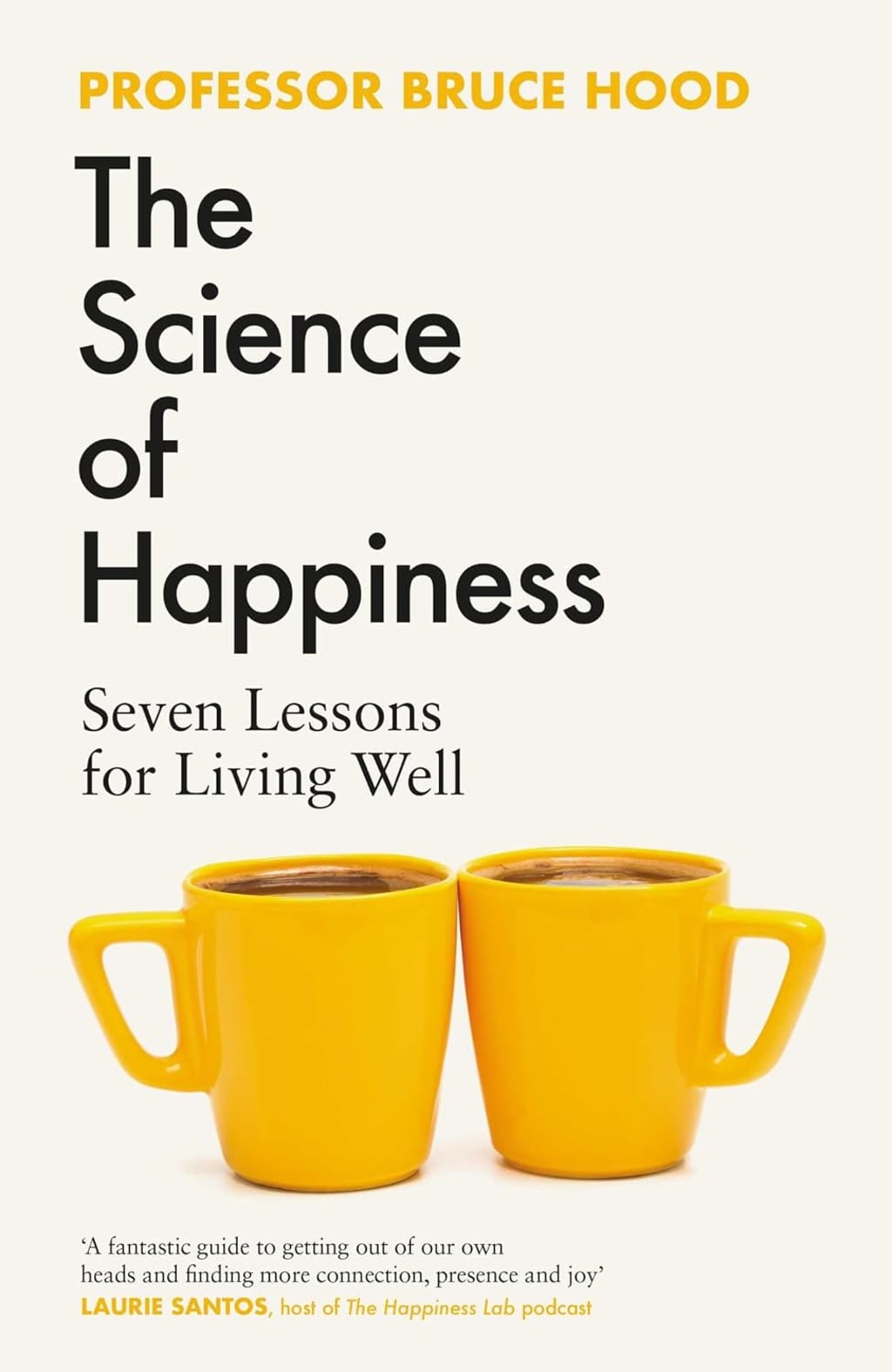
I think everyone wants to know how to be happy scientifically and so, this book seems appealing. It is not really what you would call a 'self-help' book due to the fact it is not trying to give you quick fixes, but is in fact trying to get you to change in the long run by using science to support the facts. I would say that it makes some weird presumptions that I won't dwell too much on but there are a lot of things to be learnt here. I find it kind of rubbed the wrong way against another book I read entitled The Let Them Theory especially when it comes to parenting. Where The Let Them Theory suggests that praise for all the little things is the way to get wins on the big things when it comes to children, The Science of Happiness simply does not support - stating that over praise can lead to dependency. I don't know who to believe. As a teacher, I believe the latter but as someone in the hands of doctors right now, I believe the first. Let's take a look at the book then...
Professor Bruce Hood begins by exploring the concept of happiness, challenging the common misconception that it is simply about feeling pleasure or achieving success. He explains that happiness is not a constant state but a fluctuating experience influenced by our biology, environment, and mindset. Drawing from psychological and neuroscientific research, he highlights how happiness is more about overall life satisfaction and well-being rather than fleeting moments of joy. He also introduces the idea that happiness is subjective—what makes one person happy may not work for another, making it essential to understand our personal sources of fulfilment. This is all well and good, I have a slight problem with the theory that 'overall life satisfaction' can make us happier, but I'll leave that to the very end*.

Hood delves into the evolutionary basis of happiness, explaining that our ancestors’ survival mechanisms still influence our emotions today. While traits such as anxiety, social bonding, and risk aversion helped early humans navigate dangers and form communities, they sometimes conflict with modern happiness. For example, our tendency to compare ourselves to others once ensured we maintained social cohesion but now often leads to dissatisfaction in an era dominated by social media. Understanding these evolutionary influences allows us to reframe our emotions and develop healthier perspectives on happiness. This was actually fairly interesting and kind of answers the question of why humans require to be happy or at least contented in order to work well on themselves and treat themselves as human beings.
Hood introduces the concept of the hedonic treadmill: the psychological phenomenon where humans quickly adapt to both positive and negative life changes. Whether we receive a promotion, buy a new car, or win the lottery, our initial happiness fades over time as we return to our baseline emotional state. This explains why people often feel unfulfilled despite achieving major life goals. The book suggests that instead of seeking external validation, we should focus on developing sustainable habits and attitudes that contribute to long-term well-being. This is interesting because one of the points at the start of the book concerns that though babies and children are almost constantly happy about something, adults are not. The question of how this is lost is one thing but another question is of why an adult's default state is one of detachment or even sadness.
Contrary to the belief that money and status lead to happiness, Hood highlights research showing that beyond a certain income level (enough to cover basic needs and comfort), additional wealth does little to improve well-being. He explains that material possessions provide only temporary satisfaction and that people who prioritise extrinsic goals (such as wealth and fame) often report lower levels of happiness compared to those who focus on intrinsic goals (such as personal growth and relationships). The book encourages readers to redefine success in terms of meaning and purpose rather than financial achievement. I think this has been repeated into the sun and I have read the research on it, believing it now to be a half-truth that is pedalled by people who already have financial security so that others won't bother working up to where they are. If happiness does in fact look different to different people then this is not only a half-truth, it is a flat out lie. I don't like to see contradictions, but I do like to point them out when I do.
A key finding in happiness research is that people who have a sense of purpose experience greater life satisfaction. Hood discusses how having meaningful goals whether through work, hobbies, or contributing to society, enhances well-being. He highlights studies showing that individuals who engage in purposeful activities, such as volunteering or pursuing creative passions, report higher levels of happiness than those who focus solely on personal gain. The book encourages readers to identify what gives their lives meaning and to prioritise activities that align with their values. This is probably the most true statement. For example: I feel a sense of purpose when writing these reviews and that makes me happy. I may not be smiley and overt about it and I may still sit here with resting bitch-face, but I am happiest when telling you guys about a good book I read. I am one of those people who seriously does not believe you have to have a big grin on your face to seem happy. Happiness looks different for everyone - this author says it himself.
Hood acknowledges that no one can be happy all the time and that life inevitably includes hardships. However, he presents research on resilience, our ability to recover from setbacks and how it plays a crucial role in long-term happiness. He explains that people with strong emotional resilience are better equipped to handle stress, failure, and adversity without becoming overwhelmed. Strategies for building resilience include developing a growth mindset, fostering supportive relationships, and practising self-compassion. Rather than avoiding difficulties, the book encourages readers to embrace challenges as opportunities for personal growth. I think, fellow millennials, we were definitely taught we could be happy all of the time and were really upset when that wasn't the case. But then again if you were happy all of the time, would you actually be happy at all? Would you ever actually experience happiness and the euphoria that comes with it? Probably not.
However, I do think the whole 'growth mindset' is one of those phrases that makes people sound intelligent when they don't know what they're talking about. You have probably guessed it through my ranting but you might want to look out for a long article on self-help language and books and how they have probably hindered more than helped or something like that. I feel like drowning in the self-help world for once, allow me to do that dear reader.
All in all, this is a grounded exploration of what truly makes us happy, supported by psychological research. It challenges many misconceptions about happiness and provides practical, evidence-based strategies for improving well-being. Rather than viewing happiness as a destination, the book teaches readers to cultivate habits and mindsets that lead to long-term fulfilment. But, it is not without its oddities and contradictions.
And now, a word at the end as I have promised...
How is Happiness Defined by Scientists vs Those of Us in the Real World?
This is something you know I was saving for the end. I want to keep it short seeing as I'm approaching a word count I don't want to be when it comes to book reviews.
The people who live in the real world often disagree with scientists when it comes to 'what makes people happy' and that is usually because of the biased approach from which scientists are writing. Looking at primarily health as the goal ignores the more minute causes of depression and sadness that the privileged scientist would not have to deal with. For example there is the problem of work. People do not work because they are happy more than often, and more than this often only work to pay the bills. However, work also takes up a disproportionate amount of people's lives, leaving their days off unfulfilling. If you are a scientist who's primary goal is to research and write a book, there is no way you could understand this because of your proximity (or lack thereof) concerning financial freedom. And so, dear reader, I will leave you with this question: are scientists looking from a privileged and biased lens about what constitutes as happiness? Of course they are.
About the Creator
Annie Kapur
I am:
🙋🏽♀️ Annie
📚 Avid Reader
📝 Reviewer and Commentator
🎓 Post-Grad Millennial (M.A)
***
I have:
📖 280K+ reads on Vocal
🫶🏼 Love for reading & research
🦋/X @AnnieWithBooks
***
🏡 UK
Keep reading
More stories from Annie Kapur and writers in Geeks and other communities.
Book Review: "Orpheus Emerged" by Jack Kerouac
There's never really a set time where Kerouac has to be read and I think that is the joy of certain authors. It takes real talent to break me out of my reading hyperfixations in order to read something completely different. Kerouac is one of those authors. When I see a book by him I perhaps have not read, I must read it regardless of what strangely specific topic I am reading about at that moment. Orpheus Emerged is one of those books. I think you are as surprised as I am that there's still stuff by Kerouac that I haven't read but, I hope that this does not complete the bibliography though I'll have to look it up and find out.
By Annie Kapur10 months ago in Geeks
Silver Screen Magic with Mae West
American actress and singer Mae West became a popular film actress during the Great Depression. She started entertaining in vaudeville, then performed on Broadway, and finally went to Hollywood. She signed up with Paramount Pictures and made her debut in the 1932 film “Night After Night.” She also starred in musicals, comedies, and crime dramas. The American Film Institute named her one of the best classic Hollywood actresses.
By Rasma Raisters7 days ago in Geeks
Smart phones, Humans and Aliens.
WARNING. I will be tapping into one of your favorite creative tensions: The absurdity of humans worshipping their glowing rectangles as if they were tiny oracles. There’s something deliciously poetic about that contradiction, and it lends itself beautifully to an instructive proviso.
By Novel Allen4 days ago in Poets



Comments
There are no comments for this story
Be the first to respond and start the conversation.