
Book Review: "The Night Always Comes" by Willy Vlautin
5/5 - a surprising discovery of great literature...

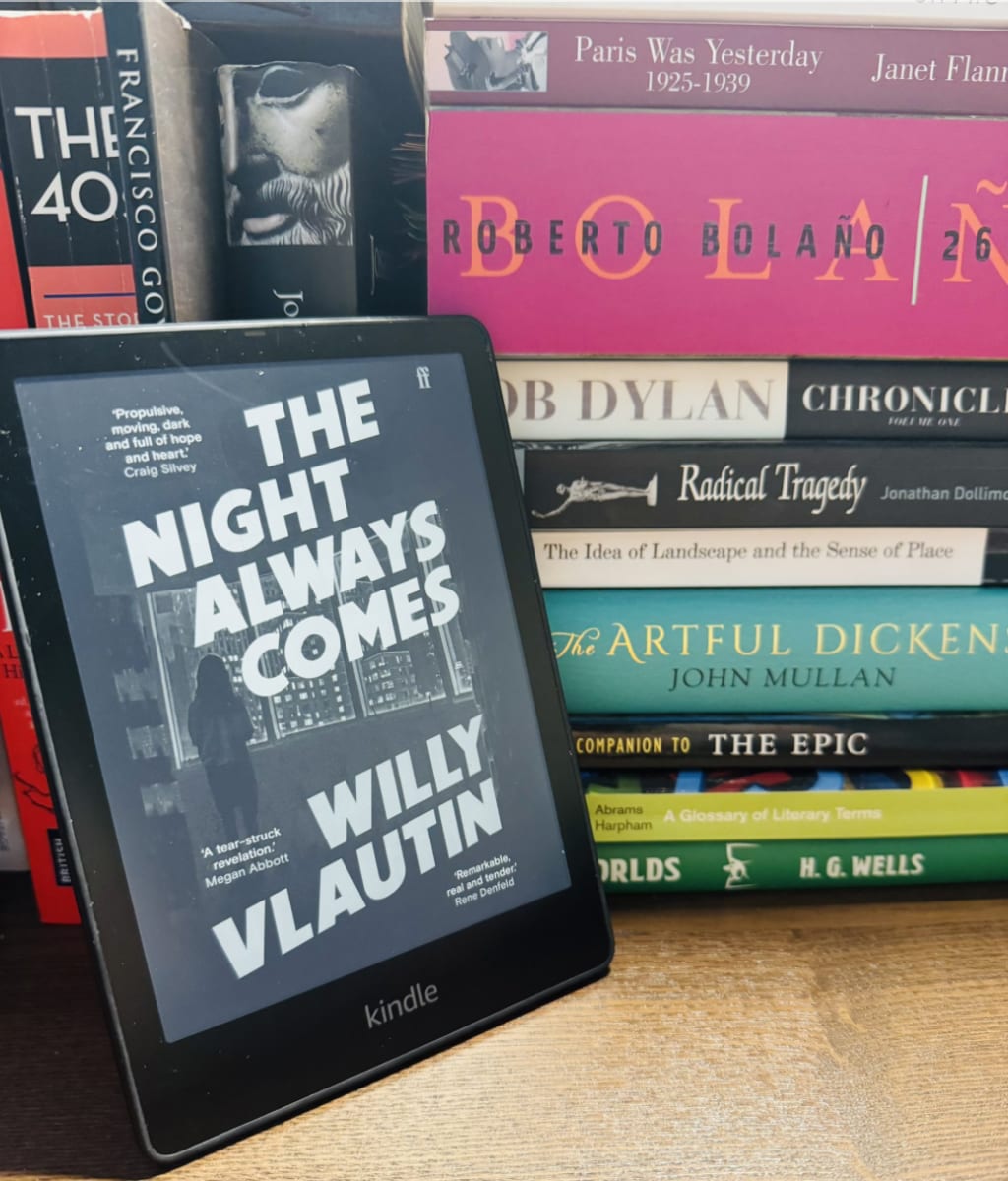
I don't know how I found this book but I did tell you I wanted to read more books by authors I had not hear of before. This is one of them. This book was not on my radar at all. It was not something in my recommendations and it was not something on a reading list anywhere. Honestly, I have no recollection of how I came across it. All I know is that when I read it, it took hold almost immediately. Intense and emotional, this book seems to detail the most human feelings in the most incredible ways. I was astounded to find out how good it actually was. So, let's go through what I thought of it...
At the heart of the story is Lynette, a 30-year-old woman who has spent years trying to lift herself and her family out of poverty. She lives with her mother, a bitter, hard-working older woman, and her developmentally disabled brother, Kenny, for whom Lynette feels a profound sense of responsibility. The family rents a dilapidated house, but Lynette has been saving tirelessly in hopes of buying it before the neighbourhood’s escalating property values push them out entirely.
The novel begins with a sense of urgency: Lynette has managed to scrape together a down payment, but her mother, who has wavered in her commitment to the purchase, now seems reluctant to move forward. This hesitation sparks Lynette’s spiral into desperation as she realises that her dreams of security may slip through her fingers. Over the next two days, she embarks on a harrowing journey to salvage the deal, taking increasingly risky and morally ambiguous actions to secure the money she needs. I think that this is such a relatable feeling that one day, for almost no reason whatsoever, you could have nothing. I certainly feel that way about my job: that if I get too comfortable or seem too contented - they will toss me out in the cold. Security and the lack of it is certainly a universal feeling.
Lynette’s determination is deeply rooted in her past, which Vlautin gradually reveals through flashbacks. She has endured a history of trauma, including sexual abuse by a family member and a series of abusive relationships. These experiences have shaped her resilience and fierce protectiveness over her brother, but they have also left her deeply scarred, struggling with self-worth and plagued by a gnawing sense of inadequacy.
Lynette’s mental health is a recurring thread throughout the novel. She battles anxiety, self-doubt, and moments of despair, yet her determination to persevere is unwavering. Vlautin conveys these struggles with raw empathy, creating a character who is both deeply flawed and profoundly relatable. Lynette’s internal monologue is suffused with longing—for safety, for love, for a life free from the constant weight of fear and failure. This is something I think, though the character's situation is a bit out there, we can all relate to. The fear of failure often dwells within all of us - we don't want to disappoint ourselves as much as we don't want to make ourselves look like we are not as good as others.
Portland itself becomes a character in the novel, its gentrification serving as both a backdrop and a metaphor for the broader themes of displacement and inequality. Vlautin’s descriptions of the city capture its dualities: the gleaming new developments and trendy cafes juxtaposed with the crumbling homes and marginalised individuals who can no longer afford to live there. This changing landscape mirrors Lynette’s struggle to hold onto her place in a world that seems determined to push her out. I like it when the author is committed to making the place feel like a character in the novel and it definitely worked in this case. The displacement through gentrification is one of the ideas that drives parts of the plot.
All in all, through Lynette’s story, Willy Vlautin captures the brutal realities of life on the margins while illuminating the enduring strength and vulnerability of those who inhabit them. His prose is spare yet evocative, creating a narrative that is both deeply personal and profoundly universal. This is a novel that lingers long after the final page, challenging the reader to confront the complexities of economic injustice and the indomitable will to survive. It is a brilliant novel which I am very glad I read.
About the Creator
Annie Kapur
I am:
🙋🏽♀️ Annie
📚 Avid Reader
📝 Reviewer and Commentator
🎓 Post-Grad Millennial (M.A)
***
I have:
📖 280K+ reads on Vocal
🫶🏼 Love for reading & research
🦋/X @AnnieWithBooks
***
🏡 UK
Keep reading
More stories from Annie Kapur and writers in Geeks and other communities.
5 Podcasts I Love
I'm starting to do a lot more about myself and that is because I feel like I'm getting a bit distant with my audience. Everything has become about something else and there's really hardly any room for me anymore. I know, I know, I'm probably not the most interesting of people - most of what I do is read and work, cook and watch movies. I know you're also probably thinking 'I actually do not care about you that much, I'm here for the book reviews.' And I apologise if that is you. I've been waiting a while to publish a list of my definitive podcasts. I think some time ago I said I would do ten in my list and I did try - but the article got so long that I considered that nobody would read it. I have since cut it down to five absolutes.
By Annie Kapur11 months ago in Geeks
Marvel Zombie
The last entry into our 2025 superhero projects catalogue is Marvel Zombies. This was a show that was anticipated by absolutely no one and it disappeared from the public consciousness as quickly as it was released. There was nothing special about the project that made it a must see, or a must remember. In fact if anything it's a must forget.
By Alexandrea Callaghan25 days ago in Geeks
Villainess Review: Amanda (Disturbing the Peace)
It's been a minute, or two, or three, since I've written a Villainess Review, though the year-end Top 10 lists centered on Lifetime film villainesses feel like a big two-part review. One of my big promises for 2026: the Villainess Reviews will be plentiful again. I don't have a set schedule for them; I never do. But there will be quite a bit on Vocal, as this April will mark my fifth anniversary of me actually doing this. Fittingly, my very first of almost 2000 stories on this site was a Villainess Review.
By Clyde E. Dawkins5 days ago in Geeks
Smart phones, Humans and Aliens.
WARNING. I will be tapping into one of your favorite creative tensions: The absurdity of humans worshipping their glowing rectangles as if they were tiny oracles. There’s something deliciously poetic about that contradiction, and it lends itself beautifully to an instructive proviso.
By Novel Allen4 days ago in Poets


Comments (1)
Terrific review!!! Loving it!!!❤️❤️💕