
Book Review: "The Last Dynasty" by Toby Wilkinson
4/5 - discussing the last dynasty of Egypt can be difficult....

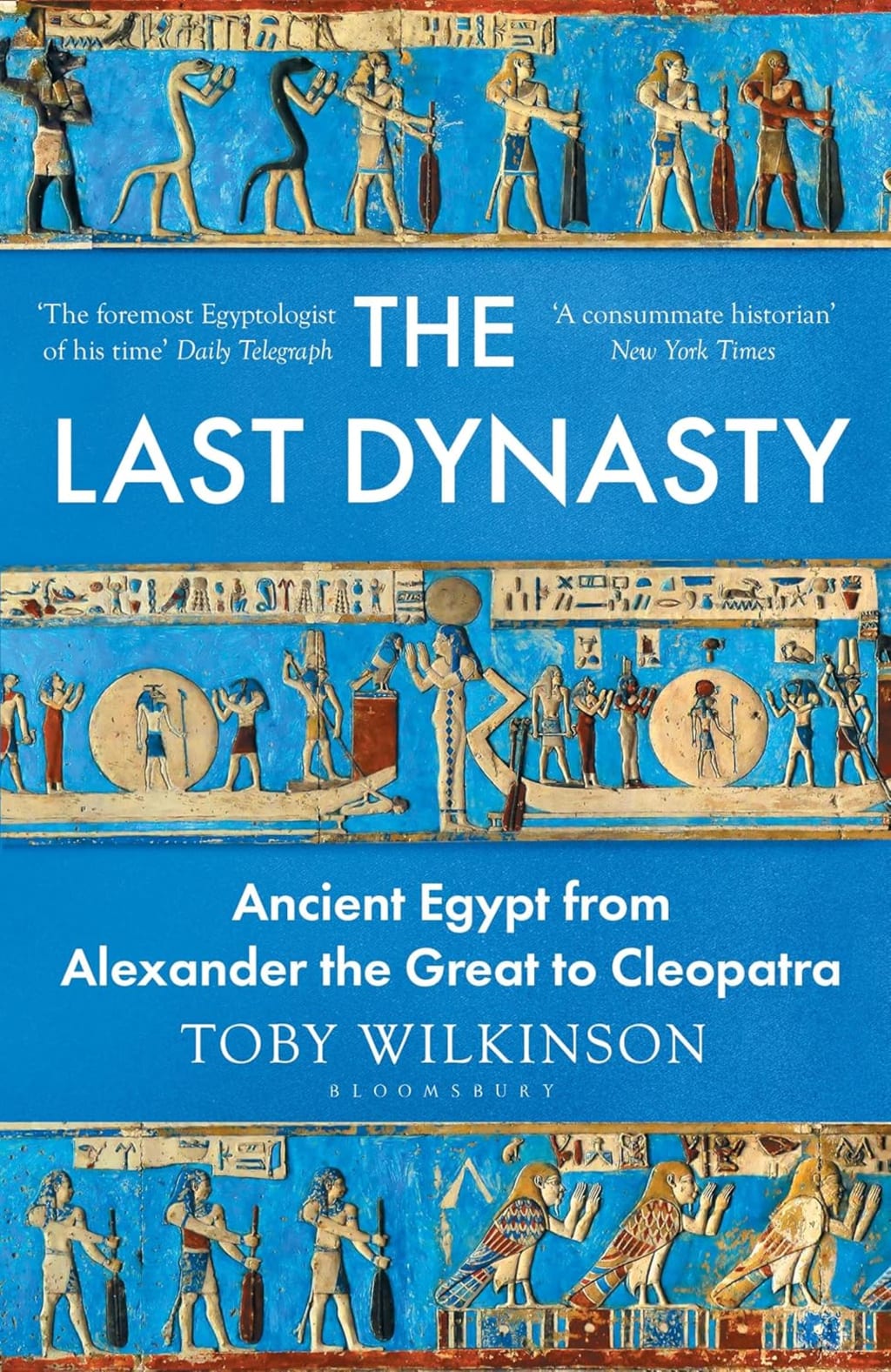
Full Title = The Last Dynasty: Ancient Egypt from Alexander the Great to Cleopatra by Toby Wilkinson
I have never ever read anything by this author before but the book was in my Amazon Recommendations. Yes, I know, how did it get there, I have no idea. I don't really read anything about Ancient Egypt very often and so, I was confused and interested. As you can tell, I have been reading a lot of nonfiction lately and I promise, I will get back to fiction soon, but for some reason there has been a lot of great nonfiction found and released. For example: the new biography on Goethe and I also found some book on the Pendle Witches. I'm not someone who reads self-help books so that's not what I mean when I say nonfiction - instead, there are many random topics I'd like to know about and so, I seek them out.
This book starts off with the death of Cleopatra and works its way back into the sequence of events from Alexander the Great that led history there. The image of Cleopatra dying has always been an interesting one since nobody actually knows how exactly she died, we can only speculate. Though, it was a political move of not wanting to get caught - a common form of death if you're going to lose. As we move back, we get to see the sacred bull, the earliest ideas in Egypt and how politically charged the atmosphere really was during the final dynasty when Egypt fell to Rome.
One of the book’s primary strengths is Wilkinson’s focus on the Ptolemies' unique approach to ruling. He presents how Alexander the Great’s conquest introduced Hellenistic influence into Egypt, which Ptolemy I, one of Alexander’s trusted generals, further developed into a powerful dynasty that combined Greek and Egyptian traditions. Wilkinson excels at showing how this blending of cultures was both practical and strategic. By aligning themselves with ancient Egyptian religious customs, the Ptolemies legitimised their rule and gained acceptance among the Egyptian populace. This cultural synthesis, Wilkinson argues, was instrumental in maintaining the dynasty’s initial success and stability.

Wilkinson does an excellent job of depicting Alexandria as a vibrant intellectual and cultural center under the Ptolemies. He details the establishment of the Great Library, emphasizing its importance as a symbol of the Ptolemies' commitment to learning and as a testament to Egypt’s role as a crossroads of ancient knowledge. By situating Alexandria within the wider context of Mediterranean trade and culture, Wilkinson paints a vivid picture of a city where ideas and scholarship flourished. His descriptions of the library's role in attracting scholars from around the known world help readers understand how the Ptolemies positioned Egypt at the forefront of Hellenistic civilisation. This commitment to intellectual achievement, Wilkinson explains, was both a source of pride for the Ptolemies and a tool for consolidating their power by enhancing Egypt’s cultural prestige.
Another strength of The Last Dynasty is Wilkinson's treatment of the Ptolemies' gradual decline, an aspect he explains with a nuanced understanding of political and economic factors. He details how the early Ptolemies’ achievements were increasingly undermined by internal conflicts and succession struggles that weakened the dynasty. Wilkinson’s account of the dynasty’s later years portrays a regime in decline, plagued by economic problems and unable to fully integrate its Greek and Egyptian elements. He provides a detailed exploration of how Rome’s rise further complicated the Ptolemies' position, ultimately forcing them into alliances and conflicts that weakened their autonomy and set the stage for their downfall
Wilkinson also humanises the Ptolemies, portraying them as complex figures navigating power and legacy in an era of shifting allegiances. Cleopatra VII, the dynasty's final ruler, is presented not only as a figure of political intrigue but as a woman striving to protect her kingdom against an increasingly dominant Roman Empire. Wilkinson’s exploration of Cleopatra’s relationships with Julius Caesar and Mark Antony is skillfully intertwined with broader historical forces, showing how her personal and political ambitions were shaped by, and ultimately thwarted by, Rome. His portrayal allows readers to appreciate Cleopatra’s resilience and ambition, as well as the tragic inevitability of her failure against Rome's military might.
One of Wilkinson’s particular achievements is his use of recent archaeological discoveries and original texts, such as ancient papyrus records, which bring new insights into Ptolemaic society. By including these sources, Wilkinson not only supports his analysis with concrete evidence but also brings a sense of immediacy and authenticity to his narrative. This rigorous approach enriches readers’ understanding of the Ptolemaic period, from the intricacies of courtly life to the challenges of governing a diverse and often fractious kingdom.
All in all, the novel is a compelling exploration of the Ptolemaic era that captures the dynasty’s grandeur, cultural achievements, and eventual downfall. Wilkinson’s expertise in ancient Egyptian history, combined with his ability to make complex historical dynamics understandable and engaging, makes this book a valuable read for anyone interested in ancient history, Egyptian culture, or the challenges of ruling a multicultural empire. Through meticulous research and compelling narrative, Wilkinson provides a well-rounded and insightful account that vividly brings Egypt’s last dynasty to life for modern readers.
About the Creator
Annie Kapur
I am:
🙋🏽♀️ Annie
📚 Avid Reader
📝 Reviewer and Commentator
🎓 Post-Grad Millennial (M.A)
***
I have:
📖 280K+ reads on Vocal
🫶🏼 Love for reading & research
🦋/X @AnnieWithBooks
***
🏡 UK
Keep reading
More stories from Annie Kapur and writers in Geeks and other communities.
Book Review: "Goethe: His Faustian Life" by A.N Wilson
It's old I know - but here's my review of AN Wilson's book on Queen Victoria. I've read quite a bit of AN Wilson, including his books on Queen Victoria, Charles Dickens and Charles Darwin (regrettably I have not yet read his book on CS Lewis but if anyone can tell me whether it's any good, then I'd be forever grateful). AN Wilson is known for his immersive biographies in which you can get completely lost in.
By Annie Kapurabout a year ago in Geeks
Silver Screen Magic with Mae West
American actress and singer Mae West became a popular film actress during the Great Depression. She started entertaining in vaudeville, then performed on Broadway, and finally went to Hollywood. She signed up with Paramount Pictures and made her debut in the 1932 film “Night After Night.” She also starred in musicals, comedies, and crime dramas. The American Film Institute named her one of the best classic Hollywood actresses.
By Rasma Raisters7 days ago in Geeks
Why The Last Holiday Still Resonates Even 20 Years Later
Plot Summary Georgia Byrd, a kindhearted but shy department store employee, discovers she has a terminal illness. Faced with her mortality, she decides to abandon her mundane life and take a lavish vacation to Europe, determined to live life to the fullest before her passing. Along the way, Georgia embraces adventure, discovers her own courage, and forms unexpected friendships that change her outlook. Amid luxury hotels, fine dining, and breathtaking scenery, she also encounters romance and laughter, learning to cherish every moment. The Last Holiday is a heartfelt story about finding the true joy of life and self-discovery.
By TheScreenAnalyst5 days ago in Geeks



Comments
There are no comments for this story
Be the first to respond and start the conversation.