
Book Review: "The Illusion of Choice" by Richard Shotton
5/5 - a great start for those looking to get into the behavioural science behind marketing

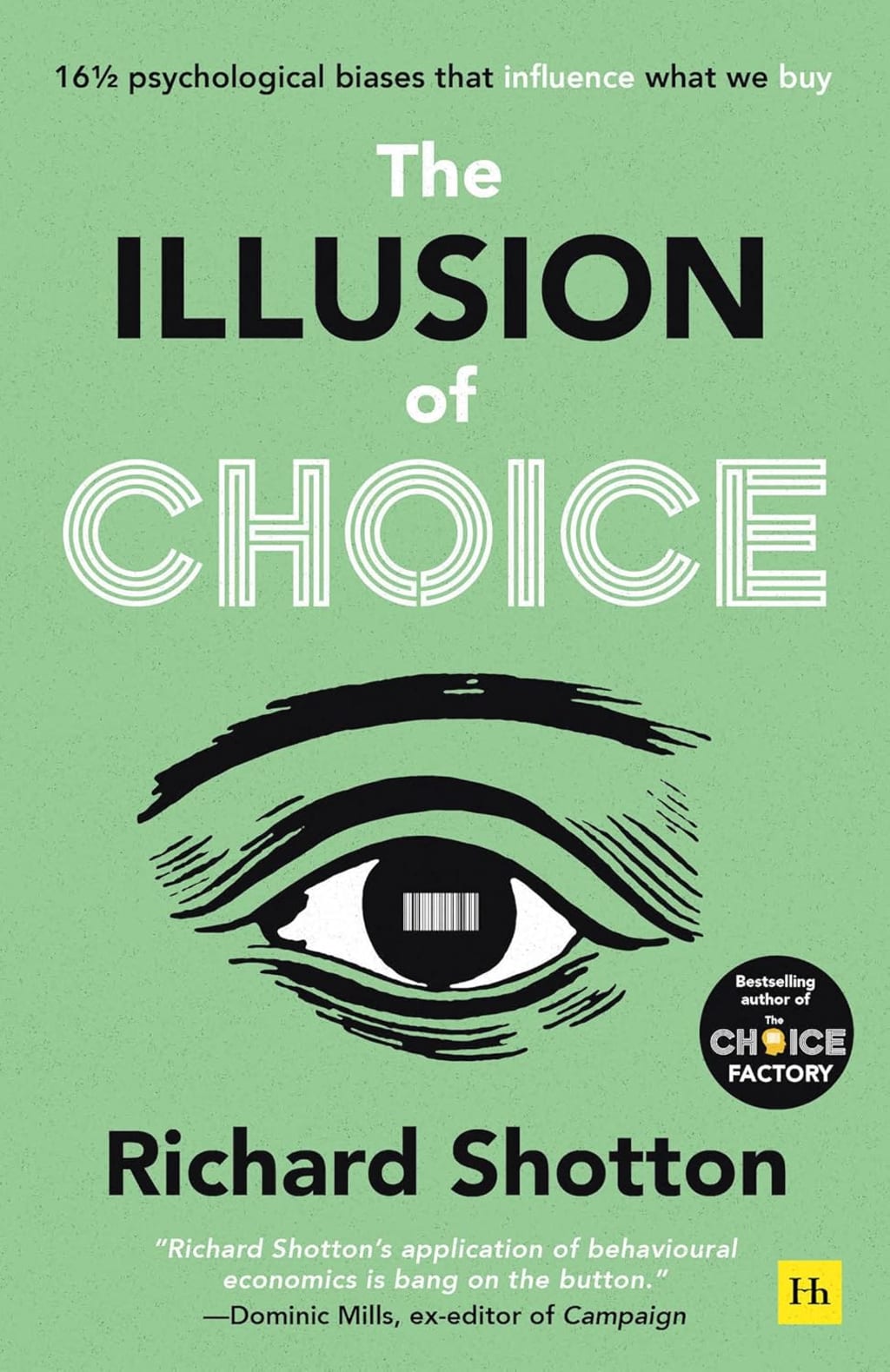
Now, I've already read this guy's other book entitled The Choice Factory and it was pretty good - though I do have to say the books are rather short. I've been seeking out books on why we are the way we are, with focuses on mental health, lifestyles, consumerism, marketing and the human brain. So far in the wider scheme of things, I have read...well, I'm not going to bother counting but you know how it goes for me; when there is a deep-dive to be had I can go on forever. So, let's take a look at The Illusion of Choice and what exactly it is trying to teach us about marketing strategies and behavioural science.
One of Shotton’s central arguments is that human beings rarely make decisions through rational deliberation. Instead, we rely on mental shortcuts known as heuristics. These cognitive tools help us navigate a complex world but often lead to irrational decisions. For instance, Shotton discusses the availability heuristic, which causes us to overestimate the likelihood of events based on their recentness or vividness. This explains why individuals might fear flying more than driving, despite statistics showing the latter is far more dangerous. By highlighting the limitations of rational choice, Shotton sets the stage for understanding how external influences exploit these tendencies. As someone who hates flying, I can definitely relate. No matter how many times you tell me it is safer than driving, humans should not be flying - we do not belong in the air.
Shotton emphasises the power of social proof in decision-making. Social proof refers to the tendency to follow the behaviour of others, especially in situations where we are uncertain. Shotton uses compelling examples to show how brands leverage this principle to influence consumer behaviour, such as advertising campaigns that emphasise popularity or widespread use. A classic example is the use of phrases like “the nation’s favourite” or “best-selling product,” which tap into our instinctive trust in collective wisdom. Shotton argues that while social proof is a powerful motivator, it is not infallible and can be strategically manipulated to create artificial demand. I think this also goes for those weird online trends where everyone starts buying the same thing and then the item gets labelled with "As seen on (social media website)" or "the new (social media website) sensation". Though something like "royalty drinks this too" could fool me, the social media one is something everyone should grow out of.
Shotton explores how the principle of scarcity affects decision-making, noting that people tend to value items or opportunities more when they perceive them as limited. This taps into a deeply ingrained fear of missing out, which marketers exploit through strategies such as limited-time offers or phrases like “only a few left in stock.” Shotton explains how this principle works on an emotional level, triggering anxiety and a sense of urgency that overrides rational thought. He also warns of the potential for overuse, as consumers become desensitised to such tactics if they are used too frequently. This is something he discusses in The Choice Factory as well and I referred to seeing the bold red "one left" lettering on Amazon when looking up used books. Honestly, this one is clever because if you really think about it, there probably never is only "one left" or "a few left in stock". Not with this century's rate of production.
Shotton delves into the role of emotion in decision-making, arguing that feelings often outweigh logic when it comes to influencing behaviour. Emotional appeals, such as those that evoke nostalgia, happiness, or fear, can have a profound impact on consumer choices. He cites examples from advertising campaigns that successfully tap into emotional resonance, creating strong associations between a brand and a specific feeling. Shotton’s analysis highlights the importance of understanding emotional triggers in crafting effective marketing strategies. I think this is true for items like Nespresso Coffee in which the idea of luxury and sophistication definitely resonates with many coffee drinkers and the aim to use George Clooney in order to do this resonates with men especially (I think). I mean, I don't think many young women see George Clooney as the epitome of sophistication - not anymore anyway.
One of the more thought-provoking arguments in the book is the paradox of choice: the idea that having too many options can be overwhelming and lead to dissatisfaction. Shotton discusses studies showing that people are less likely to make a purchase when faced with an abundance of choices, and even when they do, they are less satisfied with their decision. This principle has implications for product design and retail, suggesting that simplifying choices can lead to better outcomes for both businesses and consumers. This is why I dislike shops like Waitrose (for the Americans, I guess that might be your whole foods store but you might want to look up what Waitrose is). If I ever go there, I am met with 15 different types of apple and about a billion different types of each vegetable. I mean I get it: it is more middle class, therefore there is more choice. But honestly, I know what I want - stop shoving everything else in my face because it just gives me anxiety.
Finally, Shotton addresses the ethical implications of using behavioural science to influence choices. While these principles can be used to nudge people towards beneficial behaviours, such as healthier eating or increased savings, they can also be exploited for profit at the expense of consumer well-being. Shotton calls for a balanced approach, urging marketers and policymakers to consider the broader impact of their strategies. He concludes that understanding the mechanics of choice should empower individuals to make more informed decisions rather than simply being tools for manipulation. Well, we know that the big businesses are going to use this stuff properly, don't we. Of course it was sarcasm, they are going to make the world a horrible hell-hole of consumerism and waste production at rates unknown to Satan himself.
All in all, this book was fantastic and yet, a short and easy read. I know you probably want to stop reading now but here is my advice to you: if you're just getting into behavioural science and marketing reading, then this is probably where you want to start. It outlines literally everything and teaches you about what each thing is and how it is used.
About the Creator
Annie Kapur
I am:
🙋🏽♀️ Annie
📚 Avid Reader
📝 Reviewer and Commentator
🎓 Post-Grad Millennial (M.A)
***
I have:
📖 280K+ reads on Vocal
🫶🏼 Love for reading & research
🦋/X @AnnieWithBooks
***
🏡 UK
Keep reading
More stories from Annie Kapur and writers in Geeks and other communities.
Book Review: "The Orchard on Fire" by Shena Mackay
I have never read or even heard of this author before and if you know my writing and my reading then you will know that I try to do this around once a week (whether it gets acknowledged outwardly or not is an entirely different question). Shena Mackay has proven to be a writer to be reckoned with, her dark wit and her depiction of secret dynamics are often contained within the heart of the writing. Against the backgdrop of the 1950s, she seeks to tinge our worldview with a reality of the era rather than one that is known on social media as 'the good old days' (which were, in fact, not very good at all). Let's take a look at the aptly titled book The Orchard on Fire.
By Annie Kapur11 months ago in Geeks
Silver Screen Magic with Mae West
American actress and singer Mae West became a popular film actress during the Great Depression. She started entertaining in vaudeville, then performed on Broadway, and finally went to Hollywood. She signed up with Paramount Pictures and made her debut in the 1932 film “Night After Night.” She also starred in musicals, comedies, and crime dramas. The American Film Institute named her one of the best classic Hollywood actresses.
By Rasma Raisters8 days ago in Geeks
Kangana Ranaut Hints At Hrithik Roshan's ‘Controversial Legal Notice’ From 2016: Life Became A Living Hell
Summary of this article Kangana Ranaut has joined the ‘2026 Is The New 2016’ trend and recalled the 'miserable' phase of her life. Without naming Hrithik Roshan directly, Ranaut referred to receiving a controversial legal notice from a "colleague". She also called 2016 the best phase of her career.
By Dena Falken Esq3 days ago in Geeks
How, Too
Many people wonder how, too. You are not alone, and I am an expert. I will teach you how, too! First, you need to remit a small application fee and fill out an application describing the nature of your financial situation and how often payments will be made, as this will have great bearing on how well I teach you how, too.
By Harper Lewis4 days ago in Fiction


Comments (1)
I am very intrigued by books like this! Thank you for the review!