
Book Review: "The Idea of Landscape and the Sense of Place 1730-1840" by John Barrell
5/5 - one of my favourite books to study from when I was on my undergraduate degree...

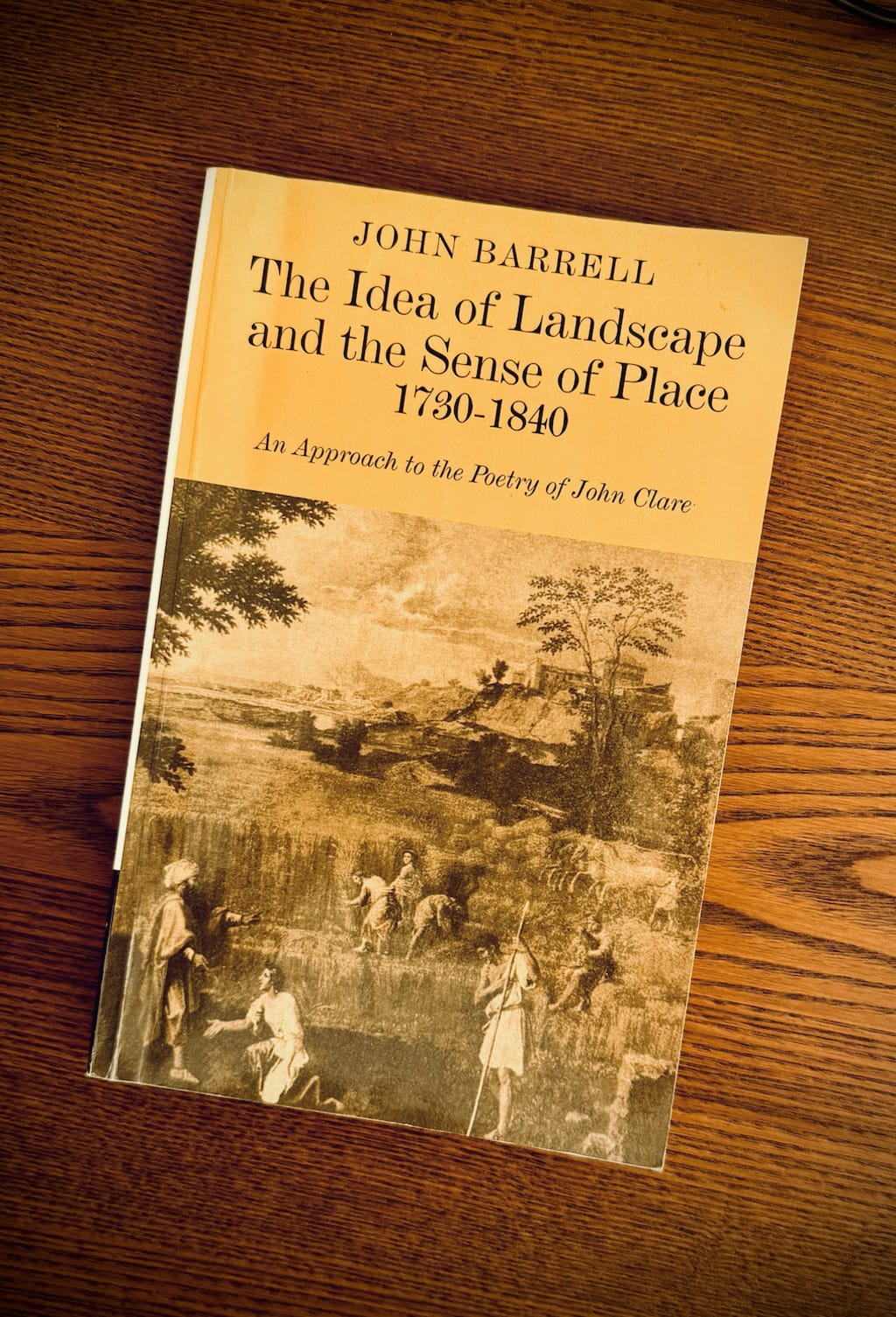
Full Title = "The Idea of Landscape and the Sense of Place 1730-1840: An Approach to the Poetry of John Clare" by John Barrell.
I want to share another university classic with you. When I was a second year undergraduate, I bought this book and I was very attached to it. I read it cover to cover about three times and really got into looking at the theory of 'critical place'. In the Romantic Era, poets were very much into depicting place and landscape, especially countrysides, as the ideal. In the poetry of John Clare however, we get 'critical place' from this. John Clare's poems often depict these same landscapes as having both positive and negative aspects - he critiques them as entire personalities. It is a fantastic book and if you ever get the chance to read it, it will really change the way you think about Romantic Poetry.
Barrell explores how the concept of landscape transitioned from the 18th to the 19th century. Early on, landscape was often perceived through a predominantly aesthetic lens, linked to picturesque views and artistic representations. It was shaped by classical ideals, where nature was frequently used as a backdrop for philosophical reflection or artistic endeavour. However, in the Romantic period, landscape began to take on a deeper personal significance. The idea of the landscape was no longer just a static, external object to be gazed upon; it became an active participant in shaping personal emotion and intellectual thought. This shift is evident in the works of poets like John Clare, whose interactions with the land were rooted in lived experience rather than idealised abstraction. John Clare was a fantastic poet and I think that in the realm of the Romantics, he is vastly underappreciated. Even though Lord Byron is my personal favourite poet, John Clare is definitely in the top five.
John Clare’s poetry offers a deeply personal engagement with the landscape, particularly the rural environment. As a poet from a humble background, Clare’s connection to nature is not romanticised but deeply grounded in his lived experiences. Barrell notes that Clare’s poetry frequently explores themes of belonging and identity through the lens of the landscape, where the physical environment becomes a site for emotional exploration. Clare’s sense of place is inseparable from his understanding of self, and his works frequently convey a profound sense of loss as he reflects on the changes in the landscape caused by industrialisation and enclosure. The land represents both a source of beauty and a painful reminder of what has been lost. I mean if we simply look at his poem I Am, which is possibly his most famous poem, we can see his emotions intertwine with the idea of where he is. It is brilliant. Words like 'vaulted' might describe the sky in the poem, but there is a definite suggestion in which it is reflected back on to his emotional depression that is continuous throughout the text.
In contrast to many Romantic poets who idealised nature as a source of spiritual or emotional solace, Barrell suggests that Clare’s relationship with nature is more complex. Romantic poets like William Wordsworth and Samuel Taylor Coleridge frequently portrayed nature as a source of escape from the corruptions of industrialisation, presenting it as a sanctuary for the individual soul. However, Clare’s depiction of nature was more grounded in the realities of rural life, with all its hardships and beauty. While he too found solace in nature, his relationship was marked by a sense of reciprocity; nature was not just a passive backdrop for human emotion, but an active participant in shaping personal identity and community ties. I think of this usually in the context of his poem 'The Skylark' in which we teeter on the emotional plain - there is both positive and negative images through association that melts into the complexities of the rural atmospheres. If you don't believe me then read the poem out loud. There are adjectives where you have to stop and think about whether the ideas and emotions portrayed are both positive and negative at the same time, as nothing is ever black and white.
As Clare’s life became increasingly marked by mental illness and a growing sense of dislocation, his poetry began to reflect a more alienated view of the landscape. In Barrell’s analysis, this alienation is most evident in Clare’s later works, where the natural world, once a place of solace and connection, becomes a site of emotional estrangement. Clare’s sense of alienation is not only personal but also symbolic of the broader social changes he witnessed in the landscape. The enclosure of the commons and the rise of industrialisation created a sense of dislocation, not just for Clare but for the rural population as a whole. This feeling of alienation is expressed in the disjointed, fragmented nature of his later poetry, where the landscape is no longer a place of comfort but a reminder of loss and isolation. Honestly, if you look at the timeline of his poetry, it becomes more and more intertwined with mental illness and yet, it makes the poems themselves even more captivating.
All in all, for Clare, the landscape is not just a passive setting for human activity, but an essential part of personal and collective identity. Barrell discusses how Clare’s poetry expresses the idea that one’s relationship to the land shapes one’s sense of self. This connection to place is particularly evident in Clare’s celebration of the local and particular, as opposed to the abstract or universal. Clare’s poems are not about generic landscapes but about specific locations that hold personal and cultural meaning. As such, his poetry reveals a profound understanding of the ways in which identity is intertwined with geography, history, and the social fabric of rural life. It is a fantastic analysis and I really hope that because of this review, you choose to pick it up. Don't even think about it as a book you can only read if you're a literature academic or if you've read John Clare's poetry inside out. It has some brilliant and extensive ideas you can sink your teeth into and view for yourself.
About the Creator
Annie Kapur
I am:
🙋🏽♀️ Annie
📚 Avid Reader
📝 Reviewer and Commentator
🎓 Post-Grad Millennial (M.A)
***
I have:
📖 280K+ reads on Vocal
🫶🏼 Love for reading & research
🦋/X @AnnieWithBooks
***
🏡 UK
Keep reading
More stories from Annie Kapur and writers in Geeks and other communities.
Book Review: "The City and Its Uncertain Walls" by Haruki Murakami
I would like to say hello to all my readers who are still here. It's been a rough few months for me and it's only March so I'm not holding out much hope for 2025. My mental health has been terrible, my head is simply not there and my life doesn't seem to be on the right track. But, there is one thing I am grateful for and that's books like those written by Haruki Murakami. Murakami has always had a dark almost magical quality to his writing as though he knows just the right words to describe these emotions that usually have no way of being described in our usual words.
By Annie Kapur9 months ago in Geeks
Silver Screen Magic with Mae West
American actress and singer Mae West became a popular film actress during the Great Depression. She started entertaining in vaudeville, then performed on Broadway, and finally went to Hollywood. She signed up with Paramount Pictures and made her debut in the 1932 film “Night After Night.” She also starred in musicals, comedies, and crime dramas. The American Film Institute named her one of the best classic Hollywood actresses.
By Rasma Raisters7 days ago in Geeks



Comments (1)
What a wise and introspective review! I love the way you connected Clare's poetry to the overall shifts in the landscape of the Romantic era and highlighted his unique vision. His complex relationship with nature, with its intertwining of beauty and loss, is indeed the shining thing when contrasted with other Romantic poets' more idealized descriptions of nature. I also agree that Barrell's analysis of Clare's growing sense of alienation adds depth to his book. It's clear that you've thoroughly submerged yourself in Clare's poetry, and I'm sure this review will prompt others to revisit his work! I've long been a huge fan of Clare's, and I've read this book.