
Book Review: "The Borgias" by Paul Strathern
5/5 - a fantastic, delicious and purely entertaining read about one of history's most ruthless families...

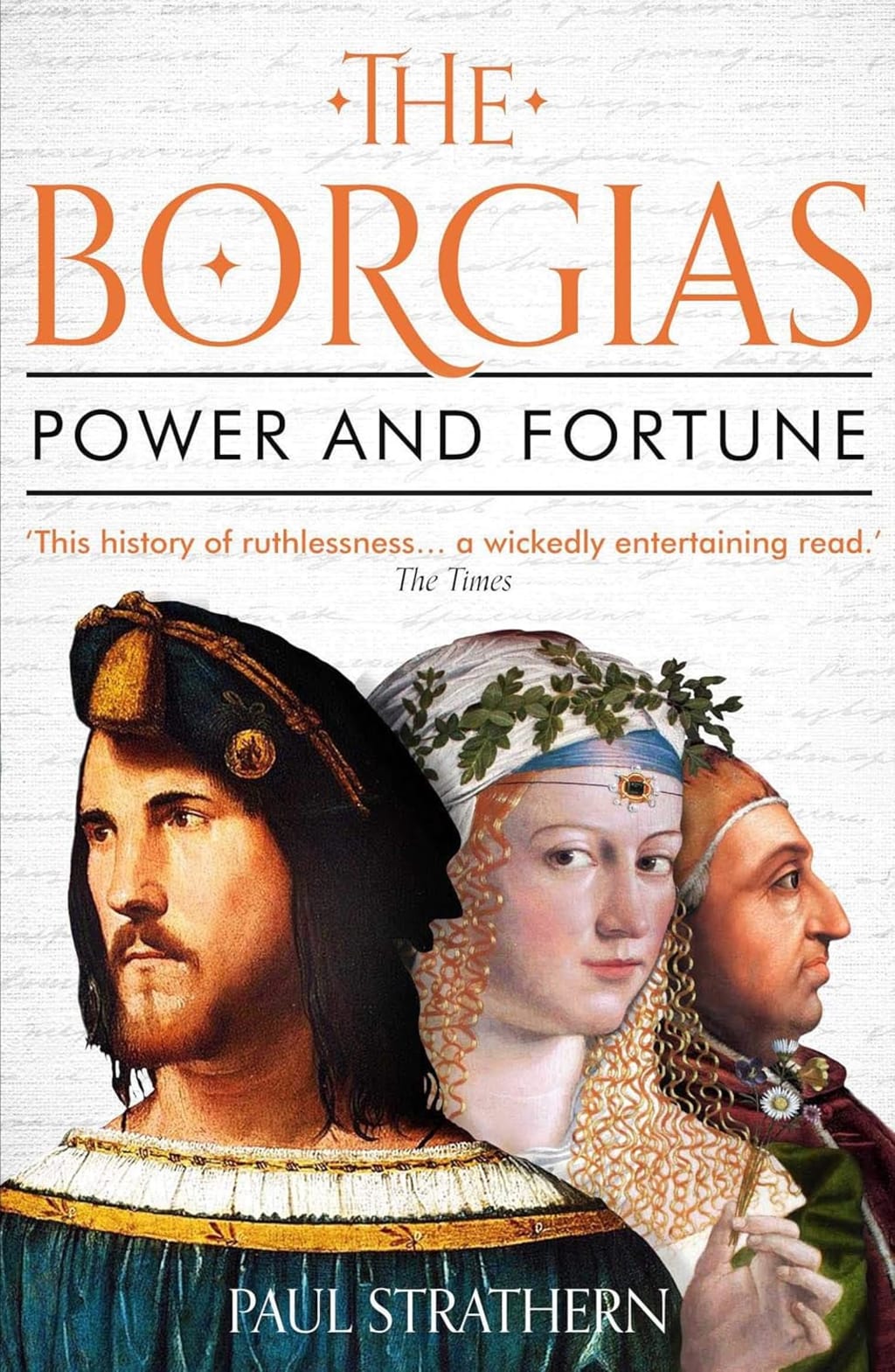
I completely forgot I had this on my phone and well, it was a good thing I remembered because I could only have it for free until the 16th of September. I started reading it in the morning of the 24th of August and finished it in the next few days whilst also trying to finish another book that I had difficulty getting through (I wasn't liking this other book so much). Anyways, a nonfiction book about The Borgias was something I definitely needed during this difficult time. I hope you enjoy reading about it as much as I enjoyed reading it.
The book introduces the Borgias as a relatively obscure Spanish family from Valencia in the 1400s. Their fortunes changed with Alfonso de Borgia, a skilled lawyer and churchman, who maneuvered his way up the ecclesiastical ladder and eventually became Pope Calixtus III (1455–1458). His short reign was rather unremarkable but laid the foundation for the family’s Roman power, appointing relatives to top positions and demonstrating that even outsiders from Spain could dominate the Italian landscape. I'm not going to lie, even though it is meticulous and calculated, you have to respect the hustle.
Calixtus’s nephew, Rodrigo Borgia, was made a cardinal at only 25 years' old and quickly established himself as one of the wealthiest and most politically savvy men in Rome - again, another hustler on the scene even though it may have not been well intentioned. Charming, ruthless, and indulgent, Rodrigo built a reputation for both administrative brilliance and scandalous appetites. He openly kept mistresses (unusual even in this era) and fathered several children; he then intended to use them as pawns in his vision for the future of the family. The Medici are pretty ruthless, but I will have to say these guys are perhaps more violent.
After decades of careful networking, Rodrigo finally achieved his life’s ambition: he was elected pope, taking the name Alexander VI (of course, after Alexander the Great, not Saint Alexander). Strathern analyses the alleged bribery and vote-buying that secured his seat, emphasising the absolute spectacle of corruption. Yet Alexander was more than a schemer: he had a keen political mind and a laser focus on consolidating power for his children. Honestly, I think that this is what this era was all about - just consolidating power. It was so interesting to read about this guy just rising up and then taking on naming himself after Alexander the Great. I mean if that doesn't tell you something about this family then I don't know what will.
In 1497, Juan’s (Rodrigo's son's) body was found floating in the Tiber, riddled with stab wounds. Strathern looks at how the murder became one of Rome’s great mysteries. How suspicions fell on jealous husbands, rival families, and even his own kin. Many historians (and Strathern himself) suggest that Cesare (another son) planned Juan’s killing, seeing his brother as incompetent and a barrier to his own rise. This event cemented Cesare as the true power behind the Borgias’ future. And of course, everyone who knows about the Borgias has heard of Cesare Borgia.
Renouncing his cardinalship, Cesare reinvented himself as a condottiere (mercenary commander) and politician. With the support of his father and French King Louis XII, he launched military campaigns across the Romagna, brutally subjugating cities, carving out areas for himself. The author portrays Cesare as a terrifying visionary: admired by one of my favourite political writers, Machiavelli (who based much of The Prince on him) yet feared as a man who combined charisma, cruelty, and brilliance. I mean, if there's anyone who is more Machiavellian (except Henry VIII) then please tell me.
By the early 1500s, the Borgias controlled vast amounts of central Italy, and Alexander VI had turned the papacy into a hereditary monarchy. The author show us: Cesare’s triumphant military parades, Alexander’s sumptuous banquets, and the infamous Banquet of Chestnuts, a scandalous orgy rumoured to have taken place in the Vatican itself. Still, their dominance terrified Italy’s great powers, uniting enemies against them. There are great amounts of rumours and propaganda whispers about the Borgias and I guess we will never know if what happened in the Vatican is actually true (I don't even think I want to know).
All in all, as we move on to the fall of the Borgias, we learn about the sudden death of Alexander VI from malaria, the descent of Cesare Borgia and much more. I thought this book was a fascinating read and yes, I will be reading more of these classic immersive pieces of Renaissance nonfiction history so watch out for them.
About the Creator
Annie Kapur
I am:
🙋🏽♀️ Annie
📚 Avid Reader
📝 Reviewer and Commentator
🎓 Post-Grad Millennial (M.A)
***
I have:
📖 280K+ reads on Vocal
🫶🏼 Love for reading & research
🦋/X @AnnieWithBooks
***
🏡 UK
Keep reading
More stories from Annie Kapur and writers in Geeks and other communities.
Book Review: "The First Witch of Boston" by Andrea Catalano
When Amazon keeps advertising something to you over and over again there is going to be a point where you just go 'hey, I guess I'll give it a go'. Or maybe you believe that it's a good idea because the algorithm knows you better than you know yourself. Well, this book was pretty much following me around. I saw it in my recommendations, across social media, any time I was on book websites. It was everywhere. So I guess, I read it. And now I know what it's all about. The First Witch of Boston is a surprisingly good book, I hope you enjoy reading about it too...
By Annie Kapur5 months ago in Geeks
Silver Screen Magic with Mae West
American actress and singer Mae West became a popular film actress during the Great Depression. She started entertaining in vaudeville, then performed on Broadway, and finally went to Hollywood. She signed up with Paramount Pictures and made her debut in the 1932 film “Night After Night.” She also starred in musicals, comedies, and crime dramas. The American Film Institute named her one of the best classic Hollywood actresses.
By Rasma Raisters5 days ago in Geeks
Shakira looks refreshed while sharing exciting news: Is she working on the 2026 World Cup anthem?
Shakira knows how to make a comeback feel exciting. After a quiet holiday season spent with her sons Milan and Sasha, the global superstar has returned to Instagram with a post that feels both intimate and loaded with meaning. The Colombian singer shared a relaxed carousel of photos and a short video alongside her longtime collaborator Alex Castillo, better known as AC, the producer behind her hit song Soltera. One simple caption said it all: “Back to it!”
By Dena Falken Esq3 days ago in Geeks




Comments (1)
I have a few books about them at home, and I think there was a TV series. Another one for my book pile, methinks