
Book Review: "The Armies of the Night" by Norman Mailer
5/5 - An intense look at revolution in action

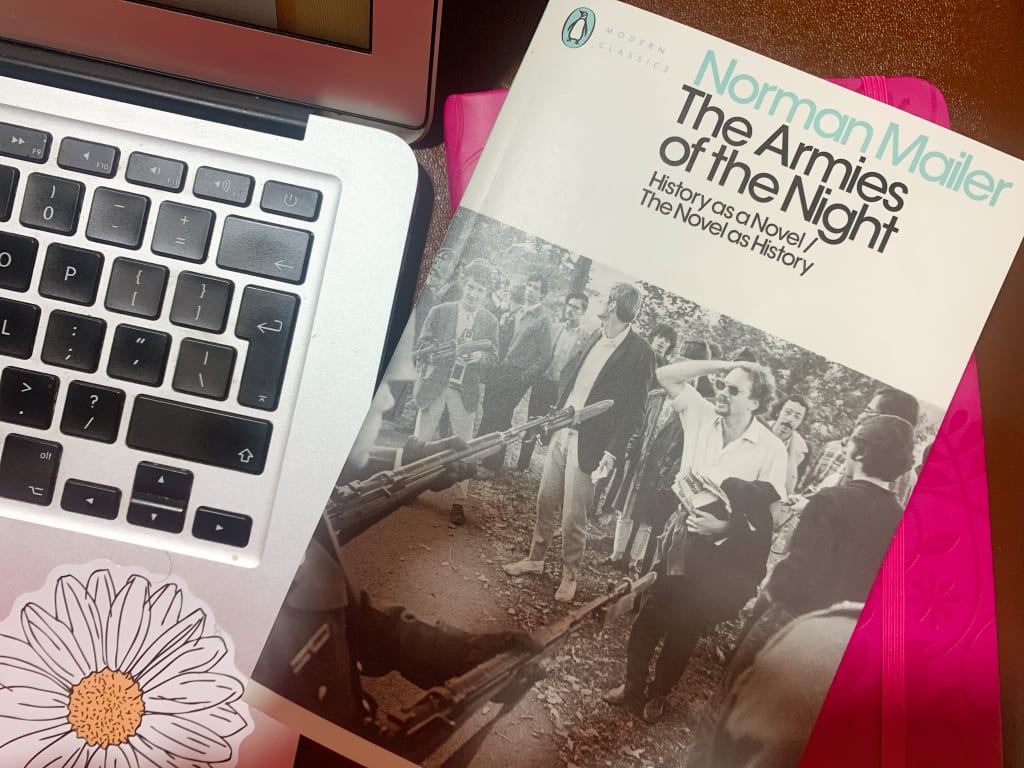
“You, Lowell, beloved poet of many, what do you know of the dirt and the dark deliveries of the necessary? What do you know of dignity hard-achieved, and dignity lost through innocence, and dignity lost by sacrifice for a cause one cannot name. What do you know about getting fat against your will, and turning into a clown of an arriviste baron when you would rather be an eagle or a count, or rarest of all, some natural aristocrat from these damned democratic states.”
This is one of the most thought-provoking quotations from Norman Mailer’s “The Armies of the Night” and throughout this book, we get to see the thousands of people who marched against the Vietnam War. We get to see the various sides and debates, but most importantly we get to see the very human loathing of sending young men out to a war that they will undoubtedly be killed in, over and over again. It is one of Norman Mailer’s best efforts at the non-fiction novel (with obviously, “The Executioner’s Song” being his greatest effort) and one of his most cautious attempts to master the art of the historical non-fiction novel whilst trying to remain as open as possible with us. He covers everyone from the intellectuals and soldiers, to the small-town hippies and the big city employees. There’s the guys in important jobs, the guys in not-so-important jobs, there’s the mothers and wives, sisters and brothers. There are the people who have lost, the people who have yet to lose and the people who just are not so sure where their loved ones even are anymore. Of course then, there is Norman Mailer in the middle of it, weaving his way through the dignified story of this march that could change the course of history. At the end of the day, America still lost the battle - but then again, it lost so much more in its youth.
Another quotation I loved from this book was this:
“Arrayed against them as hard-core troops: an elite! the Freud-ridden embers of Marxism, good old American anxiety strata—the urban middle-class with their proliferated monumental adenoidal resentments, their secret slavish love for the oncoming hegemony of the computer and the suburb, yes, they and their children, by the sheer ironies, the sheer ineptitude, the kinks of history, were now being compressed into more and more militant stands, their resistance to the war some hopeless melange, somehow firmed, of Pacifism and closet Communism. And their children—on a freak-out from the suburbs to a love-in on the Pentagon wall.”
The amazing thing about Norman Mailer is that he is never really afraid to say what he wants. He’s going to say it, he is going to back it up with facts and he is going to ridicule the politics that got us here in the first place. He does it in a way that makes you really think about the way in which the rich are trying to control the lives of the ones below them, how the lower-middle are no wiser to the fact and how the lowest of the low cannot do anything about it anyway. I love this quotation in particular because it makes sense of the time in a way that is almost angry and passionate at the same time. Especially the last line about ‘their children’ who are attempting, with all of their might, to stop whatever is unfolding and what may happen afterwards knowing that they will have to deal with the consequences and pick up the pieces.
Norman Mailer is not only creative in his approach to the protests of the Vietnam War, but he is also adamant about the way in which it is being protested. He breaks the groups up into people who are protesting: the intellectuals give the verbose speeches, the young people chain themselves to things, the mothers and wives are crying for their lost. It is an image of a generation that almost lost everything. But this has to be the most creative and articulate quotation in the entire text:
“One’s own literary work was the only answer to the war in Vietnam.”
About the Creator
Annie Kapur
I am:
🙋🏽♀️ Annie
📚 Avid Reader
📝 Reviewer and Commentator
🎓 Post-Grad Millennial (M.A)
***
I have:
📖 280K+ reads on Vocal
🫶🏼 Love for reading & research
🦋/X @AnnieWithBooks
***
🏡 UK
Keep reading
More stories from Annie Kapur and writers in Geeks and other communities.
Citizen Kane (1941)
In this article, we will be looking at 2019’s book “1001 Movies to See Before You Die” and going through each film in a random order that I have chosen. We will be looking at what constitutes this film to be on the list and whether I think this film deserves to be here at all. I want to make perfectly clear that I won’t be revealing details from this book such as analyses by film reporters who have written about the film in question, so if you want the book itself you’ll have to buy it. But I will be covering the book’s suggestions on which films should be your top priority. I wouldn’t doubt for a second that everyone reading this article has probably watched many of these movies anyway. But we are just here to have a bit of fun. We’re going to not just look at whether it should be on this list but we’re also going to look at why the film has such a legacy at all. Remember, this is the 2019 version of the book and so, films like “Joker” will not be featured in this book and any film that came out in 2020 (and if we get there, in 2021). So strap in and if you have your own suggestions then don’t hesitate to email me using the address in my bio. Let’s get on with it then.
By Annie Kapur5 years ago in Geeks
Silver Screen Magic with Mae West
American actress and singer Mae West became a popular film actress during the Great Depression. She started entertaining in vaudeville, then performed on Broadway, and finally went to Hollywood. She signed up with Paramount Pictures and made her debut in the 1932 film “Night After Night.” She also starred in musicals, comedies, and crime dramas. The American Film Institute named her one of the best classic Hollywood actresses.
By Rasma Raisters5 days ago in Geeks
After being accused of assaulting a ride-sharing driver, Kiefer Sutherland was arrested in Hollywood.
Following allegations that he "physically assaulted a ride-share driver and made criminal threats," Los Angeles police arrested veteran actor Kiefer Sutherland early Monday in Hollywood. The 59-year-old, who played President Tom Kirkman on "Designated Survivor" and Jack Bauer on "24," was taken into custody shortly after midnight following a call about an altercation with a driver.
By Raviha Imran5 days ago in Geeks


Comments
There are no comments for this story
Be the first to respond and start the conversation.