
Book Review: "Spoilt Creatures" by Amy Twigg
3.5/5 - an interesting story interspersed with 'first world problems'...


It's early June 2025 and if this is published after I announce the winners of the 'Day in the Life' competition then congratulations to those who won! I'm not in a great mental space but at least I still have books. I mean it could be a lot worse. I came across this book in my recommendations and so, I wanted to share what I thought of it. With its strong start and implications of media bias, Spoilt Creatures is a book about what happens when men invade the space of women when they aren't invited. It is about the retaliation against this and what happens when you have what is quite a dodgy social structure.
The book begins with a statement by the main character - Iris, in which she states that the same pictures and story are being used to cover what happened in a very biased way. Thus suggesting that what we are about to witness is the whole story behind this gory drama. We are then thrown back into the Spring of 2008 where Iris encounters the strange and enigmatic Hazel, a woman who introduces her to the idea of living in a female-only commune as to escape the pressures of the male-dominated capitalist society she lives in now. Iris doesn't have much luck in her early 30s as her disappointments are many. Though I will have to say that a lot of Iris's worries are 'first world problems' rather than actual issues of say, abuse or fleeing war. Not to put her down, but the book doesn't do a great job of convincing us that what Iris is going through is intense. It's just inconvenient that's all.
Breach House is a remote farm in the Kent countryside and serves as a sanctuary for these women who are, like Iris, seeking a more female-orientated lifestyle away from men. It is mainly because of the social structures of a male-dominated society which seek to reduce women's agency and power. Again, not to sound like I'm dismissing anything but if you think that this is happening to you in the western world, how about you try living in one of those countries where it is illegal for women to drive. I mean, the whole argument kind of falls apart there. Breach House of course, is the commune in question and is run by Blythe, who has a strict set of rules and systems. This is basically the exact same thing that the women in the commune were trying to escape, but at least the author acknowledges and works with the irony.

Iris starts to immerse herself in commune life and takes to eating communal meals, performing rituals celebrating female empowerment and of course, farming. It is really here with her fascination regarding the commune where Iris starts to notice the parallels between Blythe's leadership style and the 'patriarchy'. I mean, I truly don't know how she didn't see it before if the 'patriarchy' is always so apparent and everyone knows what to look out for. Maybe it's because Blythe is a woman and it wasn't expected? I'm not sure how to rationalise this one but there we go. Blythe clearly has some authoritarian style control over the commune and its women whilst also promoting ideas of liberation and sisterhood.
This has a very obvious peak which opens up this leadership style - and I say it's obvious because it is: some of the members invite men on to the farm. The intrusion leads to intense conflict and the reaction of Blythe to cut the commune further off from the real world grows ever more apparent. The shattering of the ideal female-only space raises some questions about the way it operates. There will always be a hierarchy, even when you have female-only spaces. It could be older women, middle class & middle aged white women or it could even be women who went to university. What I will say though is that the author does a really good job at analysing that and not basically retiring the idea of a female-only space to the communist utopia in which 'everyone is the same' and 'everyone is valued'. Let's face it, especially if you're among middle class women, that will almost never be the case because of how adamant they are about their personal beliefs.
The commune descends into chaos and fear, the paranoia rippling through each facet of the women's lives. This slowly but surely leads to the climax which I will not mention here and the collapse of the weird utopian vision that at least Blythe had. But, be that as it may, Iris' narrative makes it seem like something was really lost here. However, what I do enjoy is that the book also deals with reintegrating a cult member into society in a way that truly looks at the psychology of it.
All in all, I had my doubts about this book and yet, it still turned out to be relatively interesting. I'm sure I'll come across more like this but for now, I think I'll leave the collapsing female utopia books alone. I'll come back to them when I can.
About the Creator
Annie Kapur
I am:
🙋🏽♀️ Annie
📚 Avid Reader
📝 Reviewer and Commentator
🎓 Post-Grad Millennial (M.A)
***
I have:
📖 280K+ reads on Vocal
🫶🏼 Love for reading & research
🦋/X @AnnieWithBooks
***
🏡 UK
Keep reading
More stories from Annie Kapur and writers in Geeks and other communities.
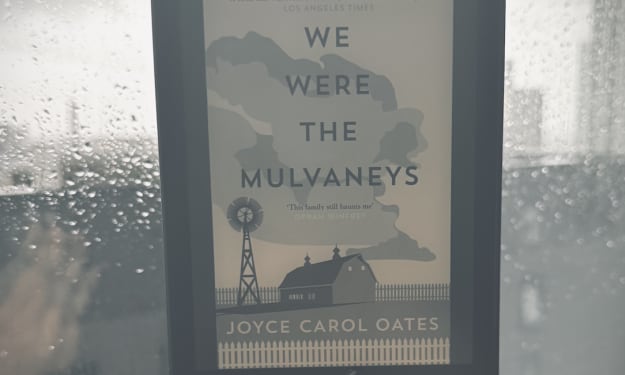
Book Review: "We Were the Mulvaneys" by Joyce Carol Oates
It's June 2025 and I've had headaches and colds and unfortunately, I'm not in a great place mentally or physically. I don't know what's going on, I just know it's some sort of decline. Anyways, I hope everyone is enjoying how the weather has turned to rain - I left the window open just a little in order to experience a breath of fresh air. It's difficult when you live in a city to get any fresh air and even then, the air isn't really fresh. I've been flaring up with possible allergies and so, I decided to take my mind off it with a morning read. This is We Were the Mulvaneys by Joyce Carol Oates - yes it's another JCO novel.
By Annie Kapur7 months ago in Geeks
Silver Screen Magic with Mae West
American actress and singer Mae West became a popular film actress during the Great Depression. She started entertaining in vaudeville, then performed on Broadway, and finally went to Hollywood. She signed up with Paramount Pictures and made her debut in the 1932 film “Night After Night.” She also starred in musicals, comedies, and crime dramas. The American Film Institute named her one of the best classic Hollywood actresses.
By Rasma Raisters8 days ago in Geeks
Can I Watch Super Bowl in NZ?
Super Bowl, one of the most exciting sporting nights of the year, is now less than a month away and the excitement is already palpable. Scheduled on February 8, 2026 at Levi’s Stadium in Santa Clara, California, this will be the third Super Bowl held in the San Francisco Bay Area.
By David Cooka day ago in Geeks


Comments
There are no comments for this story
Be the first to respond and start the conversation.