
Book Review: "Rub Out the Words" by William S Burroughs, ed. by Bill Morgan
4/5 - Probably the most readable of all of Burroughs so far...

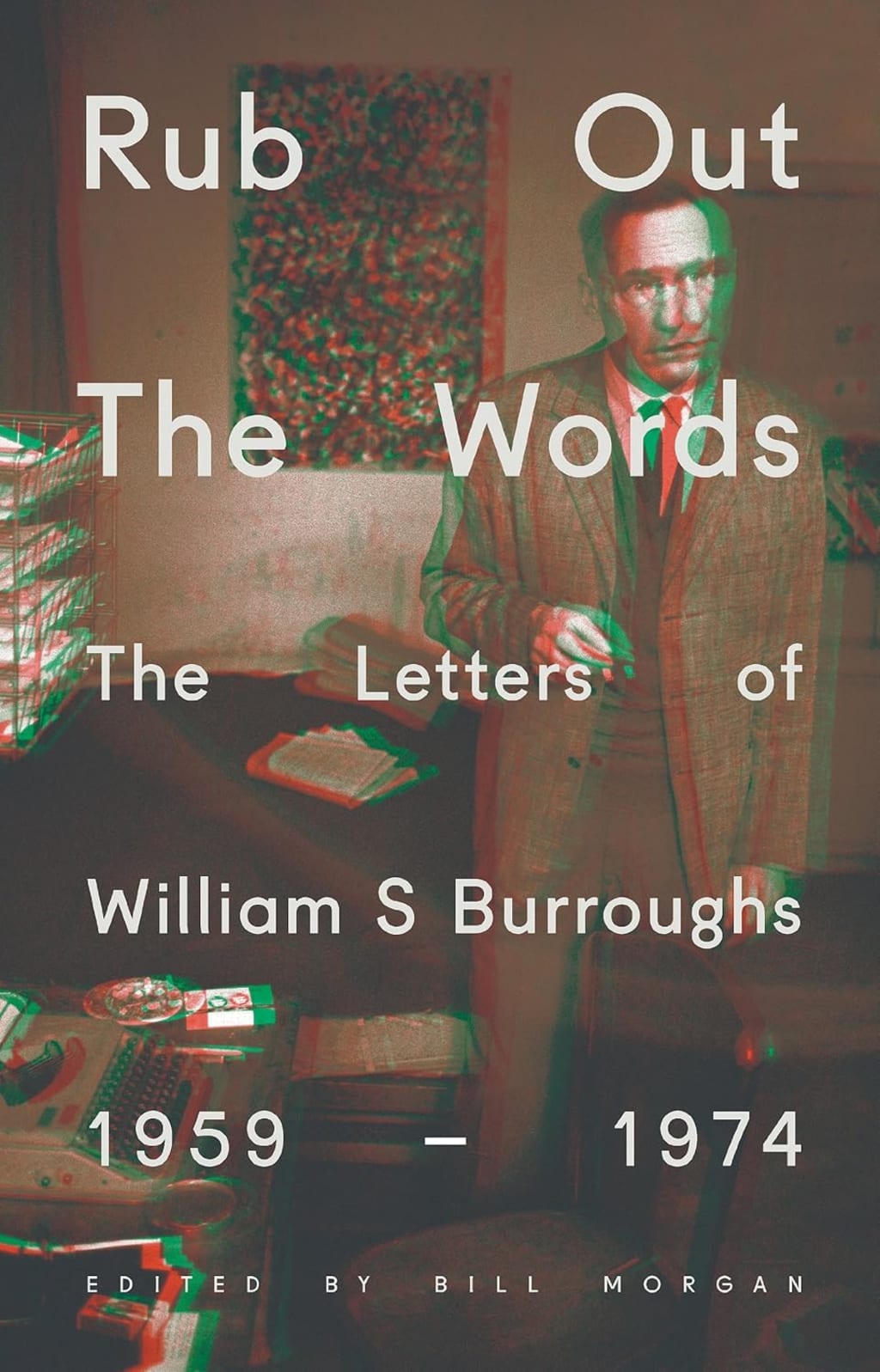
William S Burroughs is back and it is a love-hate relationship. Sometimes, he can write some stuff that is actually readable and other times, he can write things that make me want to throw the book against the wall. In a book I read previously by him (and on a train by the way) called Queer I remember having mixed feelings, more negative than positive, and then swearing off the author as I'd given him too many chances but still here we are. Something keeps pulling me back to reading Burroughs and I think it might be for the fact (and only the fact), I want to know exactly what was going through his head when he shot his wife dead in a 'game of William Tell'. I guess you could call it morbid curiosity to some extent. However, this is a book of letters which lets us into his conscience - though it does start nearly a decade after his wife's death, it is still somewhat interesting.
The letters highlight Burroughs’ deep connection with prominent writers like Allen Ginsberg and Jack Kerouac, who were central to the Beat movement. His correspondence with Ginsberg is especially notable, as they collaborated on various projects, and Ginsberg often acted as Burroughs' literary adviser. Burroughs’ letters show a mix of admiration, intellectual exchange, and even tensions with his peers as they discussed their work, politics, and personal lives. One of these includes the book And the Hippos Were Boiled in Their Tanks, if you're a big beat generation fan.
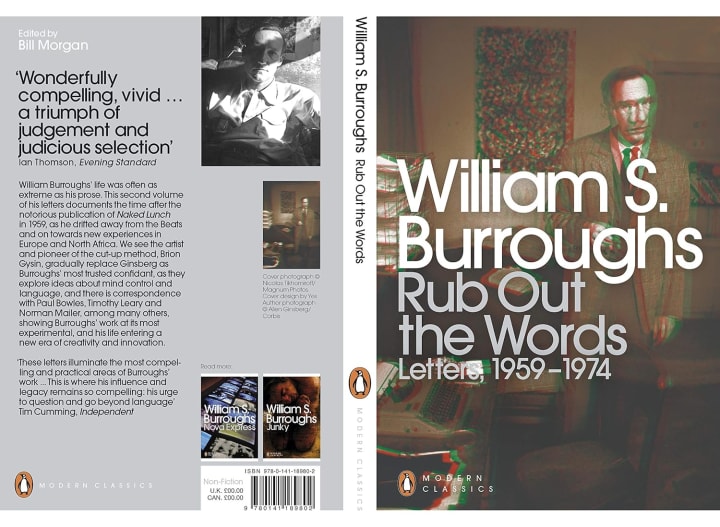
Burroughs used the letters to explore his experiments with the cut-up method, which he co-developed with Brion Gysin. He reflects on how cutting up and randomly rearranging text allowed him to subvert traditional narrative forms, unlocking new possibilities for storytelling. His enthusiasm for this technique is palpable as he encourages his correspondents to try it, explaining how it taps into subconscious associations and challenges linear thought. I like this idea but I don't think it worked well in his literature as he would have liked it to. I mean, you and I have read Burroughs and when he does cut-up, I don't think I can understand what he's trying to get at. It doesn't make his writing more readable, just confusing.
The letters provide an intimate look at Burroughs’ writing struggles, from battling writer’s block to navigating the pressures of his growing literary fame. He details the painstaking revisions of Naked Lunch, how he tried to push the boundaries of conventional narrative structure, and the difficulty of creating his Nova Trilogy (The Soft Machine, The Ticket That Exploded, Nova Express), works that fused surrealism, science fiction, and social commentary. He also discusses frustrations with censorship and public reception, especially in the U.S. This is interesting because these men were living at a time of massive censorship and the great looming shadow of McCarthyism was still throwing itself over America. The frustration is definitely seen in the letters although I do think it is often something that gets repetitive after some time.
Burroughs’ long-term addiction to heroin and other drugs is a recurring theme. The letters reveal how he used his personal experiences with addiction as creative fuel, reflecting on the physiological and psychological grip of narcotics. He views drugs not only as a personal vice but as part of a broader societal and political issue. The correspondence reveals his acute understanding of the addict’s mind, which deeply informs the disorienting, fragmented style of his writing. I liked this part because it shows a certain level of self-awareness of Burroughs' part. It also shows us how human he is. It is one of the few themes in this book that doesn't get worn out by repetition because each time he mentions it, it is relevant to his want to explore consciousness. There is less of the 'what' and more of the 'why'.
From reflections on his dead wife, to becoming interested in Scientology, from McCarthyism to self-imposed exile in Tangier. Burroughs has quite a bit to say in this book of letters where he expresses himself in a raw and unbridled way. I think it would have been better to start a little bit earlier so that we could see at least the trials he went through over his wife's death. But there is something really personal about these letters that even though his novels are semi-autobiographical, they don't touch on in the same way. The letters feel much more personal.
About the Creator
Annie Kapur
I am:
🙋🏽♀️ Annie
📚 Avid Reader
📝 Reviewer and Commentator
🎓 Post-Grad Millennial (M.A)
***
I have:
📖 280K+ reads on Vocal
🫶🏼 Love for reading & research
🦋/X @AnnieWithBooks
***
🏡 UK
Keep reading
More stories from Annie Kapur and writers in Geeks and other communities.
Book Review: "The Gambler and Other Stories" by Fyodor Dostoevsky
You're not going to like me. I did some serious thinking last night that maybe it would be a good idea to shut down my blog on this website. I took a long 12+ hour interrupted (very, interrupted) sleep and came to my senses that even if I didn't feel the same as I used to, it was definitely a good idea to keep this up. Mostly, it is really the only place I can vent about books because I can't do it at work and at home, there's nobody to vent to - I live alone. Currently, I'm listening to Billy Joel, Lou Reed, Bob Dylan and other greats - and really just cheering myself up with a cup of coffee. So, we can assume that this blog will still be around: stay hopeful if you like reading my stuff.
By Annie Kapurabout a year ago in Geeks
Silver Screen Magic with Mae West
American actress and singer Mae West became a popular film actress during the Great Depression. She started entertaining in vaudeville, then performed on Broadway, and finally went to Hollywood. She signed up with Paramount Pictures and made her debut in the 1932 film “Night After Night.” She also starred in musicals, comedies, and crime dramas. The American Film Institute named her one of the best classic Hollywood actresses.
By Rasma Raisters5 days ago in Geeks
Fallout Season 2 Episode 2 Review: "The Golden Rule" Explained
Let’s dive headfirst into Fallout Season 2 Episode 2, an hour stuffed with Easter eggs, callbacks, and wild lore reveals. This one is titled “The Golden Rule,” and trust me—it’s not just a cute thematic nod. This episode lives in that moral tug-of-war between Lucy, The Ghoul, and the messy ethics of post-apocalyptic civilization.
By Bella Anderson7 days ago in Geeks
So You Decided To Become a Nurse Practitioner:
So you decided to become an "Advanced Practice" nurse. Congratulations!... is what I would say if this was a good idea. Grad school? In this economy? What were you thinking? Likely it was something along the lines of either 1) “I've seen these other chucklefucks do it— Why can't I?” or even 2) “I've got a nice career, I should shake it up. I miss feeling like I have no clue what I'm doing.”
By Sandor Szaboa day ago in Fiction


Comments
There are no comments for this story
Be the first to respond and start the conversation.