
Book Review: "Poet, Mystic, Widow, Wife" by Hetta Howes
4/5 - the depths of agency in Medieval Women's Writing...

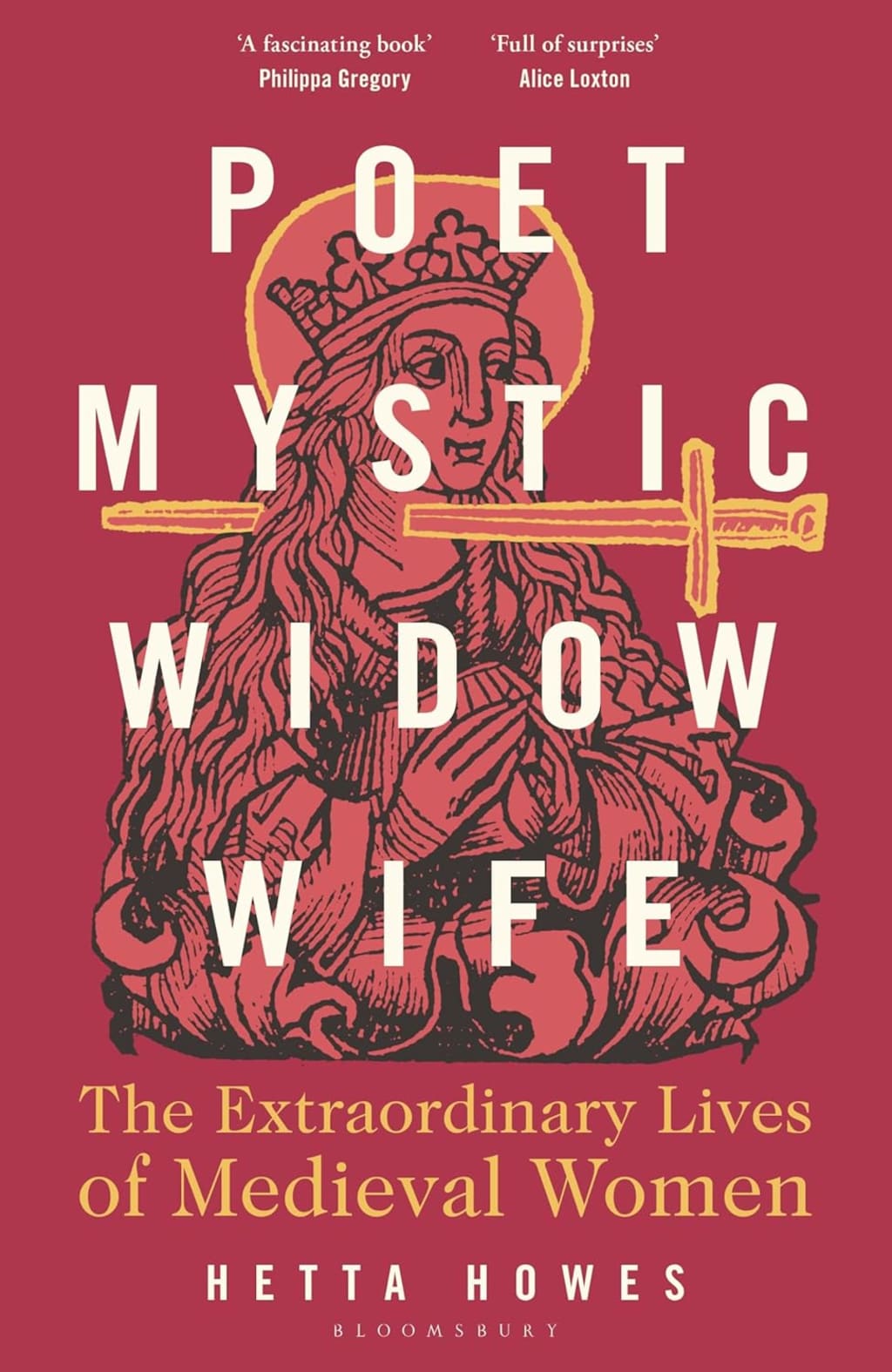
I have to say I was not initially thinking about reading this book but every single time I bought a Kindle book, this was always the first or second one in the Amazon Recommendations aferwards so it became hard to ignore as you can imagine. I wasn't sure what to think because my first thoughts before reading had to do with the fact I had read so many books about Medieval Women and how their lives played out before. I was looking for something new and honestly, I think I got something new. It was not really in the way I expected, but it was new and more detailed all the same.
Howes examines how these four women—Marie de France, Julian of Norwich, Christine de Pizan, and Margery Kempe—navigated a world that often silenced women’s voices. Through literary and spiritual writing, they redefined what was permissible for women, transforming limitations into avenues for expression.
Despite the dominant male voices of their time, they used subtlety, metaphor, and allegory to discuss topics like love, loyalty, faith, and virtue in ways that men couldn't. I think when the author discusses women writing, this becomes even more clear. It is one of the great things about this book which I did hope was longer.
These women belonged to the upper classes, allowing them to access education and literacy, which most women of their era could not. Marie de France and Christine de Pizan, for instance, drew upon their societal positions to create allegorical and courtly literature that resonated with noble audiences. Howes highlights how their privileged positions were a double-edged sword: they enabled these women to write but also subjected them to intense scrutiny.
The privilege came with societal expectations to reinforce values they were subtly challenging, which required them to approach their work with caution and a sharp awareness of reputation. I think I knew this already but it was nice to have the reminder. I think that in this book though it was a bit more detailed than in the books I had read.

The Church wielded considerable control over religious discourse, often dismissing or silencing women’s theological contributions. However, Julian of Norwich and Margery Kempe embraced mysticism, a space where women could claim a personal relationship with the divine. Julian’s visions, which she documented in Revelations of Divine Love, reflect deeply personal experiences with God that challenge the institutional authority of the Church.
Margery Kempe, meanwhile, pushed boundaries by narrating her visions openly, which both inspired followers and drew suspicion. Howes shows how these women navigated complex theological territory to assert their spiritual voices. I have read their books and honestly, they are both boundary pushing for any gender of their time. However, I still think that this is something that to someone who regularly reads on the topic - is generally surface level.
Howes details how these women crafted a delicate separation between their public writings and private selves. For example, Marie de France wrote allegorical stories that avoided any direct mention of her personal life, creating a public persona detached from herself. Christine de Pizan, too, carefully curated her image as a serious intellectual and moral guide. This strategy helped shield them from potential scandal, allowing them to voice opinions while maintaining the privacy and respectability necessary to ensure their continued reception among patrons and religious authorities.
In a society where women were expected to be silent, submissive, and devoted to domestic roles, these women used their writing to challenge this structure. Margery Kempe refused to conform to the expected binary roles of wife or nun, instead seeking an independent spiritual life that allowed her to express her devotion on her own terms.
Christine de Pizan, through her works like The Book of the City of Ladies, directly confronted misogynistic stereotypes, offering a vision of women’s potential beyond mere domestic roles. Howes emphasises that these writers used intellect and faith to subvert traditional expectations, often facing backlash in the process. I was surprised that The Book of the City of Ladies is used as an example of subverting expectations when it is practically the most middle class Medieval thing ever written, forget about it being written by a woman. I'm not sure how I feel about this.
All in all, through these biographies, Howes paints a vivid picture of the complexities of medieval womanhood. Christine’s roles as widow and single mother, Julian’s solitude as an anchoress, and Margery’s life as a traveler and lay mystic reveal how multifaceted and demanding life could be for women.
Howes explores their daily routines, struggles, and triumphs, providing insight into their material conditions, social interactions, and spiritual aspirations. These intimate details illuminate the challenges these women faced and the strength they needed to survive and thrive within restrictive frameworks.
About the Creator
Annie Kapur
I am:
🙋🏽♀️ Annie
📚 Avid Reader
📝 Reviewer and Commentator
🎓 Post-Grad Millennial (M.A)
***
I have:
📖 280K+ reads on Vocal
🫶🏼 Love for reading & research
🦋/X @AnnieWithBooks
***
🏡 UK
Keep reading
More stories from Annie Kapur and writers in Geeks and other communities.
Book Review: "A Taste for Poison" by Neil Bradbury
I love my fair share of books about weird deaths that happened in the Victorian Era. But this book is even more interesting as it mixes the Victorian Era weird death complex with the idea that certain substances even by the start of the 20th century, were thought to be entirely safe - not even used for the poisonings that they are so very well known for. It was a turbulent time that fifty or so years that saw the downturn of the Victorian Era and the upstart of out modern times, but this is also where so many chemicals and toxins also changed their tune and no longer were things like Strychnine considered a 'pick-me-up', though I've got no doubt it could definitely make you smile.
By Annie Kapurabout a year ago in Geeks
Silver Screen Magic with Mae West
American actress and singer Mae West became a popular film actress during the Great Depression. She started entertaining in vaudeville, then performed on Broadway, and finally went to Hollywood. She signed up with Paramount Pictures and made her debut in the 1932 film “Night After Night.” She also starred in musicals, comedies, and crime dramas. The American Film Institute named her one of the best classic Hollywood actresses.
By Rasma Raisters6 days ago in Geeks
Agnes Abdullahu's DiaMondaine Diamantaires Club partners with Isis Fashion Awards (Brings Diamonds, Luxury and Deluxe Dubai Flair to Amsterdam)
In the glittering world of high-end jewelry and haute couture, there are those who simply attend events, and then there are those who weave the very fabric of the experience. As the calendar turned toward the highly anticipated 4th edition of the Isis Fashion Awards (IFA) on May 6th, a new and formidable alliance began to take shape.
By postworldview3 days ago in Geeks
Miss Persephone's Manual to a Seemingly Ordinary Life
Miss Persephone was found at the dining table, her blue eyes swollen, her tears arriving and retreating like the tides of the ocean. Earlier that day, her family had visited her in the retirement home where she had lived for eight years. It was her eightieth birthday.
By Imola Tóth5 days ago in Fiction


Comments (1)
So much resides on my TBR list because of you... Thank you for this!