
Book Review: "Open When" by Dr Julie Smith
3/5 - I don't think I'll be giving this author any more second chances...

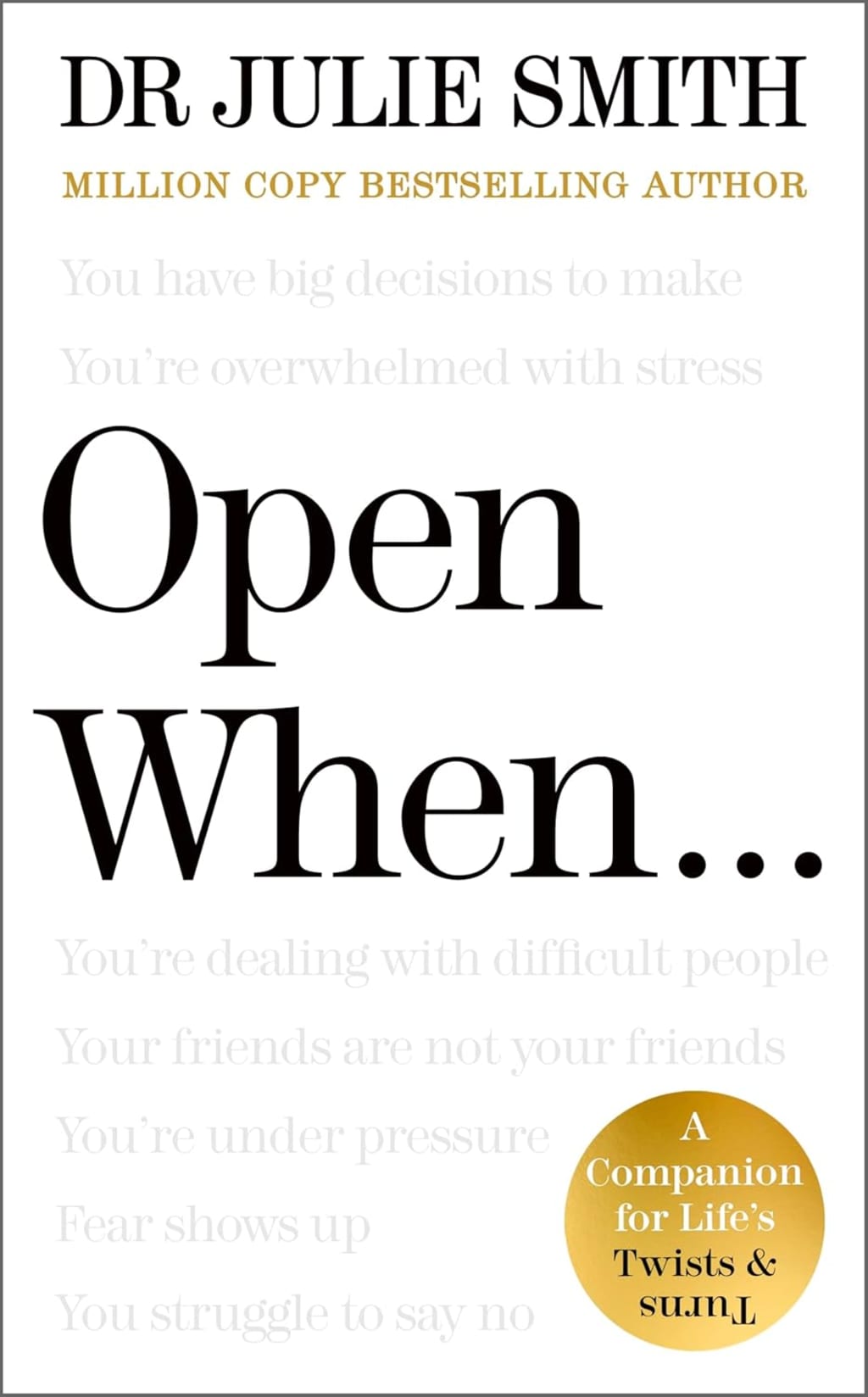
I think that this book was recommended to me by someone but I don't remember who. If we put it into context, there's a whole thing about people recommending people self-help books when they know you well enough to do so. I think I have been recommended Atomic Habits more times than I can count and yet, I have no intention of reading it. For me, there is a fine line between self-help that actually works and self-help that comes off as taken straight from a 'positive affirmations' Instagram post. Unfortunately, this book by Dr Julie Smith toes that line and toes it carefully - sometimes it does fall into the latter and so, you know it isn't going to get the full marks from me.
One of the book’s undeniable strengths is Smith’s writing style, which is engaging, heartfelt, and emotionally intelligent. Her prose is clear and evocative, with a lyrical quality that makes even the most difficult topics—such as grief and self-doubt, accessible and moving. There’s a sense of genuine warmth in her words, and her ability to take apart complex emotions into relatable reflections ensures the book resonates with a wide audience. When Smith writes about loss, in particular, her words carry a quiet power, perfectly capturing the raw, inescapable ache of grief while offering glimpses of hope and healing. For readers who have suffered a similar loss, these sections may strike a deep and familiar chord. Whilst this is all well and good, the chapters do still reduce themselves to the self-help quality often seen on social media rather than an in-depth analysis. That being said, many of the reflections are somewhat helpful to understanding how your mind changes across time.

However, while the concept and writing style are great, the book as a whole feels constrained by the conventions of its genre. At its core, Open When falls squarely into the realm of self-help, and for all its charm and sincerity, it doesn’t offer anything groundbreaking for readers who might be in search of deeper insight or transformative advice. Much of Smith’s guidance (while thoughtful and empathetic) remains surface-level, with familiar refrains about resilience, self-compassion, and “finding the light in the darkness.” While these sentiments are comforting and well-intentioned, they lack the originality or specificity needed to truly stand out among countless other self-help books that tread similar ground.
This shortfall is particularly noticeable when the book addresses readers who might be in the depths of despair or struggling with feelings of hopelessness. She offers broad affirmations about survival and healing, but these lack the raw depth or practical strategies that might resonate with someone in acute emotional pain. For example, while her letters on grief emphasise the importance of resilience and small victories, they do not delve deeply into the lived experience of enduring despair or the messy, nonlinear path to recovery. In this way, the book feels more like a gentle companion offering solace than a guide with actionable steps to navigate life’s darkest moments.

One notable weakness is how the book misses an opportunity to delve into deeper, more specific insights that could truly set it apart. For instance, when discussing personal setbacks or the complexities of mental health, Smith’s reflections often remain in the realm of generalised encouragement rather than offering the new perspective or hard-earned wisdom that might resonate more powerfully. Her focus on resilience and self-compassion is admirable, but without venturing into the uncomfortable or unpolished realities of pain and recovery, these insights feel somewhat hollow for readers seeking guidance that goes beyond platitudes.
Another issue is the occasionally overly polished tone, which sometimes creates a sense of emotional distance. While the premise of writing letters to her younger self allows for moments of reflection and vulnerability, there are instances where the narrative feels carefully curated, as though Smith is hesitant to fully expose the rawness of her experiences. This restraint, while understandable, prevents the book from achieving the level of intimacy and authenticity that might elevate it beyond a conventional self-help read.
I don't know what to say. There were defintely some good point about this book but there were so many bad points it was hard to ignore. I did read her previous book a while back and did not enjoy it in the slightest. However, I was open-mided enough to give the second book a chance. It was not all that much though - I was not entirely impressed.
About the Creator
Annie Kapur
I am:
🙋🏽♀️ Annie
📚 Avid Reader
📝 Reviewer and Commentator
🎓 Post-Grad Millennial (M.A)
***
I have:
📖 280K+ reads on Vocal
🫶🏼 Love for reading & research
🦋/X @AnnieWithBooks
***
🏡 UK
Keep reading
More stories from Annie Kapur and writers in Geeks and other communities.
Book Review: "I've Been Thinking" by Daniel C. Dennett
As you know, I've been living in Nottingham for a few months now and it's February, but I still haven't made any friends. This means that more often than not, I have stayed in my apartment when not at work because I have quite literally nowhere I need to go. After my mental health going into the gutter I decided to book a doctor's appointment (yes, it's become that bad) and until the time for it came, I wandered around the streets of the city centre. This is where the independent bookshop Five Leaves comes in. I had been meaning to visit for a while but couldn't find the time or reason to go. Now, with both at hand, I picked up a couple of books and this was one of them. At the Caffé Nero the next day - I sat and read most of the book, much to the surprise of some unusual on-lookers who, everytime I lifted by head, would give me a strange glance as if they'd never seen anyone read in a cafe before. But here we are...
By Annie Kapur10 months ago in Geeks
Silver Screen Magic with Mae West
American actress and singer Mae West became a popular film actress during the Great Depression. She started entertaining in vaudeville, then performed on Broadway, and finally went to Hollywood. She signed up with Paramount Pictures and made her debut in the 1932 film “Night After Night.” She also starred in musicals, comedies, and crime dramas. The American Film Institute named her one of the best classic Hollywood actresses.
By Rasma Raisters10 days ago in Geeks



Comments
There are no comments for this story
Be the first to respond and start the conversation.