
Book Review: "Love on the Dole" by Walter Greenwood
5/5 - heartfelt and emotional, this book presents us with a very real tragedy that still applies today...

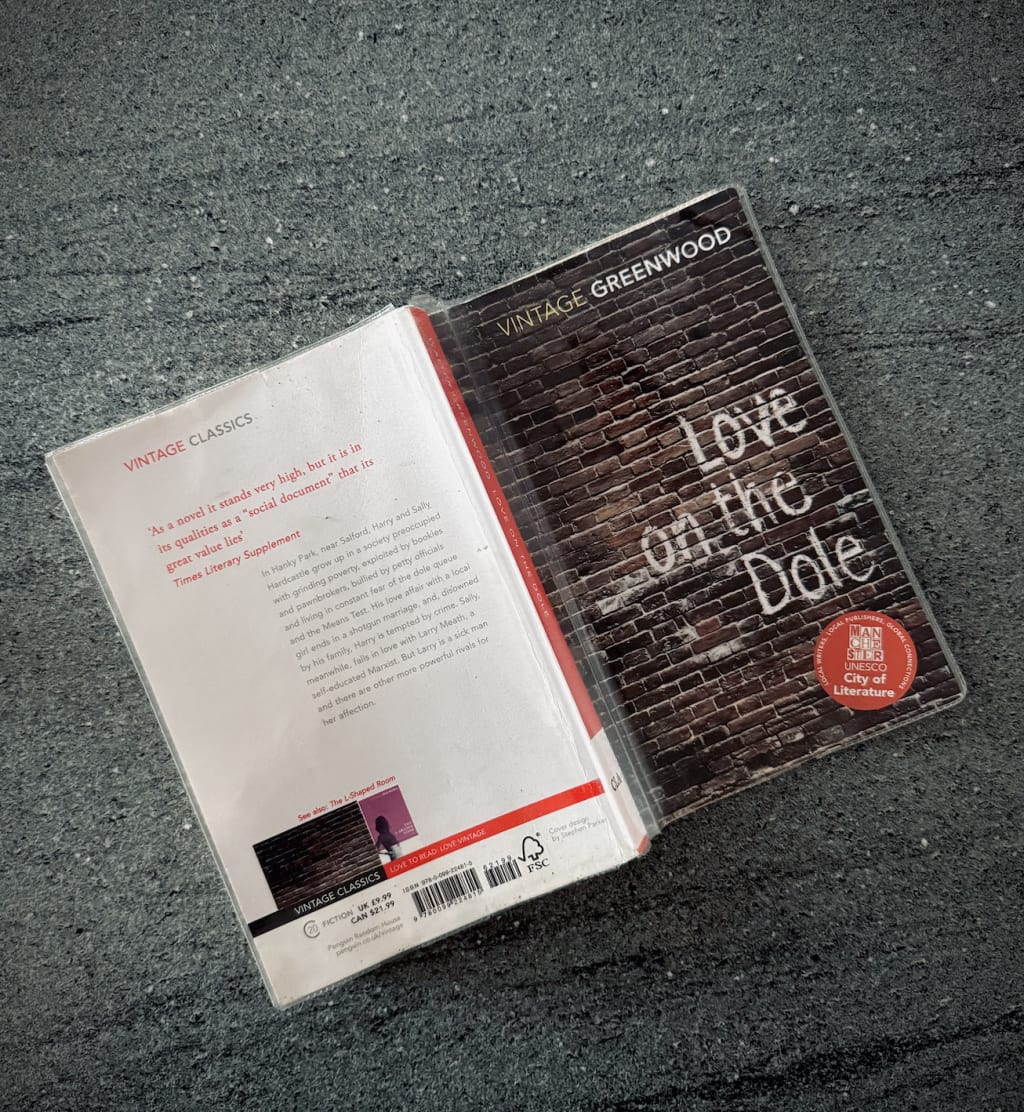
As you know by now, I've been back to the library (which seems to probably be closed throughout August so I'm going to need to sort myself out for the whole month). But, I found quite an interesting red spined book and not only had I not seen this one before, I'd never heard of it. I used to go through the websites which listed the red spines and made sure I'd read as many as I could but here we are. I can't believe I missed this one. It's called Love on the Dole and of course, it's a tragedy. It's upsetting. It's so damn emotional.
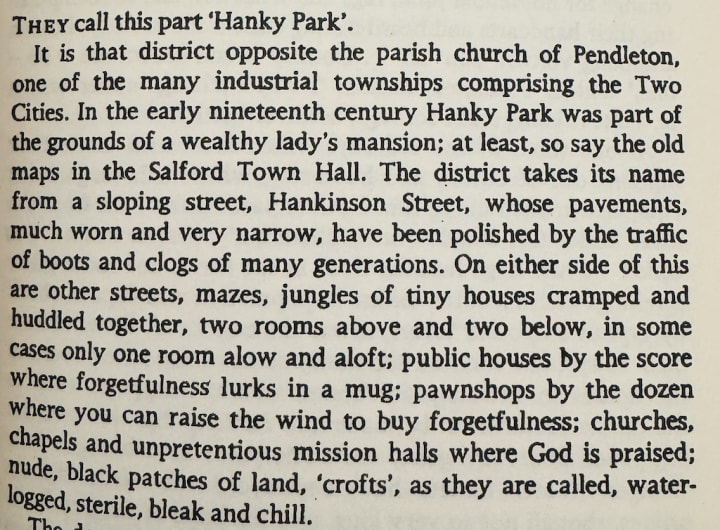
It's set in the fictional Hanky Park in the very real town of Salford during the 1930s and details the lives of those in the Hardcastle family. Now, it's really rare that we get a hyper-realistic Great Depression novel from England and so, I found this beginning to be fairly interesting. Mr. Hardcastle works at a local mill, while his son, Harry, is eager to escape the drudgery of factory life. Sally Hardcastle, Harry’s sister, is practical and stoic, holding the family together. The reality of their situation is grim and depressing, often made more so by the atmosphere and descriptions that Greenwood purposefully writes to be just awful. Looking at the opening of the novel, you can probably see what I'm talking about.
At thirteen, Harry leaves school to become an apprentice at Marlowe’s engineering works, a low-paying job that offers a very limited prospect for the future which is also completely unstable in its era. He hopes to build a future in skilled labour, but the exploitative nature of the apprenticeship becomes quickly apparent. He’s paid poorly and treated dismissively, while his future remains uncertain as does everyone else's. The author is very clearly using this character to highlight the lie of social mobility through work in which the middle class simply say 'if you work hard you can achieve' - in reality, that is not the case at all. I would even argue that it still is not the case at all. Many people have realised that working hard does not mean you will have an adequate quality of life - it just raises more problems. Greenwood will deal with that last part concerning Harry later in the book.
Sally, intelligent and self-possessed, begins a relationship with Larry Meath, a politically minded man who educates himself through reading and espouses socialist ideals. Larry, who works sporadically and faces ongoing unemployment, represents a glimmer of hope and intellectual awakening in Sally’s life. This is strange because these two have a relationship which is based on mutual respect, a completely different set of dynamics to every other relation/friendship in the text. There is a great emotional depth to their relationship that presents them as a strong couple even though they are in trying times.
As the Depression deepens, the mill where Mr. Hardcastle works begins to lay off workers. Eventually, he loses his job, throwing the family into deeper poverty. Harry, too, finds himself unemployed after completing his apprenticeship. With few job prospects and little support from the government, the family starts to rely on the dole (unemployment benefits), which is both humiliating and inadequate. In every era, unemployment benefits are meant to humiliate the person receiving them. I have heard stories about people who, after paying their bills with their unemployment benefits, can no longer afford to buy food and so live off tins (that go out of date far less quickly than actual food) from food banks. The author is definitely trying to show us the desperation associated with an unstable economy in which when people are losing their jobs, can starve its own population.
Unemployment and poverty begin to eat away at the family’s morale. Mr. Hardcastle grows increasingly bitter and withdrawn. Harry, now idle, becomes involved in drinking and betting as a way to escape his hopeless situation. Sally watches as her family disintegrates under the strain. Greenwood's depiction of the psychological toll of poverty is unflinching; he shows not just the practical challenges but the erosion of dignity, identity, and interpersonal relationships. As Larry becomes more and more involved in left-wing activism in order to campaign for a better life for his fellow people, a horrifying tragedy happens. A workers' protest turns violent and unfortunately - whilst in the thick of it - Larry is struck down by the police and dies. He leaves Sally without hope and she, in turn, becomes desperate and despondent.
I've only really told you where this tragedy cycle begins but it is safe to say that the things the Hardcastle family goes through are not to be taken lightly. People are still going through this today and, because the middle class cannot understand what it is like to be them - they are usually ignored and invisible. Politicians ignore their blight because politicians have no care about human needs in their countries. I hope reading about the Hardcastle family can help people become a little bit more empathetic to others.
***
Don’t forget to join my unofficial challenge!
About the Creator
Annie Kapur
I am:
🙋🏽♀️ Annie
📚 Avid Reader
📝 Reviewer and Commentator
🎓 Post-Grad Millennial (M.A)
***
I have:
📖 280K+ reads on Vocal
🫶🏼 Love for reading & research
🦋/X @AnnieWithBooks
***
🏡 UK
Keep reading
More stories from Annie Kapur and writers in Geeks and other communities.
Manhattan Transfer by John Dos Passos
John Dos Passos’s Manhattan Transfer, published in 1925, is a landmark modernist novel that captures the pulse of New York City during the early 20th century. Dos Passos, heavily influenced by his experiences as a young man in the 1910s and 1920s, sought to depict the complexities of urban life and the fragmentation of modern society.
By Annie Kapur7 months ago in Geeks
Silver Screen Magic with Mae West
American actress and singer Mae West became a popular film actress during the Great Depression. She started entertaining in vaudeville, then performed on Broadway, and finally went to Hollywood. She signed up with Paramount Pictures and made her debut in the 1932 film “Night After Night.” She also starred in musicals, comedies, and crime dramas. The American Film Institute named her one of the best classic Hollywood actresses.
By Rasma Raisters7 days ago in Geeks
Jan-Willem Breure Joins the Joburg Film Festival Jury (JFF) - Septimius Awards Director becomes Judge at South Africa Oscar Qualifying Film Festival in Johannesburg
The golden horizon of South African cinema continues to expand, and the 2026 Joburg Film Festival marks a significant moment in this evolution with the appointment of Jan-Willem Breure (Director & Founder of the Septimius Awards) to its international jury. Breure, an acclaimed filmmaker and entrepreneur, brings a perspective forged through a life of global transitions. Born in Rwanda and later adopted by Dutch missionaries, his journey took him through the landscapes of Kenya and Namibia before he eventually settled in the Netherlands. This cross-continental upbringing gave him a rare understanding of the nuances inherent in African storytelling, a trait that has defined his professional career.
By postworldviewabout an hour ago in Geeks


Comments (3)
That sounds like such a heavy, moving read. I really appreciate how you dig into its emotional weight and the political undertones. Definitely sounds like a book that doesn't let you walk away untouched.
Omgggg, in the midst of everything going badly, Larry had to die. That was terrible. Loved your review!
I have not forgotten your challenge, and I recognize this book. I think it was filmed...?