
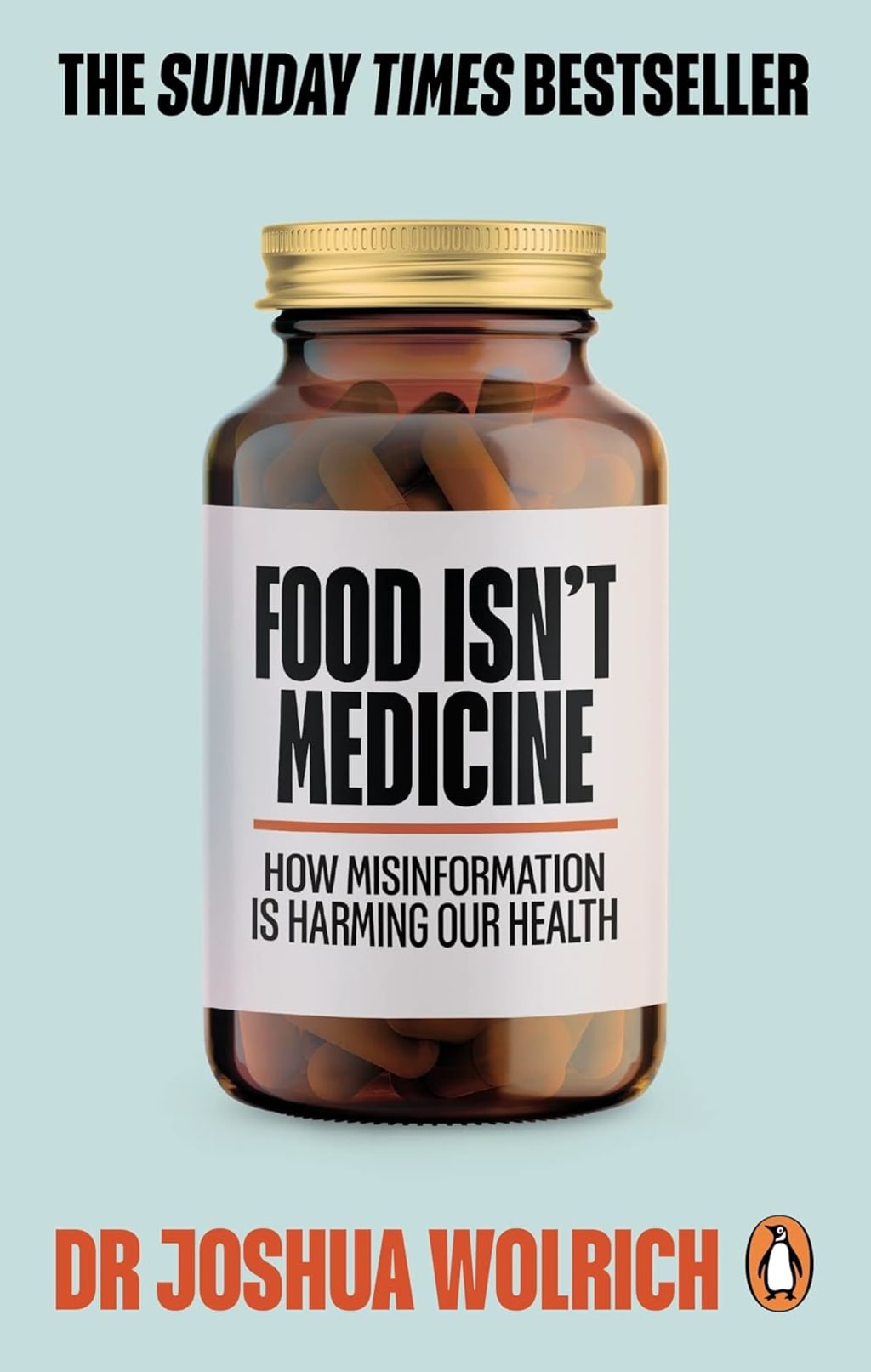
Book Review: "Food Isn't Medicine" by Dr Joshua Wolrich
2.5/5 - I don't really know what to think here, though it is an interesting pop-science book...

Content Warning:
Topics such as eating disorders and diet culture will be sporadically discussed within. Take this into account when deciding if and when you'll read this review.
If you need assistance or know anyone who could need help with these issues, contact your crisis line or mental health provider.
Thanks,
Annie
***
Book Review: "Food Isn't Medicine" by Dr Joshua Wolrich
When it comes to books about food, I'm obviously quite careful. I honestly believe that the person who knows your body best is you. For example: I drink enough black coffee to kill a small country and I'm highly averse to putting milk and sugar in any hot drink. But I'm not about to preach that to anyone else - carry on with whatever works for you and whatever time you like it. That might be simplistic but I think this book definitely takes my idea by the horns in that it isn't trying to tell you how to live your life, rather it is breaking down diet myths. The one thing I have a problem with is calling a 'diet' a 'disordered behaviour' - implying it is an eating disorder trope. As someone who is still on a massive diet, I am quite enjoying my change of lifestyle as it has given me more energy and made me happier.
Dr Joshua Wolrich tackles some common diet myths by at first, using his own story of not wanting to be an overweight doctor and taking us on a journey of how he became obsessed with weight loss, whilst also ironically sacrificing his health. I'm not going to lie, but at first it does feel like he is presenting health and dieting as two opposing things and I don't know whether that could in fact be just as harmful as doing the opposite. Yes his story is a compelling one and telling us about how he was restricting himself from all the things he liked to eat is something that is very interesting but I genuinely wonder how this applies to the broader range of people and whether it applies to anyone except for a the privileged who can be (ironically) choosy about what they eat. For example: does telling this story just show that privilege he has over others? Probably, in my opinion. But then again, I'm playing devil's advocate. Let's move on.
He tells us that these various diets (such as the Mediterranean Diet) have no weightings in science. This is basically untrue and kind of harmful I believe. Not all dieting is disordered eating. People diet not only to lose weight, and this author definitely assumes that weight loss is basically the only reason people diet. Many people also diet in order to try new foods, feel generally a bit better and, some like me, to iron out quite a bit of damage. Weight loss for many is just a side-effect of finally eating well. To assume that the main cause of dieting is to lose weight and therefore, it must lead to disordered eating is a heavily privileged position to take and possibly a wrong one to presume. It's very surface layer and didn't challenge any beliefs that are usually held about dieting - but seemed to reinforce that there aren't diets that would make you 'better' or 'well'. This is something absolutely nobody in the real world argues.
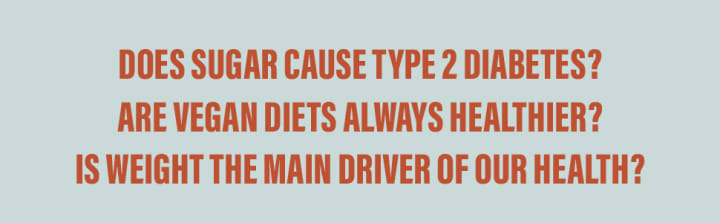
When it comes to facts about fad diets, I'm not going to argue - he's probably right about people putting on more weight as soon as they start eating 'normally' again. But to say that there is not a single diet that would improve heart health is really stretching it. I say this because though they are not strict diets, websites like the British Heart Foundation often have information on foods that could improve your health and possible foods you want to avoid. If it is really between the charity of researchers who want to save your mother from having another heart attack or someone who has been described as not only a wellness doctor but an 'influencer', then I think I've already made up my mind on who to believe. The British Heart Foundation really does wonders for breaking down information and which sources to trust. Unsurprisingly, none of the information I have ever seen features this author.
Another claim made in this book is one against the 'carnivore diet' which, again unsurprisingly, the author does not expand on but sidetracks himself into the cult of veganism and why the cult-like mindset of vegans notoriously has turned people away who would have probably considered it if the vegans themselves hadn't turned into preachers. The one reason I think he avoids talking about the carnivore diet is because it works if your health is at a certain point. Lower carb diets have been seen to have a positive impact on those with type 2 diabetes even though this book seems to say it doesn't. The author is careful with his wording though. He doesn't say it doesn't work, he simply says that it isn't a cure. Those are two different things. If you can alleviate pain and discomfort by doing something small and simple, you'd probably do it and see what the outcome was even if it was not a long-term solution. This is the thing, food may not be medicine but alleviating pain and discomfort is definitely a real thing when it comes to diets and lifestyles. This is something the carnivore diet has achieved for very sick people and I'm not going to say it is a cure, but I will say it's a good remedy for their discomfort.
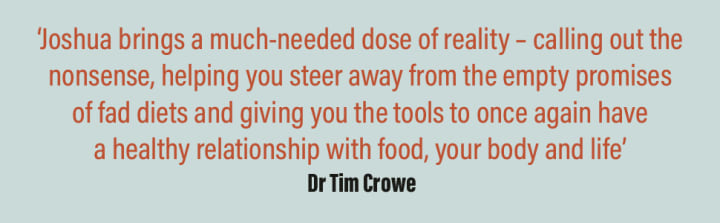
Finally we have the idea of 'health at every size'. This is really the first time I'm hearing of this concept but I think many people with more than half a brain cell would be able to say that you cannot possibly tell someone's health data from looking at their size, BMI or weight. This author makes the claim that doctors are constantly judging people by their weights and BMIs and often refusing to treat people for major diseases if they are over a certain threshhold. I am not going to say whether I agree or disagree and I might just have to take his word for it because I haven't seen this field or heard of this malpractice before. I would agree with the author and say it is wholly a bad angle to take and any doctor or nurse who is taking that angle should have their license removed with immediate effect as they could miss something very important and the patient could die. But, I will also say that some routines and surgeries perhaps require the patient to perhaps lose a bit of weight so that there is less discomfort for them in the recovery stage or even for the fact that it would be safer to operate on organs that way. I can't say for sure, but putting out a blanket statement without a critical analysis of other possibilities has never sat well with me.
Anyways, I'm going to stop there and let you explore the book for yourself. I would definitely recommend for you to read it because although I found myself not really agreeing with much in the book, it was still interesting to read. It probably didn't go as deep as I would have liked it to, and it didn't really get into any science I didn't already know (which is weird since I barely know any science), it is still a good challenge to fad diets and diet culture. Again, still check this book out. I'm still mulling over it now.
About the Creator
Annie Kapur
I am:
🙋🏽♀️ Annie
📚 Avid Reader
📝 Reviewer and Commentator
🎓 Post-Grad Millennial (M.A)
***
I have:
📖 280K+ reads on Vocal
🫶🏼 Love for reading & research
🦋/X @AnnieWithBooks
***
🏡 UK
Keep reading
More stories from Annie Kapur and writers in Geeks and other communities.
Book Review: "Good Behaviour" by Molly Keane
It's not everyday I go outside but when I do, I like to pop into the bookshop and see what's on offer. On a two-for-one there were these lovely Virago Modern Classic books and so, of course I picked up Molly Keane's Good Behaviour, a book I have been needing to read for a while. From chapter 1, I was captivated because of the dark humour and undercurrent of satire. I feel like this is a book every woman should read before she takes anyone's shit. It is a brilliant look at how growth is massively impacted by the way in which we see others of our own kind - especially the main character's mother. This book was brilliant.
By Annie Kapur2 months ago in Geeks
Silver Screen Magic with Mae West
American actress and singer Mae West became a popular film actress during the Great Depression. She started entertaining in vaudeville, then performed on Broadway, and finally went to Hollywood. She signed up with Paramount Pictures and made her debut in the 1932 film “Night After Night.” She also starred in musicals, comedies, and crime dramas. The American Film Institute named her one of the best classic Hollywood actresses.
By Rasma Raisters6 days ago in Geeks
What is Baddie Hub?
What It Is and Where It Came From The term “baddie” used to describe a person with bold style and confidence has moved from social media slang into a broader online space focused on fashion and lifestyle inspiration. Originally popularized by creators on Instagram and TikTok, this trend soon grew into online communities and platforms dedicated to sharing looks, beauty tips, and ways to stand out confidently in both appearance and attitude.
By Dena Falken Esqabout 19 hours ago in Geeks
A Dart at Dusk
Seconds ago, the sullen sun set on the two of us… my exuberant furry companion and me. A fresh breeze embraces us, delivering welcome relief from the day’s oppressive heat. His typical stumbling and staggering along — apace with a sloth — has turned into trip-trapping, high-stepping, almost skipping along.
By Angie the Archivist 📚🪶6 days ago in Petlife


Comments
There are no comments for this story
Be the first to respond and start the conversation.