
Book Review: "Fear" by Robert Peckham
5/5 - one of the best nonfiction books I have read in a long time...

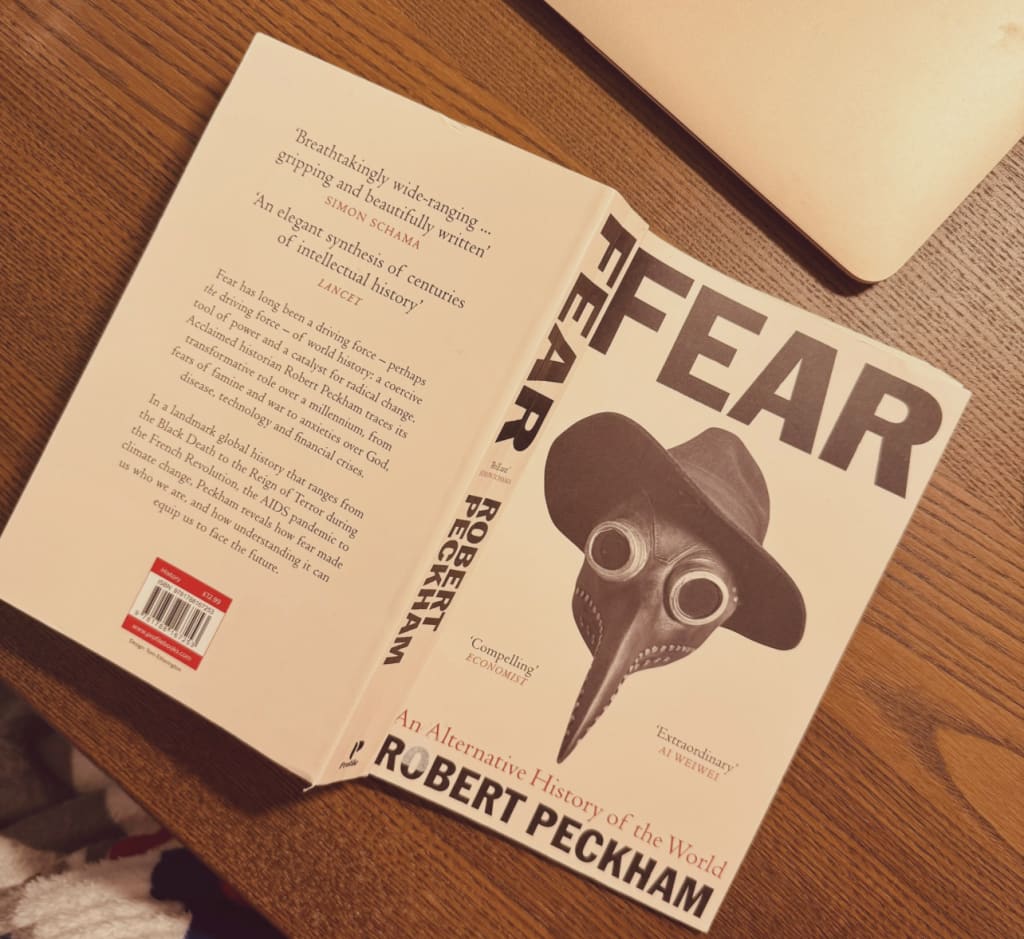
I feel like there are a lot of deals on used books at the moment and this was one of them. I love books that re-examine our lives and times, our histories and the way we have been told certain narratives. This book, entitled Fear: An Alternative History of the World examines our relationship with fear through terrifyingly bad events such as the plague and the AIDS crisis. What drew me to the book was not only that, but the cover which features a plague doctor's mask topped off with a strange looking 1950s gangster-style hat. A lengthy book with big black lettering for its title, I was sure that this book could not possibly disappoint. And it did not. Let's have a look at the points I found most interesting and most shocking...
Robert Peckham presents fear not merely as an emotion but as a fundamental driver of historical events, political movements, and societal transformations. Unlike conventional histories that focus on wars, revolutions, or economic shifts, Peckham examines how fear—both real and manufactured—has shaped human behaviour and decision-making over centuries. From ancient plagues to modern pandemics, from totalitarian regimes to financial crises, the book explores how fear has been wielded as a tool of power, control, and resistance. By reframing history through this lens, Peckham invites the reader to reconsider the narratives that have shaped our world and to recognise fear as an underlying force in global affairs.
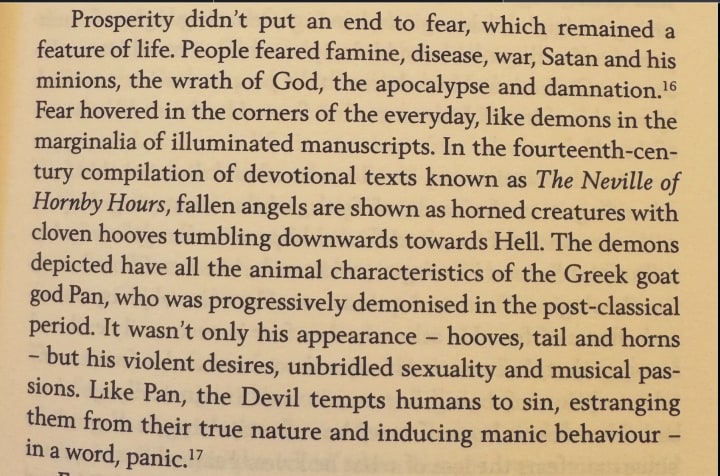
The author explores how rulers, from emperors to modern-day politicians, have systematically used fear to control populations and justify extreme measures. Whether through the threat of foreign invasion, internal enemies, or abstract dangers such as moral decay, leaders have frequently positioned themselves as the protectors against existential threats. Historical examples include:
- Robespierre and the Reign of Terror: How fear of counter-revolutionaries justified mass executions.
- The Nazi regime and propaganda: How fear of Jewish people, communists, and other "enemies of the state" led to the consolidation of Hitler’s power.
- Joseph McCarthy and the Red Scare: How Cold War paranoia enabled the persecution of suspected communists in the United States.
- The War on Terror: How post-9/11 fear led to sweeping surveillance laws, military interventions, and a redefinition of civil liberties.
Peckham argues that fear-based governance is not an anomaly but a recurring pattern throughout history, with those in power consistently exploiting it for their own ends.
Economic crises are not merely the result of mathematical calculations and market forces—they are driven by fear. Peckham examines historical moments where mass anxiety has led to financial collapse:
- The South Sea Bubble (1720): How speculation fuelled by both greed and fear of missing out led to a catastrophic stock market crash.
- The Great Depression (1929): How fear of economic collapse led to bank runs and government intervention.
- The 2008 Financial Crisis: How fear of financial ruin spread through global markets, resulting in bank bailouts and austerity policies.
He states that fear is at the core of economic behaviour—both at an individual and systemic level. The fear of losing wealth or missing opportunities often drives reckless decision-making, leading to cycles of boom and bust.
Along with this, religious institutions have historically relied on fear to maintain control and obedience. Peckham explores how different faith traditions have used fear to shape morality and social order: The fear of hell in Christianity, The Reformation and the fear of heresy and Modern religious extremism. Honestly, I think that the religious argument is one of the oldest tricks in the book when it comes to fear.
My personal favourite chapter was 'colonising panic' which starts with looking at whether a human sacrifice felt fear when she was pushed into a volcano. It moves on to speaking about how fear and terror were integral for colonising and creating that split between the natives and those who were colonising. Violence and terror therefore were the most important ideals that colonisers brought with them. This was not just through brutality, but it was also by new disease that the developed western world brought with them.
All in all, I could sit around a talk about this book for ages. Here is a bit of an overview of some more of my favourite parts: 'The Despotism of Liberty' which covers the Robespierre era, 'The Slave Matrix' which has some of the most horrific imagery I have read in the whole book and finally, 'Diabolus Ex Machina' which covers the industrial revolution and the fears about the growing city that came along with it. This was a truly engrossing book.
About the Creator
Annie Kapur
I am:
🙋🏽♀️ Annie
📚 Avid Reader
📝 Reviewer and Commentator
🎓 Post-Grad Millennial (M.A)
***
I have:
📖 280K+ reads on Vocal
🫶🏼 Love for reading & research
🦋/X @AnnieWithBooks
***
🏡 UK
Keep reading
More stories from Annie Kapur and writers in Geeks and other communities.
Book Review: "James and John" by Chris Bryant
I've known for a bit that this book is a book to read and yet again, I had to wait for available funds to be able to get it. James and John is about a miscarriage of justice which resulted in horrors but then again, it is about so much more. It is about the way in which that from the Restoration to the Georgian period, the English especially began to get so disgusted by homosexuality that it was pretty much omitted from Victorian arrest records and the most famous case therefore became Oscar Wilde's 1895 trial after he wrote The Picture of Dorian Gray. Even foreigners from on the continent were confused about the Englishman's disgust at same-sex relationships to the point that homosexuality was punishable by execution. This book details England's dark years in which love was punishable by death. It was a truly terrifying time.
By Annie Kapur10 months ago in Geeks
Silver Screen Magic with Mae West
American actress and singer Mae West became a popular film actress during the Great Depression. She started entertaining in vaudeville, then performed on Broadway, and finally went to Hollywood. She signed up with Paramount Pictures and made her debut in the 1932 film “Night After Night.” She also starred in musicals, comedies, and crime dramas. The American Film Institute named her one of the best classic Hollywood actresses.
By Rasma Raisters5 days ago in Geeks
Jay Kelly - A Netflix Movie Review
Are you running to something or from something? Jay Kelly is a 2025 film about a famous movie actor who is beginning to have doubts about his career. While on the train to his next job, Jay reflects on his life, confronting his past and present.
By Marielle Sabbag6 days ago in Geeks
The Devil's Cut
“Comrade, finally you’re awake.” The voice was smooth, sensual. A flickering incandescent bar was all that lit the white, sterile room. All Vladimir remembered was everything going black. He tried to move his arms and found them strapped to the gurney.
By Matthew J. Fromm4 days ago in Fiction


Comments
There are no comments for this story
Be the first to respond and start the conversation.