
Book Review: “Everybody Lies” by Seth Stephens-Davidowitz
2.5/5 - obvious data trends with fun, but flawed insights…

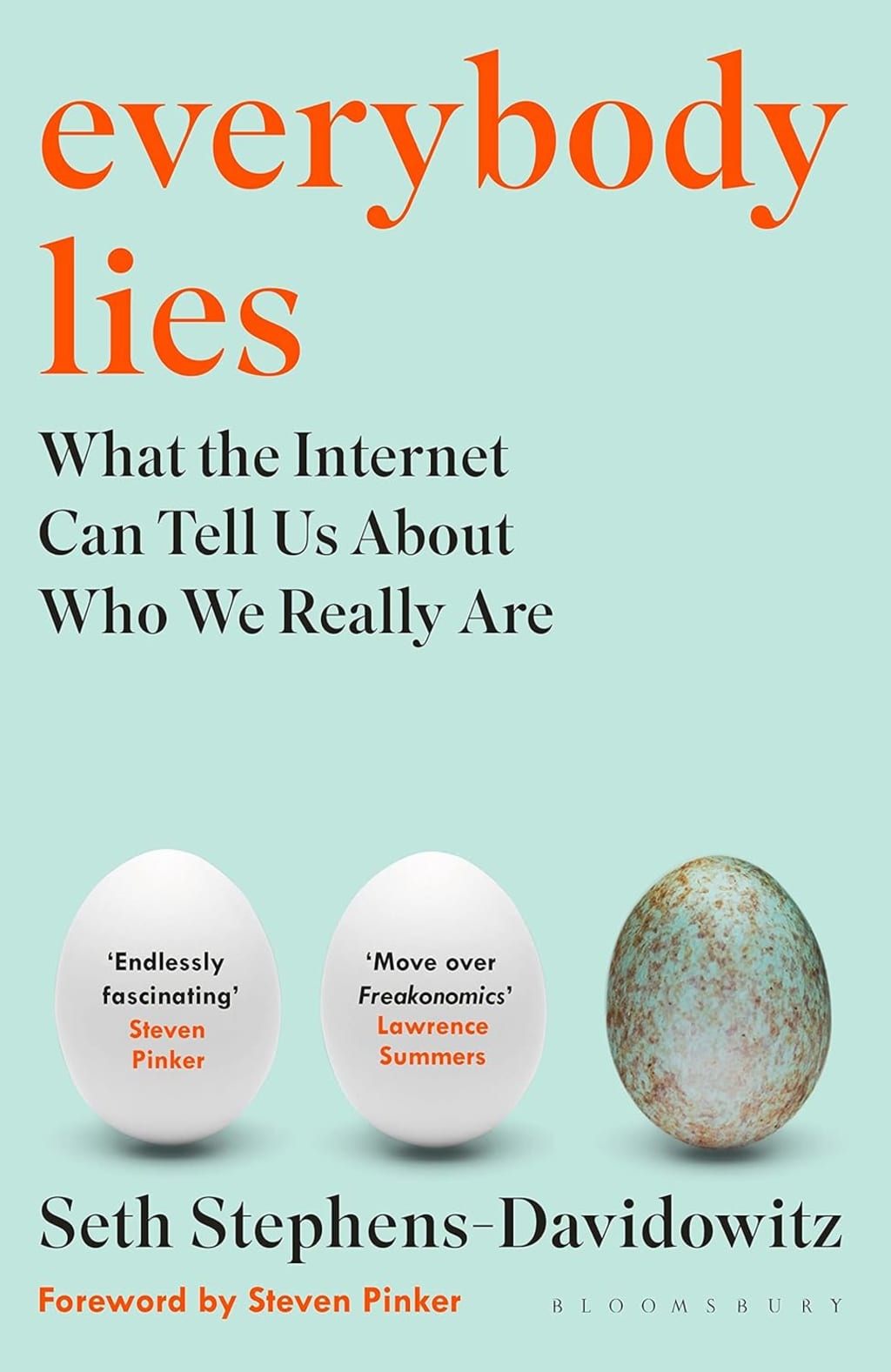
I found this book because someone had put it on social media and to be honest, I read the blurb first and it goes over some very obvious talking points. I wasn’t fascinated by the argument to begin with and nor was I taken in by the writing style once I started reading. This book has its advantages including: accessibility, opening up conversation and the author has done a good job of keeping the argument logical. However, the downsides for me include: its readability lacks seriousness, it focuses too much on one or two things, it doesn’t really go into depth about anything and it’s obvious confirmation bias. Let’s see why this book is definitely great for ‘pop statistics’ but basically means nothing to those of us who have read Alex Edmans’ book “May Contain Lies”.
People often present an idealised version of themselves in surveys or social media, avoiding topics that might make them seem socially unacceptable. Stephens-Davidowitz demonstrates how search engine data, collected anonymously, reveals people’s real attitudes, beliefs, and concerns—things they wouldn’t typically admit in public.
This form of “data truth” uncovers genuine views on issues like health, relationships, and biases, offering a truer glimpse into human behaviour. The only problem I have with this argument is that it is basically the most common thing that everyone on social media knows. The theory that the writer has of this being an unknown concept is actually insulting to the reader. Just because people don’t really talk about it much doesn’t mean that it is unknown. Also the thinking of your own data as the ‘truth’ is a strange form of confirmation bias that I don’t think the writer intends to admit to but is doing so in the name he gives to it.
In their searches, people often reveal insecurities, questions, and desires they might not share even with close friends or partners. Stephens-Davidowitz uncovers patterns that suggest widespread dissatisfaction, curiosity about infidelity, and anxieties about sexual performance. These search patterns reveal a deeply private side to human relationships, uncovering what people genuinely wonder about but rarely speak of openly. The fact that this basically says ‘people ask Google questions they would like the answer to but feel stupid to tell others about‘ is not a discussion point. Is this not what Google was simply made for? It doesn’t matter what the question is, people using Google as a search engine is not research, it’s stating the obvious.
Search data often uncovers the real political sentiments people hold, which are sometimes hidden from pollsters. For example, Stephens-Davidowitz reveals how populist ideologies gain traction online, particularly in private search histories, which can serve as a gauge for measuring political polarisation. Analysing these patterns helps to understand the hidden drivers of political movements and voter behaviour that polls might miss. This is an important point because a lot of this goes on in the world. We will have one person who claims to be left and is actually right and vice versa. However, again this is not a research point. It is just obvious.
When it comes to a lot of the research, we can tell by reading that it has been cherry picked to represent the black and white instead of dealing with the reality of the issue which would no doubt hold a grey area. The confirmation bias comes from when the writer was discussing what he was looking at: how search data often shows us who people really are in comparison to their online lives. However, to only have data which massively confirms your point makes the people who regularly read research in the audience not only question how this is research but makes them question the entire point of the study. These facts have not only been cherry picked, but some of them are also (in research) able to be easily disproven.
All in all, I would refer to this book as ‘pop statistics’ or basically then McDonalds of data science. It’s a fun read and is often entertaining and you’re able to laugh along with the author. It is an accessible and easy read for those looking to get into the subject of reading about data science. However, it should not be taken seriously. This is a book with obvious talking points that have been done to death, shoddy research methods and on top of that, a huge amount of confirmation bias which offers no leg room to alternative view points. Fun does not always mean insightful.
About the Creator
Annie Kapur
I am:
🙋🏽♀️ Annie
📚 Avid Reader
📝 Reviewer and Commentator
🎓 Post-Grad Millennial (M.A)
***
I have:
📖 280K+ reads on Vocal
🫶🏼 Love for reading & research
🦋/X @AnnieWithBooks
***
🏡 UK
Keep reading
More stories from Annie Kapur and writers in Geeks and other communities.
Book Review: "Poet, Mystic, Widow, Wife" by Hetta Howes
I have to say I was not initially thinking about reading this book but every single time I bought a Kindle book, this was always the first or second one in the Amazon Recommendations aferwards so it became hard to ignore as you can imagine. I wasn't sure what to think because my first thoughts before reading had to do with the fact I had read so many books about Medieval Women and how their lives played out before. I was looking for something new and honestly, I think I got something new. It was not really in the way I expected, but it was new and more detailed all the same.
By Annie Kapurabout a year ago in Geeks
Silver Screen Magic with Mae West
American actress and singer Mae West became a popular film actress during the Great Depression. She started entertaining in vaudeville, then performed on Broadway, and finally went to Hollywood. She signed up with Paramount Pictures and made her debut in the 1932 film “Night After Night.” She also starred in musicals, comedies, and crime dramas. The American Film Institute named her one of the best classic Hollywood actresses.
By Rasma Raisters5 days ago in Geeks
What if the Inhumans Were Never Missing?
The Marvel Cinematic Universe has never suffered from a lack of ideas. What it has suffered from, increasingly, is congestion—too many concepts competing for narrative oxygen, too many histories forced to coexist without the space to breathe. Few properties exemplify this problem more clearly than the Inhumans, a civilization introduced with enormous mythological potential and then effectively abandoned, left dangling somewhere between canon and apology.
By Jenna Deedy7 days ago in Geeks
Wild Card Weekend Recap: What Happens Now?
I think I figured out why I love Wild Card Weekend so much. It's because it's the first playoff anything of the calendar year. The NFL season starts in the fall, and once upon a time, the champion was crowned either on or slightly before New Year's. The evolution of the NFL schedule has resulted in the playoffs starting just into the New Year, and currently, the final week of the season falls on the first weekend of the New Year, with Wild Card Weekend coming a week after that. So yes, chronologically, the NFL's Wild Card Weekend serves as the first playoff anything of the calendar year.
By Clyde E. Dawkins6 days ago in Unbalanced



Comments
There are no comments for this story
Be the first to respond and start the conversation.