
Book Review: "Bowling Alone" by Robert D. Putnam
4/5 - an interesting book about the collapse of community and social cohesion...


As you can probably see, I am riding another deep-dive train and this time I'm looking at how our own age is basically destroying us. One thing I can honestly say by now is that the kind of books I've been reading were written back in the 90s and 2000s and so, seem to project the idea that this has been around for far longer than the simple social media/AI age. Bowling Alone is a cornerstone of this kind of literature. As I was making the rounds about Reddit - not posting, just looking - I was trying to find a book which looks at this from an individual perspective rather than a technology perspective or one that deals with the group of us as a population of users and consumers. So, Bowling Alone was the highest recommendation. Let's take a look at what the book was about and what I thought about the major points it made.
First of all, the author argues that America has undergone a long-term decline in “social capital,” meaning the networks, trust, norms, and civic bonds that allow societies to function well. I think we can apply this to the Western world as a whole. As a millennial, I lived on the cusp of what was thought to be the 'turn' from this social world to this massively individualist society. But what is 'social capital' exactly? Social capital refers to the value created when people form connections such as: neighbourly relationships, clubs, associations, community groups, and informal trust-based networks. I can't say I would personally enjoy any of these since I don't like people that much in reality. But I can understand why losing these things could not only be detrimental to someone's mental health but the entire functioning of basic empathy.
He shows that these forms of connectedness once strengthened democracy, civic participation, and personal wellbeing. In our own day, this is treated as a kind of nostalgia. You've seen those people who shove 1950s adverts of 'happy families' all over the place and what they really mean is 'I'd like to still be able to beat my wife and children and force a woman to obey me'. But community is something else entirely. The people who suffer the most are those who tend to say these things online. Whether or not they deserve a community in physical place is beside the point. But when community in physical place goes away - we all suffer because we have to see to them whinge on the internet.
I'm going to skip over the fact that more people were bowling than ever even though less people than ever belonged to bowling leagues because though I see the importance in bowling and its metaphor - I find it silly and reductive. The fact that bowling league participation costs money that people don't have and the fact that many people (like myself) find bowling to be a rather childish activity are entirely ignored for this strange argument with unreliable metaphors.

As we move on, we see the decline of all forms of civic partnership from the 1960s onwards. Voting rates, public meetings, political club memberships, campaign volunteering, trust in government, and even following current events have all suffered. The author argues that when citizens disengage from political life, democracy becomes more vulnerable to polarisation, misinformation, and elite manipulation. This has happened in our own day with all this divisiveness between all different kinds of people. But is also seems to match up with a point I found in the book Amusing Ourselves to Death by Neil Postman in which he stated that the disengagement from the important stuff for the sake of entertainment addiction will be the downfall of free-thinking and more importantly, critical thought. Democracy becomes polarising and misinformation rules the day. It's a simple idea to understand but a difficult one to admit you are a part of.
Another point that I found important was that social trust, or the belief that “most people can be trusted, has fallen sharply. This has resulted in the eroding of cooperation, empathy, and societal cohesion. Trust is the measure of social capital, according to the author (I don't think so, but I'm not as well researched on the topic of social capital as the author, so I'll keep myself out of this one). Beginning in the 1960s, trust in strangers, neighbours, institutions, and even close acquaintances dropped over and over again across the years. High-trust societies create safer neighbourhoods, better schools, stronger economies, and happier people. Declining trust creates anxiety, isolation, and defensive individualism.
The problem we have here is the fact that we are constantly being sold the idea at the moment that people on the whole, are not trustworthy. I personally believe though that trust is a weakness and distrust is a sruvival technique. Do I wholly trust people? No. Do I trust someone with a situation in which I view them competent? Yes. There's a huge difference between those two things and the author doesn't actually specify what different kinds of trust can do for us. Transactional trust is a thing and is very positive in comparison to trusting people with ourselves.
The author identifies four major issues that come into play when we are looking at the decline in community and social cohesion. First of all, there is a generational change in which we can see that the war era had people who were far more socially cohesive mainly because they needed to be in order to survive. That is no longer the case in our own time. We do not require other people to ensure our survival. The second one is television. Passive entertainment replaces social participation; TV encourages isolation and shortens attention spans. I both agree and don't agree. The amount of television you require to actively watch rather than passively consume in order to lower your attention span, I can imagine would be significant and near impossible.
The next one is time and money - the pressure of earning and using time. Longer working hours and dual-income households reduce available time for civic life. In other words, women are no longer organising community activities and providing all of that unpaid and stressful emotional labour for their husbands and families. So what? Why is the author implicitly blaming women for this blight? If you as a man can't go and make friends with one of eight billion people, you're the problem. Plus, I'm pretty sure that in most cases, there are other people at work. Talk to them. Another point he makes is about commuting. Longer commutes reduce time for community, weaken neighbourhood ties, and decentralise communal spaces.
The urban sprawl, of course is to blame here. We get less and less places to simply exist and more and more places where we must spend money to do so. It's a shaky point at best. There's libraries, parks and even park cafe's in which coffees can cost a minimal amount. I don't like the idea of blaming loneliness on expansion. Societies only thrive on expansion and if you stop that, it collapses and you are left with something far worse than just 'I don't have any friends'. You're left with 'my children are going hungry'. I know which one I'd choose.
The decline of community has resulted in some people experiencing health problems and the author also argues that there is a downside when it comes to economic prosperity. Keep in mind that the author has already admitted that time and money pressures were one of the causes and apparently the lack of economic prosperity is now the result of loneliness. I'm not going to lie, but it is going a bit back and forth here. Is it a cause or is it an effect? Oh well. He shows that strong social networks have lower crime rates, better mental health, higher educational achievement and even longer life expectancies. This is strange because the life expectancy for a person living in the 21st century is higher than it has ever been in the developed world, somewhat higher than it was pre-1960s, which is the world of nostalgia and social cohesion the author keeps referring to. The numbers simply don't work.
This book is filled with cautious optimism but I would like to state that things are probably a lot worse than when the book was published. However, I don't think that this problem is as 'conspiracy' as this book is suggesting though I do agree with some of the points. I would recommend you read this for yourself as it is interesting to wrestle with some of the ideas.
About the Creator
Annie Kapur
I am:
🙋🏽♀️ Annie
📚 Avid Reader
📝 Reviewer and Commentator
🎓 Post-Grad Millennial (M.A)
***
I have:
📖 280K+ reads on Vocal
🫶🏼 Love for reading & research
🦋/X @AnnieWithBooks
***
🏡 UK
Keep reading
More stories from Annie Kapur and writers in Geeks and other communities.
Book Review: "Amusing Ourselves to Death" by Neil Postman
Neil Postman is an interesting author whom I'm reading quite a bit of lately mainly because I've been hearing about his books online. I first read his book Technopoly which deals with the fact that these massive companies have absolutely no regard for how their technology and market monopolisation will impact the average person. But Amusing Ourselves to Death is something far more sinister than this. I have been itching to read this book (yes, that is a thing that happens to me) and I spent some time compiling my thoughts into workable paragraphs so that you can understand as much of what is going on as possible. I would urge you to read this book for yourselves though, it is so important.
By Annie Kapurabout a month ago in Geeks
Marvel Zombie
The last entry into our 2025 superhero projects catalogue is Marvel Zombies. This was a show that was anticipated by absolutely no one and it disappeared from the public consciousness as quickly as it was released. There was nothing special about the project that made it a must see, or a must remember. In fact if anything it's a must forget.
By Alexandrea Callaghan16 days ago in Geeks
Poet 'flabbergasted' by London fireworks request
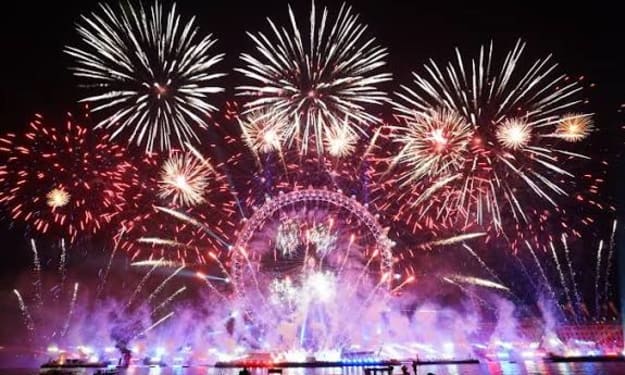
In an unusual request that has left the literary world buzzing, a prominent British poet expressed shock after being asked to contribute a poem to accompany London’s iconic New Year’s Eve fireworks display. While poetry and fireworks may seem like an unlikely pairing, the organizers of London’s world-famous spectacle hoped to add a new layer of meaning and reflection to the annual celebration. For the poet involved, however, the request proved both surprising and challenging, highlighting the intersection of art, public spectacle, and expectation. An Unexpected Invitation The poet, whose work has been celebrated for its introspective and reflective qualities, revealed that the invitation came out of the blue. “I was completely flabbergasted,” they said. “To think that my words could be part of a massive public event like the London fireworks—it’s thrilling, but also daunting.” The request involved composing a poem that could be read aloud just before the fireworks began, setting the tone for millions of viewers both in person along the Thames and watching through live broadcasts. Organizers reportedly wanted a piece that captured the essence of London, the passage of time, and the hope that comes with the arrival of a new year. While the themes may appear straightforward, translating them into a poem suitable for such a massive, public platform is no small feat. As the poet noted, “It’s one thing to write for readers in a quiet room. It’s another to write for thousands of people looking up at the sky, waiting for the pyrotechnics to begin.” Balancing Art with Spectacle This request highlights a broader question about the role of art in public celebrations. London’s New Year’s Eve fireworks have traditionally focused on visual spectacle, with music often accompanying the display. Adding poetry introduces an element of reflection and literary expression, encouraging viewers to pause and consider not just the fireworks but the ideas and emotions they evoke. The poet described the challenge as a balancing act. “You want to create something meaningful, something that resonates, but you also have to recognize that it’s just before a massive, loud display of fireworks,” they explained. “Your words have to land instantly, emotionally, because the visual spectacle is overwhelming.” This challenge reflects the broader difficulty artists often face when working in public spaces: their work must be accessible, immediate, and impactful while retaining depth and authenticity. The Pressure of Public Expectation Being asked to contribute to such a high-profile event comes with enormous pressure. The poet admitted feeling the weight of responsibility, noting that millions of people will hear the poem, and the stakes are high. “When you write for the page, you have the luxury of quiet reflection. Here, you’re competing with pyrotechnics, cheers, and cameras,” they said. “It’s thrilling, but it’s also nerve-wracking.” This moment also reflects how poetry continues to find new avenues for public engagement. From spoken word performances to interactive installations, poets are increasingly being called to contribute to events outside traditional literary spaces. The London fireworks request exemplifies this trend, illustrating how poetry can amplify emotions, create context, and transform a visual spectacle into a moment of collective reflection. Creative Freedom or Constrained Vision? While the invitation was an honor, the poet noted some constraints. “They wanted certain themes, certain emotions, and a length that could fit into the opening sequence,” they said. “It’s challenging to balance artistic freedom with practical requirements, but it’s also an opportunity to push your creativity in new directions.” For many poets, constraints like these can stimulate innovation, forcing them to think differently about rhythm, imagery, and narrative structure. The experience also raises questions about how public art is curated and who gets to shape collective experiences. Poetry, by nature, is subjective and personal, but in this context, it becomes part of a shared cultural moment, bridging private reflection and public celebration. Looking Forward As London prepares for its annual New Year’s Eve fireworks, all eyes will be on the Thames, anticipating the dazzling display. Behind the spectacle, however, will be a poet whose words aim to complement and deepen the experience. For viewers, it may be a reminder that fireworks are not just visual wonders but emotional and intellectual experiences, enriched by the power of language. The poet’s reaction—flabbergasted, humbled, and inspired—speaks to the ongoing relevance of poetry in contemporary life. Even in an age dominated by social media, lights, and screens, the written word retains the ability to surprise, move, and connect people in unexpected ways. London’s New Year’s Eve fireworks may never have been just a visual celebration; now, thanks to a poet’s touch, it promises to be a moment where the sky and the human imagination meet. Conclusion While the idea of combining poetry with fireworks may seem unusual, it underscores the enduring power of words to frame human experiences. As London’s crowds count down to midnight, the poem will offer a pause—a moment to reflect on the past year, anticipate the future, and experience the beauty of language alongside the thrill of pyrotechnics. For the poet, the request was flabbergasting, but for the city and its millions of spectators, it may become an unforgettable way to welcome the New Year.
By Fiazahmedbrohi 6 days ago in Geeks
Fair Exchange, No Robberies
Dark Memoirs - Index There are at least two kinds of people in the world: those who write this half-arsed kind of intro to a story that looks to separate the rare and the norm, and those who realise it's an overused framing device and don't.
By Paul Stewart6 days ago in Chapters



Comments
There are no comments for this story
Be the first to respond and start the conversation.