
Book Review: "Amusing Ourselves to Death" by Neil Postman
5/5 - a fantastic, in-depth analysis of just how we became so distracted and why it's so dangerous...

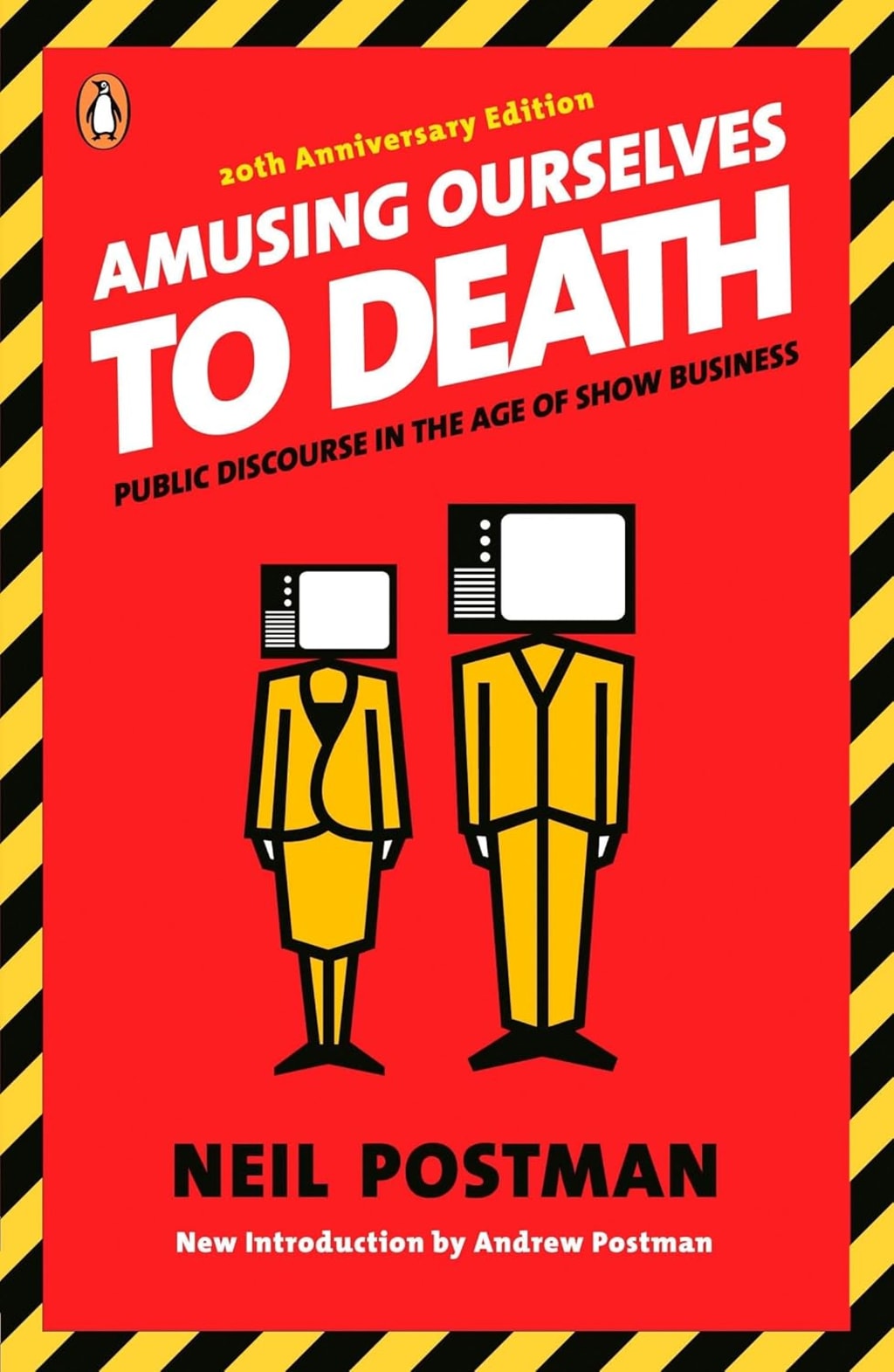
Neil Postman is an interesting author whom I'm reading quite a bit of lately mainly because I've been hearing about his books online. I first read his book Technopoly which deals with the fact that these massive companies have absolutely no regard for how their technology and market monopolisation will impact the average person. But Amusing Ourselves to Death is something far more sinister than this. I have been itching to read this book (yes, that is a thing that happens to me) and I spent some time compiling my thoughts into workable paragraphs so that you can understand as much of what is going on as possible. I would urge you to read this book for yourselves though, it is so important.
One of the main points is about how the form of communication matters as much as the idea being communicated. Every single medium imposes a way of thinking upon the person/people engaging with it. One of the mediums he deals with first is television. Television’s visual, fast-paced, emotionally driven structure favours amusement, brevity, and spectacle rather than actually dealing with the ideas at hand. One of the examples I have enjoyed over the times is the Lincoln-Douglas Debate in comparison to the Kennedy-Nixon debate. One was listened to and then read, the other was televised and then watched. Having read the Lincoln-Douglas Debate I can honestly say that I have born witness to some of the greatest linguistic technicalities ever written into a debate format. But the Kennedy-Nixon debate was lacklustre to say the least and the only goal was to make Nixon look bad - which is not very difficult to do at all considering the way the man was already. Therefore, as a result of television being the medium of consumption, institutions that once relied on rational discourse: politics, journalism, education, religion, are transformed into entertainment products. There is no way people are listening to Kennedy and Nixon talk for three hours on the television.
Neil Postman moves on to looking at typography and television noting that before television our mediums of entertainment and information were basically dominated by reading and writing. Print-based discourse encouraged linear reasoning, critical thinking, informed citizenship, and long-form arguments. Pamphlets would feature these complex arguments which the reader, who must have a proficiency for critical thinking, could follow along with and thus, make an informed and reasonable decision about what to do/believe next. Basically, people were accustomed to sustained reasoning which sometimes supported what they already believed and sometimes would challenge it entirely. It was normal for the average person to have their thoughts and beliefs challenged and changed by written documents and critical reasoning - producing a highly literate and intelligent culture of people. This is the foundation of democracy, argues Postman. What we have now though is...well, interesting but nonetheless, far less intelligent and literate.
Of course Neil Postman recognises the same pattern we do in the sense that we are controlled by our ability to distract ourselves. He refers to 1984 by George Orwell and Brave New World by Aldous Huxley - the two behemoths of dystopian fiction, to prove his point. Orwell argues that we are controlled by oppression whereas, Huxley argues it is by distraction and so, Postman leans into Huxley a little bit more. This is where I will say that it is probably a good idea to have a working knowledge of the philosophies expressed in Brave New World before you read this book or this entire idea is going to be alien to you. He argues that in a world flooded with entertainment, people do not rebel because they are too amused to care, and meaningful political discourse is drowned in noise. Tyranny will come forth not because we are oppressed, but because we are distracted. It is a scary thought that people are so addicted to entertainment that they completely miss the actual political discourse.

He also argues that television news reduces complex issues to superficial images, creating “pseudo-context” rather than genuine understanding. From making viewership a priority, in the new age the news and journalism often focuses on fast transitions between stories and sensational content over actual issues. It is something to be analysed about our culture. There is a huge difference between getting your news content from the TV show Loose Women to reading say The Financial Times. Stories appear disconnected, lacking depth or causality. The result is a stream of information that feels urgent but produces no real knowledge or action. Postman actually gets quite snarky about it in the fact he uses the phrase "Now...this" to describe how global disaster and celebrity gossip are placed side-by-side in equal weighting in the news even though one is clearly far more important than the other.
Then we have the point that politics becomes a form of show business, where image replaces substance and candidates are judged by charisma rather than ideas. The idea of a televised debate angers him in the sense that he can recognise that the leaders are basically judged on their charisma, their ability to speak and their ability to win over an audience rather than the fact that they would, or would not, change anything when in office. Therefore, televised debates become beauty contests, campaign ads focus on emotional manipulation, and slogans replace policies. The politicians become actors to an audience who wishes to be entertained rather than informed. I think Postman might be correct here but we can expand this even more to soundbites found on 'shorts' in which nobody is informed. 30-second videos without context of people talking make for great entertainment for people who can no longer focus on anything.
One point I really enjoyed reading about was the education system. Postman argues that education is distorted when schools adopt television’s entertainment model, leading to shorter attention spans and “Edutainment.” He warns that introducing television into classrooms weakens literacy and critical thinking. Educational programmes prioritise excitement over difficulty and visual stimulation over conceptual understanding. This is why the whole 'screens should be kept out of classrooms' rule is a great idea but it needs to be expanded to encompass projectors, smart boards and all of these things we don't need. A whiteboard and a pen is more than sufficient - a teacher should not just be gifting the answers when students do not know. Smart technology and projectors makes this all too much of a possibility.
Last point, I promise. But advertising has technically become the main point of cultural communication. They shape entire identities. Adverts rarely provide rational reasons to buy products. Instead, they sell lifestyles, fantasies, emotions, and identities. This, in turn, changes how people see themselves and begin to seek fulfillment through consumption rather than understanding. This, Postman states, has dire consequences and I think we are beginning to experience many of them.
I know this was a long review but this book is so good. It goes into real depth and wrestles with the idea that perhaps life wasn't ruined by social media but by the fact we became addicted to entertainment and distraction. Maybe the whole thing was by design in a hope that through this distraction, we would never notice the large corporations robbing us blind. The question is, how do we undo this after years of conditioning?
About the Creator
Annie Kapur
I am:
🙋🏽♀️ Annie
📚 Avid Reader
📝 Reviewer and Commentator
🎓 Post-Grad Millennial (M.A)
***
I have:
📖 280K+ reads on Vocal
🫶🏼 Love for reading & research
🦋/X @AnnieWithBooks
***
🏡 UK
Keep reading
More stories from Annie Kapur and writers in Geeks and other communities.
Book Review: "Unbound" by Richard L. Currier
You know how I love a good deal and so, I got this one on my phone again, on the cheap. Well, in reality I got it for free but that story is for another time. I'm not hugely into books that go so deep into anthropology that I can't really understand them philosophically speaking but I took my time with this one and it was pretty enjoyable. The book is actually well written, although at the beginning it was fairly hard to get into. However, even though I did feel like I was ploughing through it from time to time, I came out of it alive and pretty well-informed too. So, this book is getting some good marks.
By Annie Kapurabout a month ago in Geeks
Standing While Falling
Quotation from Friedrich Nietzsche "He who wrestles long with monsters should beware lest he himself become a monster. And if you gaze long into an abyss, the abyss also gazes into you. Man is not destroyed by suffering, but by the meaning he makes of it."
By LUCCIAN LAYTH4 days ago in Critique


Comments (1)
I book could be an eye opener for some for sure. His last name is so appropriate to the things he write about. Postman, or he use that pen name 🤔 intentionally?