
Book Review: "Being and Nothingness" by Jean-Paul Sartre
4/5 - Sartre's philosophy of existence...

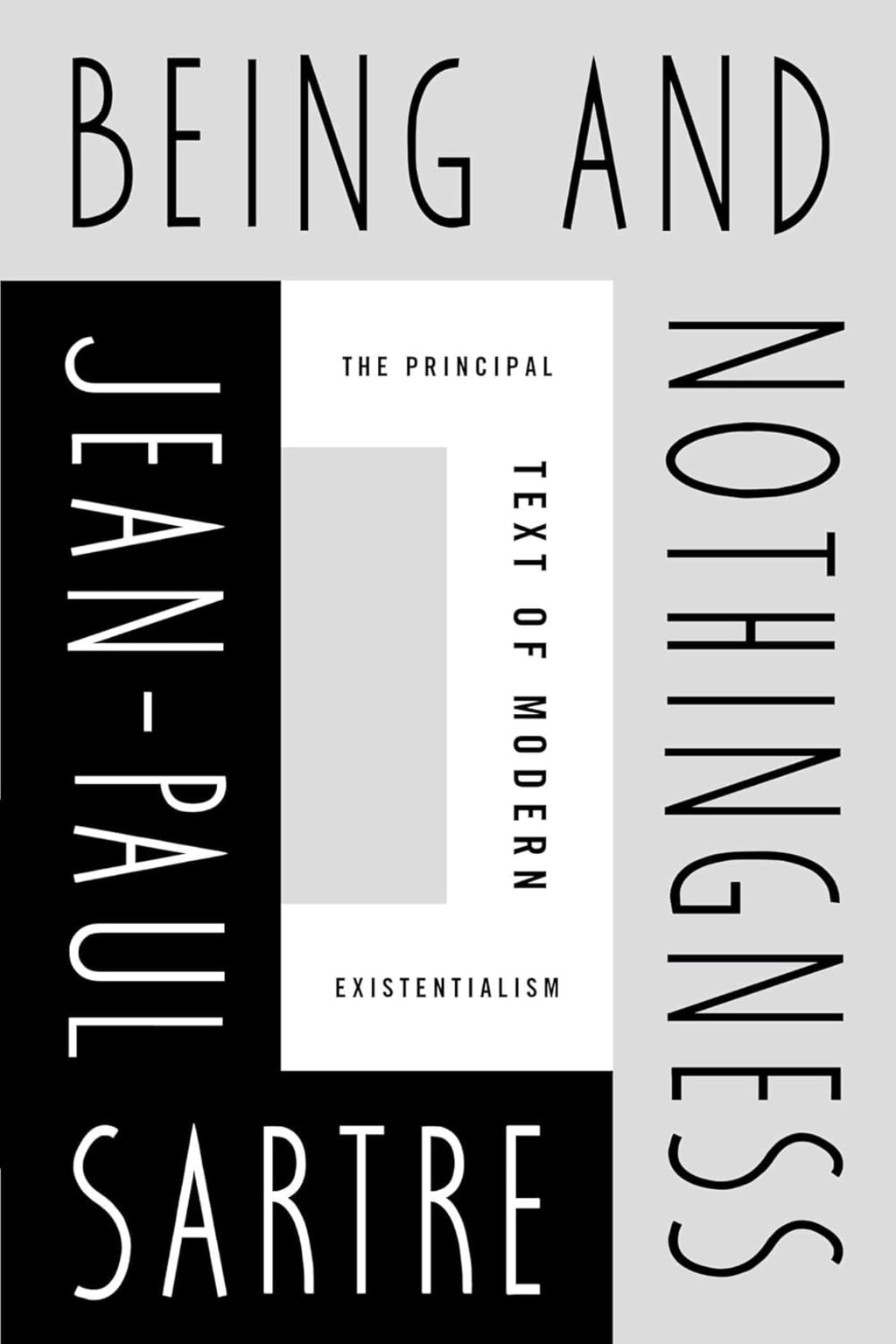
I've been meaning to read the whole thing for a long time. Back when I was studying my Master's Degree, I read about a chapter or so of this book and I'm not going to lie to you, though it was compelling, I didn't feel like I was understanding exactly what it had to offer in the way of deeper meaning. I struggled a little with the chapter and so, as I do, I thought I would wait a bit before tackling the whole book. I tried it a couple of days ago and honestly, I was surprised at how much I had to use secondary sources. It doesn't sound like me reading Sartre to use so many secondary sources to read the book but, here we go.
At the heart of Sartre's philosophy is the principle that existence precedes essence. Unlike objects or artifacts crafted with a specific purpose in mind, humans first exist and then, through their actions and decisions, define their essence or nature. This is something I can get behind. I mean, who can argue with existing first and then being of purpose second? Only those who believe you exist for someone else will predicate your existence upon how useful you can be to them.
Central to Sartre's existentialism is the notion of radical freedom. Humans possess the freedom to make their own choices, unbound by any predetermined essence or divine will. However, with this freedom comes an immense weight of responsibility. Every choice an individual makes contributes to defining their essence and, by extension, humanity as a whole.
This burden of responsibility can be daunting, leading many to experience existential angst or anxiety. Sartre argues that many people attempt to escape this anxiety through what he terms "bad faith" (mauvaise foi). Bad faith involves self-deception, where individuals deny their freedom and responsibility by conforming to societal roles and expectations. By doing so, they avoid the discomfort of confronting their radical freedom and the necessity to make authentic choices.

I understand this though I might not wholly agree with what it is suggesting. Radical freedom is a great idea until it puts society in danger and thus, it begins to collapse. Also, I believe that radical freedom is point of view. What one person believed was freedom in the 1940s is not necessarily the kind of freedom we think of today in 2024. Freedom is always predicated on social norms and so, in that respect, Sartre might be correct in his analysis.
Sartre introduces the concept of being-for-itself (être-pour-soi) to describe human consciousness. Being-for-itself is characterised by self-awareness and the capacity for reflection. It is dynamic, always in the process of becoming, as it constantly projects itself toward future possibilities. This contrasts with being-in-itself (être-en-soi), which refers to objects or things that exist in a fixed state without consciousness or the capacity for self-reflection. Being-in-itself is static and complete, while being-for-itself is fluid and incomplete, always striving toward some future state of being.
I'm not going to lie when I say that it took me three or four reads of the same few paragraphs to understand what was going on here. Sartre's concern with consciousness seems to be contradictory with those who believe he is a hard-lined nihilist even if he does accept the terminology himself. I think that the ideas he has regarding consciousness could be better explained if I'm being perfectly honest. Sometimes it is convoluted for the sake of being convoluted.
The one idea that I perhaps think I most agree with in the text is 'the look'. This is where Sartre explores how the presence of others influences self-perception. When someone else looks at us, we become acutely aware of being seen as an object in their world. This can lead to feelings of alienation and objectification, as our subjectivity is threatened by the gaze of the other. The look makes us conscious of our facticity—the aspects of our existence that are given and cannot be changed—while simultaneously reminding us of our freedom to transcend these facts through our choices.
The idea of objectification is probably best understood by women since we experience it so often. 'The look' is analysing the fact that when someone looks at us in a certain way, we understand what it is to be an object in the world, to not be regarded for our consciousness, to not feel even remotely human. The alienation happens when this happens for prolonged periouds of time and thus, the things that make us human aren't only threatened but they are reduced to being almost nothing since the other person is not seeing us as a human being.

The one idea I cannot get behind is 'living authentically'. Living authentically, according to Sartre, involves acknowledging and embracing one's freedom and responsibility. Authentic living means acting in accordance with one's true self, rather than succumbing to external pressures and societal expectations. It requires individuals to confront the reality of their freedom and to make choices that are genuinely their own. Authenticity is the antidote to bad faith, as it entails a conscious effort to live in a manner that is true to one's own values and aspirations.
This sounds like something I will read on Instagram if I were to reinstate my account. 'Living authentically' means very little in the real world as many of us are simply trying to get by and do not give less of a s*** about whether it is 'authentic' or not. I'm not going to lie, it's one of those ideas I simply find laughable.
I'm going to stop there because this might get a bit long. All in all, even though there are many more ideas in the book, these are the ones that stood out quite a bit to me. I hope you choose to read this book too because though it is difficult, it is definitely worth it.
About the Creator
Annie Kapur
I am:
🙋🏽♀️ Annie
📚 Avid Reader
📝 Reviewer and Commentator
🎓 Post-Grad Millennial (M.A)
***
I have:
📖 280K+ reads on Vocal
🫶🏼 Love for reading & research
🦋/X @AnnieWithBooks
***
🏡 UK
Keep reading
More stories from Annie Kapur and writers in Geeks and other communities.
Book Review: "Angela Carter's Book of Wayward Girls and Wicked Women" by Angela Carter et al
Angela Carter is one of the great writers of the 20th century whom I believe, is highly underrated. Someone I used to work with noted that 'The Bloody Chamber' was her favourite book of all time and honestly, though it is not mine, I can definitely understand why. Known for her rich, descriptive prose and feminist themes alongside her folklorish concepts, Angela Carter is perhaps best known for her works on fairy tale-based horror. Whilst she lived in Japan, she was influenced to write her dark 'The Infernal Desire Machines of Doctor Hoffman' and ultimately, she would write another set of stories called 'Wise Children'.
By Annie Kapurabout a year ago in Geeks
Marvel Zombie
The last entry into our 2025 superhero projects catalogue is Marvel Zombies. This was a show that was anticipated by absolutely no one and it disappeared from the public consciousness as quickly as it was released. There was nothing special about the project that made it a must see, or a must remember. In fact if anything it's a must forget.
By Alexandrea Callaghan26 days ago in Geeks
How to Watch Super Bowl?
Super Bowl, one of the most exciting sporting nights of the year, is now less than a month away and the excitement is already palpable. Scheduled on February 8, 2026 at Levi’s Stadium in Santa Clara, California, this will be the third Super Bowl held in the San Francisco Bay Area.
By David Cook2 days ago in Geeks




Comments
There are no comments for this story
Be the first to respond and start the conversation.