
Book Review: "As I Walked Out One Midsummer Morning" by Laurie Lee
5/5 - poetic, political, philosophical...Laurie Lee opens his eyes wide open to the Spanish Civil War...

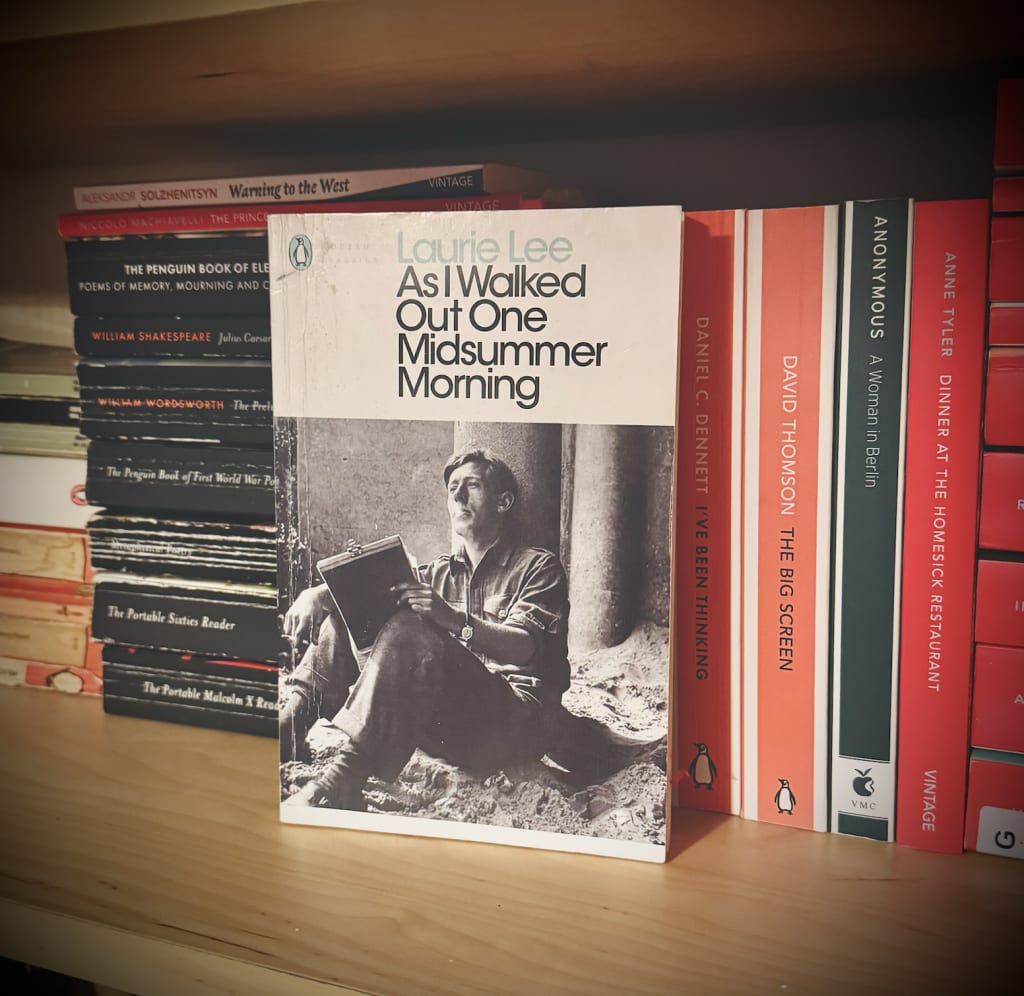
Cider with Rosie I admit, did not move me too much - though I have to admit it was good. But when it comes to sequels I have to say that As I Walked Out One Midsummer Morning is probably one of the better examples of one. It is a testament to travel and self-discovery and of course, I read books like this because I hate travelling and self-discovery is something of a side-note for me. I prefer to read about other people who take trips to find themselves philosophically, however unbelievable I think it would be to actually do in real life unless you ran into something like a war-zone and saw someone die (see: Orlando). Let's take a look at what makes this book extra special...
In 1934, we get the memoir open with our narrator leaving his home in Gloucestershire with a violin and a few coins. I was quite astounded he left with so little yet, it was a great image of the unpredictability of things to come. You'll probably notice if you've read it, this book pretty much picks up from where Cider with Rosie left off. We get this feeling of displacement though in which the narrator is getting restless and so, he leaves home to embark on the trundle towards adulthood. It's quite an opening and this is of course, where we get the title from because the morning he leaves is one in 'midsummer'.
He earns his food and shelter by playing his violin in public spaces. There's this energy in the capital that feels as though it is both a behemoth of anonymity whilst also maintaining the illusion that everyone is somebody somewhere here. He finds casual work as a labourer on building sites, often looking upon and commenting on the depression era. He notices the class divides between the rich and poor in London. The high rates of unemployment and the poverty in the industrial metropolis, he states, seems to be a far cry from where he came from - Gloucestershire, with its idyllic countrysides and rural beauty. I was surprised that he was able to keep going so well even though he was in a place that was basically the exact opposite of where he came from.
Our narrator leads a modest life on his wage, but is still adventurous in his heart and mind - he hangs around with bohemians and plays his violin on the streets. He starts to understand the low-level attachment of the working class, seeing things through their eyes of survival rather than the grasp of the middle class and aristocracy. His violin becomes both his livelihood and his passport to human connection. He also falls in love with Celia, a young woman whose kindness and spirit introduce him to love’s first tenderness, though their relationship is fleeting. I have to say that listening to the song Casual by Chappell Roan really helps when you're trying to get yourself immersed in these parts. Yes, that's what I was doing.
Laurie Lee walks to Spain on impulse and lands in Vigo, on the northwestern coast. He arrives only knowing only one Spanish phrase: “¿Puedo tener un vaso de agua?” (“Can I have a glass of water?”). Undeterred, he sets off walking across the country, relying on his violin and the generosity of strangers. His musical talent earns him food, shelter, and friendship, and his gentle nature opens doors in villages that have rarely seen foreigners. Honestly, every book which features Spanish people in the 30s is fantastic - they're always so spirited, cultured and incredible, I think that just might be a feature of being Spanish-blooded. There isn't a person alive that hasn't fallen in love with the literary impact of the Spanish and their descendent countries.
Of course, political unrest is stirring but as he travels across places like Castile, Galicia, and Andalusia, he becomes enchanted by Spain’s sun-drenched landscapes, its passionate people, and its blend of beauty and hardship. The poetic language really comes out here: everyone from the people entering a cafe to those who beg on the streets become portraits of poetry and adoration, a fascination written into the story by Laurie Lee as he plays observer. The Spain Lee travels through is impoverished but generous. He experiences the hospitality of villagers who share their last crust of bread with a stranger. His reflections on poverty are tender rather than judgmental; he sees dignity and humanity in those who have little.
When he gets to Seville, conversations in cafés turn to fascism, socialism, and rebellion. Political unrest is no longer stirring, it is in full-force and things are changing. The whole country teeters on the brink of oblivion as Laurie Lee, formerly not very much 'into' politics, must come to his senses quickly before he is swept up into this growing storm. It isn't long before his life is in serious danger. The Spanish Civil War is underway, it's 1936 and there's no ignoring it now...
I thought this book was fantastic and much better than its predecessor. Laurie Lee writes with a poetic almost sentimental air, heavily descriptive and his internal thoughts litter the narrative like a constant philosophical commentary. He grows, changes his opinion and moves through Spain with open eyes that, if he hadn't have gone to London I don't think he would've had wide open enough to see the political turmoil approaching. This has genuinely been a great experience of reading.
About the Creator
Annie Kapur
I am:
🙋🏽♀️ Annie
📚 Avid Reader
📝 Reviewer and Commentator
🎓 Post-Grad Millennial (M.A)
***
I have:
📖 280K+ reads on Vocal
🫶🏼 Love for reading & research
🦋/X @AnnieWithBooks
***
🏡 UK
Keep reading
More stories from Annie Kapur and writers in Geeks and other communities.
Book Review: "Scotland Yard: A Bloody History" by Simon Read
How do I explain this? I was bored and got a book on my phone again! This book, entitled Scotland Yard: A Bloody History, gives us a history of one of the most famed institutions in Britain in various crimes that are gruesome to say the least. But, from ignoring a letter concerning how to do fingerprinting some decades before fingerprinting would be a method to solving crimes all the way to crimes that were probably on par of that of Jack the Ripper in terms of horror - this book holds no punches. It gives us a fun, intriguing and yet, informative narrative about the birth of a police system which not only has its successes but also its drawbacks.
By Annie Kapur2 months ago in Geeks
Silver Screen Magic with Mae West
American actress and singer Mae West became a popular film actress during the Great Depression. She started entertaining in vaudeville, then performed on Broadway, and finally went to Hollywood. She signed up with Paramount Pictures and made her debut in the 1932 film “Night After Night.” She also starred in musicals, comedies, and crime dramas. The American Film Institute named her one of the best classic Hollywood actresses.
By Rasma Raisters5 days ago in Geeks



Comments
There are no comments for this story
Be the first to respond and start the conversation.