
Book Review: "Are You Mad at Me?" by Meg Josephson
5/5 - insightful and fantastic...I have learnt so much about 'fawning'...

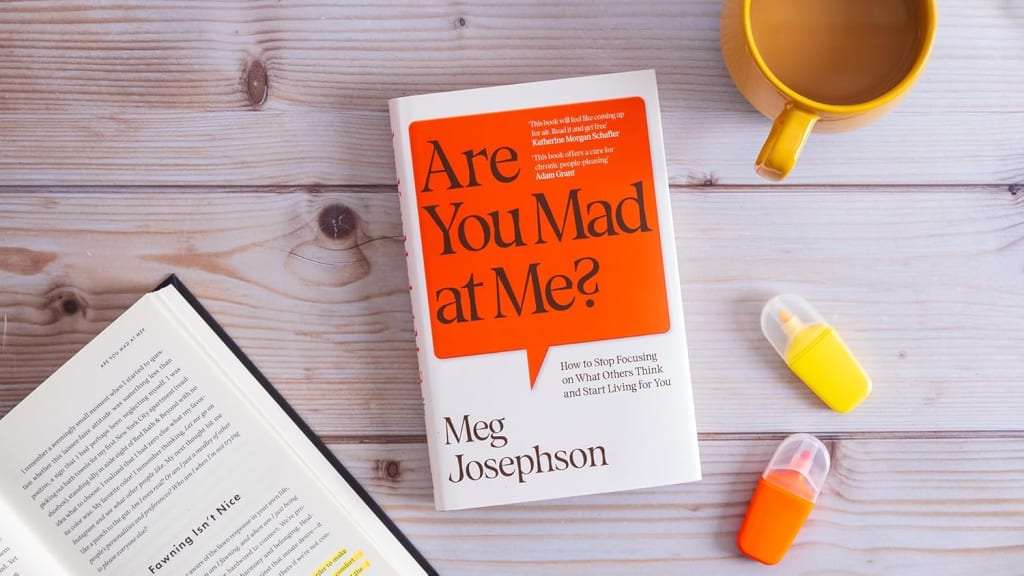
There's not much of a story behind this one. I found it whilst scrolling on Twitter and then noticed that it was quite pricey on Amazon. I searched around and found it on the internet for a lower price, snagged it and read it on my phone. Meg Josephson's book is about a number of things, but one of the main concepts that is covered is that how trauma changes fundamentally who we are and how we interact with people and our lives. There's so many books on how to 'get better' but not many books that explain what to 'get better' from. It was definitely an interesting read...
One of the main concepts she wants the reader to understand is that 'people-pleasing' is not a moral failure but rather a trauma response where the person tries to disarm a situation by doing something called "fawning". This is where the person becomes extremely conflict-avoidant. Once this person grows up having to have managed the emotions of particularly volatile adults in their life by disarming situations, they carry that over and end up burning themselves out over the emotions of others. This is not only bad for the individual doing the fawning, but it also leaves them open to emotional manipulation. When I was looking up the statistics for people who are emotionally manipulated and simply believe that they are doing the right thing, I found thousands upon thousands of stories.
Obviously though, not everyone knows what fawning is and so, Meg Josephson does a brilliant job at telling us not only the definition of the word but what the archetypes and behaviours of this concept seem to be. Fawning is a survival mechanism presented in childhood to avoid conflict situations with unpredictable adult figures. This can include being silent when the adult is volatile and being overtly helpful if the adult presents outwardly violent disappointment. This leads to anxieties such as: internalising hyper conflict-avoidance, obsessive behaviours and repeated beliefs that people are mad at you as you get older and older.
Josephson then looks at this fawning behaviour in individual who are: peacekeepers, performers, caretakers, perfectionists, chameleons and finally, lone wolves. Fawning presents in different ways in all of these individuals but they all have one or two main things in common: conflict-avoidance and people-pleasing. After this, the author gives us one of the main ways the reader (if they are one of these fawners) can cope with being this way. The technique is called NICER and it stands for: Notice, Invite, Curiosity, Embrace, Return. It is meant to help the person recovering to navigate overwhelming emotions and thoughts, especially if they become obsessive.
One thing I enjoyed about this is the Josephson does not shy away from the link between mental wellbeing and physical wellbeing, sharing her experiences of difficulties in recovering from fawning behaviour and how they caused things like acid reflux and burnout. It is definitely true that these behaviours can cause things like autoimmune responses to kick in and a development of lots of conditions typically associated with exhaustion.
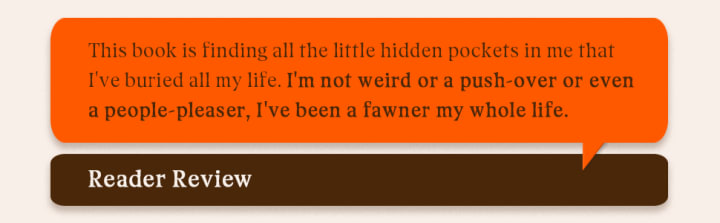
Another thing I found key about this book is the way the author decentralises herself whilst also providing her own story. She doesn't overshare anything and nearly everything she tells us is part and parcel to the process. Her writing is compassionate and caring whilst also providing a great insight into the steps and ways in which a person fawning and raised in difficult emotional circumstances can recover. It is quite refreshing to read one of these books and not be bogged down by someone's life story, some parts of which don't even add to the narrative they are trying to write.
All in all, I thought this book was very helpful, insightful and just a plain fantastic read. I have learnt so much about fawning, what it is, how to see it in different ways and most importantly, how 'people pleasing' is a response rather than a personality trait. Maybe we should all look out for these behaviours in others, even though there are many out there who would exploit these kinds of people and manipulate them. It would be great if we could all simply help each other to become better people with stronger personal boundaries.
About the Creator
Annie Kapur
I am:
🙋🏽♀️ Annie
📚 Avid Reader
📝 Reviewer and Commentator
🎓 Post-Grad Millennial (M.A)
***
I have:
📖 280K+ reads on Vocal
🫶🏼 Love for reading & research
🦋/X @AnnieWithBooks
***
🏡 UK
Keep reading
More stories from Annie Kapur and writers in Geeks and other communities.
I Was Thinking About Quitting Vocal...
I have to admit it, there was once in the very recent past where I was thinking about quitting the platform altogether. A couple of years ago, I went on a year-long hiatus from Vocal and my account dormantly made a couple of hundred pound. But, I was actually thinking about shutting down my account and leaving the platform a few weeks' ago and there were a few things I had to reason with. There were a few points I actively had to convince myself were not really reasons at all to quit the platform.
By Annie Kapur5 months ago in Geeks
Silver Screen Magic with Mae West
American actress and singer Mae West became a popular film actress during the Great Depression. She started entertaining in vaudeville, then performed on Broadway, and finally went to Hollywood. She signed up with Paramount Pictures and made her debut in the 1932 film “Night After Night.” She also starred in musicals, comedies, and crime dramas. The American Film Institute named her one of the best classic Hollywood actresses.
By Rasma Raisters8 days ago in Geeks
Freezing Rain and Ice Disrupt Travel Across Central and Eastern Europe
Dangerous winter weather brings chaos to roads, rails, and airports as authorities urge caution A powerful wave of freezing rain and ice storms has swept across large parts of central and eastern Europe, bringing daily life to a near standstill and creating hazardous travel conditions for millions. From Germany and Austria to Poland, the Czech Republic, and parts of the Balkans, ice-coated roads, grounded flights, and disrupted rail services have turned routine journeys into dangerous ordeals. Meteorologists warn that freezing rain — one of the most treacherous winter weather phenomena — poses a greater risk than snowfall because it creates an invisible glaze of ice that is nearly impossible to detect until it is too late. What Is Freezing Rain and Why Is It So Dangerous? Freezing rain occurs when rain falls through a layer of warm air and then passes into sub-zero temperatures near the ground. Instead of freezing mid-air like snow, the rain remains liquid until it hits a cold surface, where it instantly turns to ice. The result is black ice — a thin, transparent layer that covers roads, sidewalks, power lines, aircraft wings, and railway tracks. Unlike snow, it offers no traction and is extremely difficult to remove. Experts describe freezing rain as one of winter’s most dangerous hazards, capable of crippling transport networks within hours. Travel Chaos Across the Region Across central and eastern Europe, the effects have been swift and severe. Major highways have reported multi-vehicle accidents, while local roads have become impassable in rural and mountainous areas. In several countries, authorities temporarily closed sections of motorways after trucks jackknifed on ice-slick surfaces. Rail networks were also hit hard. Ice accumulation on overhead lines caused power failures and signal disruptions, forcing trains to run at reduced speeds or be canceled altogether. Thousands of passengers were stranded at stations as operators struggled to keep services running safely. Air travel faced similar challenges. Airports in Germany, Poland, and the Czech Republic reported delays and cancellations as aircraft required repeated de-icing. Even a thin layer of ice can dramatically affect an aircraft’s lift, making safety checks essential but time-consuming. Emergency Services Under Pressure Emergency responders across the region were stretched thin as calls surged. Ambulances struggled to reach patients on icy streets, while fire brigades responded to accidents, fallen trees, and damaged power lines. Hospitals also reported a rise in slip-and-fall injuries, particularly among older residents. Broken bones, head injuries, and hypothermia cases increased as people attempted to navigate frozen sidewalks. Authorities urged residents to avoid non-essential travel and to remain indoors whenever possible. Power Outages and Infrastructure Damage Beyond transport, the ice storm also affected energy infrastructure. Ice-laden power lines sagged and snapped under the weight, leading to localized power outages in several regions. In rural areas, repair crews faced dangerous conditions as they worked to restore electricity. Icy roads slowed response times, leaving some communities without power for extended periods during freezing temperatures. Telecommunications networks also experienced disruptions, further complicating emergency response efforts. Economic Impact and Business Disruptions The freezing rain has had an immediate economic impact. Delivery services were delayed, factories reduced shifts due to staff shortages, and retailers reported lower foot traffic as customers stayed home. Logistics companies warned that prolonged icy conditions could disrupt supply chains, particularly for food and medical supplies that rely on just-in-time delivery systems. Tourism was also affected, with winter destinations reporting canceled bookings and delayed arrivals, even as ski resorts benefited from colder temperatures at higher elevations. Climate Change and Extreme Winter Weather Scientists point out that climate change may be contributing to more frequent freezing rain events. As winters become warmer overall, temperatures often hover around the freezing point — the exact conditions needed for freezing rain. This creates a paradox where regions experience fewer snowstorms but more ice storms, which can be far more destructive. Climatologists warn that infrastructure across Europe was largely designed for snow, not prolonged ice events, leaving cities vulnerable as weather patterns evolve. Authorities Urge Vigilance Governments and meteorological agencies issued repeated warnings, advising drivers to reduce speed, increase braking distance, and equip vehicles with winter tires and emergency kits. Pedestrians were encouraged to wear non-slip footwear and use handrails whenever possible. Schools in several areas shifted to remote learning to reduce travel risks. Officials emphasized that patience and caution save lives, reminding citizens that even experienced drivers cannot control a vehicle on black ice. Looking Ahead Forecasts suggest that temperatures may gradually rise in some areas, easing icy conditions, while others could face additional freezing rain before the system moves on. Cleanup and repairs are expected to continue for days, even after the weather improves. The freezing rain sweeping across central and eastern Europe serves as a stark reminder that winter’s most dangerous storms are not always the most visible. As climate patterns continue to change, authorities and citizens alike may need to rethink how they prepare for — and respond to — ice, not just snow.
By Fiaz Ahmed Brohi7 days ago in Geeks


Comments (1)
Gosh this book is written about me. I've not heard the term fawning before but it helped me understand myself better