
Book Review: "An Immigrant's Love Letter to the West" by Konstantin Kisin
3.5/5 - Kisin constantly toes the line between absolutely brilliant and downright annoying...

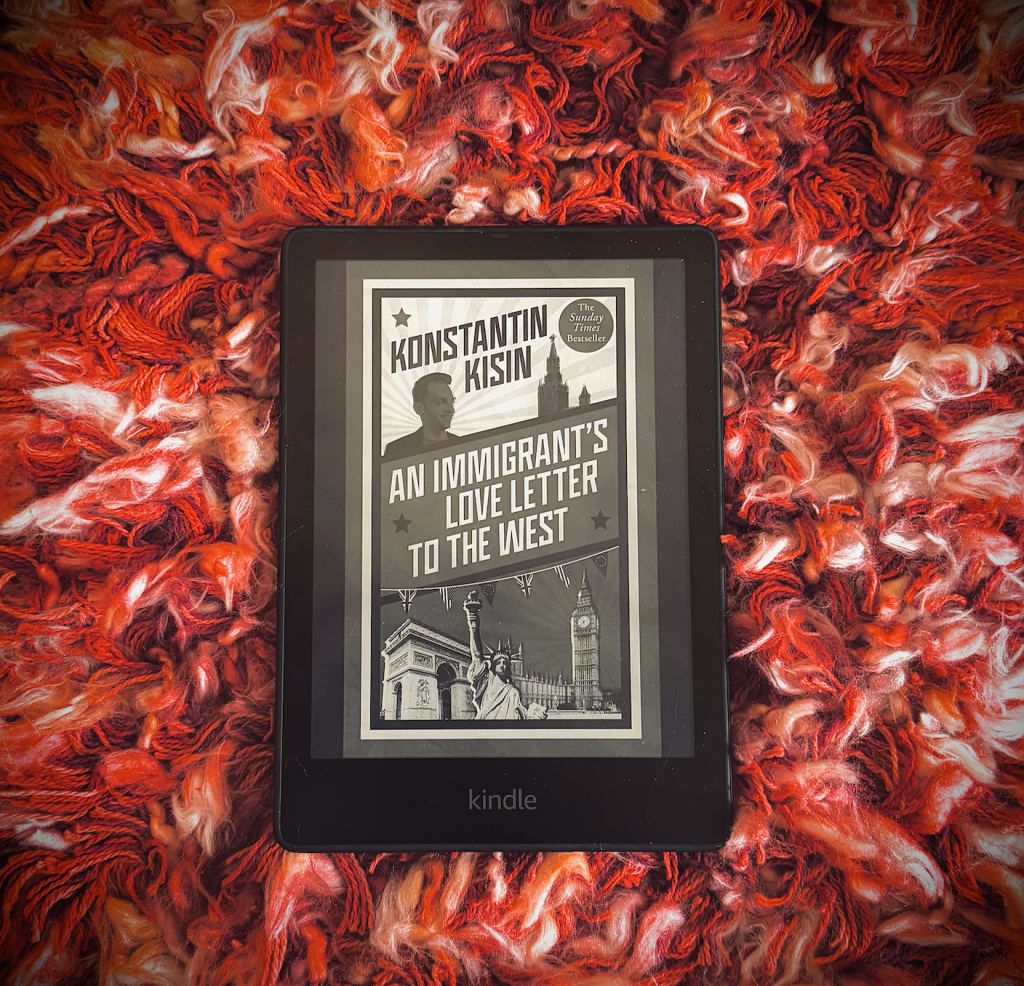
"The history of humanity is a series of unopened tombs which hold not only stories of our past, but also stark warnings about our future"
- "An Immigrant's Love Letter to the West" by Konstantin Kisin
There's no TL;DR. Read the whole thing or move on.
Welcome back to another book review! It's April 2025 and I really don't want you to make any snarky comments about why I'm reading this book - everyone is entitled to an opinion even if you don't like it. In the last six months, I have been listening to this guy's podcast and honestly, I have to say it's pretty good. I decided after a lengthy amount of back and forth in my head, to read this book. Initially, I was going to listen to the audiobook, but I found out Kisin narrated it himself and quickly left that idea alone. I can stand his voice for a podcast - but probably not an entire audiobook. What starts off as a mixture between a warning from history and some comedic fun turns into fairly annoying quips and still, some very interesting stuff about the Soviet Union.
The book begins with a short prologue about why Kisin thinks that these people who complain about the state of the west are wrong and how much he believes in progress. I find he is trying to quell certain statements regarding how conservative he is or is not that have been floating about online, but that's for another time. The prologue possibly has some of the best language in the whole book (which is where the quotation above is taken from as well) where Kisin instructs us to learn from history as tombs are still to be opened.
The first chapter and even to some extent, the second and third chapters are about how great the western world is whilst investigating what the west are getting themselves into when they start to police what people can or cannot say, do and think - especially on the left of the political stratosphere. Kisin gives us some insight about this through Soviet History which often includes his own family. In this terrifying paradigm we see Kisin's ancestors in gulags and as slaves in various countries. Honestly, it is great to see he feels so strongly about saving the western world from the mistakes made by 20th Century Russia.
He gives us perspective on people like Marx and Engels who though both stated that they supported the rise of the working class, were both thoroughly middle class and Engels even had people working under appalling conditions for him. He compares this to how Bernie Sanders is also the same kind of hypocrite and makes some quippy remarks about Michael Mann and pie. I'm only going to say this once as I feel it might get very boring if I repeat this over the course of the review. The quips are fine for the first few chapters and even give us perspective on Kisin's upbringing where he makes fun of himself (especially as a child in England without his parents who is unable to speak English). However, when you're halfway through the book - they can (but aren't always) become very annoying. I will tolerate them for the sake of this review.
I think that when Kisin discusses racism he does so in a way that might be a little one-sided in terms of the studies and the people he references. However, he still makes a good argument about how young Black boys are often coached in what to do in a situation where a policeman or policewoman stops them. This is something passed down from their parents as their parents are old enough to be a part of that world where that happened more to them than it did to White people. Kisin seems to ignore that but addresses the statistics of White people being more likely to suffer under police brutality than Black people are. It's a little confusing as a point and the writing tends to be more all over the place than the rest of the book. It can be seen that perhaps Kisin is a little out of his depths here. It really is not written as well as his chapters concerning the Soviet Union and why the west needs to stop moving in that direction.
There is a whole chapter which I thought was rather interesting, on free speech. This is where Kisin takes apart the argument that millennial liberals are out to make the world a virtuous place and instead leads on the path that they are policing speech because it feels good to tell people what to do. The argument that free speech isn't free when you can be fired for saying hurty words has been around since before the millennials and yet, we still as a generation, get blamed anyway. This is actually fair. But then Kisin goes on a wild tangent about the cancelling of himself from a stand-up gig and the cancelling of the man who wrote How to Lose Friends and Alienate People. I think everyone saw the point a long time ago, but it is still entertaining to see him recount such things.
I have a bit of an issue with the chapter on How Language is Used to Conceal the Truth as it states that the term 'diversity' has been used to place one person above another by race, gender etc. which is technically correct. But when he states that nobody is calling for men in primary school teaching roles I think he might want to read multiple newspaper sources over the last decade which spend at least once every few months crying about it. It's just an incorrect analysis, sorry Kisin. I do however, enjoy his argument that the word 'liberal' relates more now to middle-class "trust fund revolutionaries" than it does to those who actually want social openness and change. That is so hilarious it is actually true.
Chapter 6 starts with Kisin telling us a story about a Russian journalist who was shot dead for being a journalist. Again, when he talks about the line between the state of the west and the state of authoritarian Russia, you can tell he has definitely done his research. He goes through how it compares regarding the Covid-19 Pandemic and this is actually some pretty good stuff. I won't argue with it. His next point where he highlights the wrongs of capitalism but strongly devotes his argument to stating there are more positives than negatives to it might be a little askew after talking about the pandemic but hey, it's his book not mine. I do like however, that he addresses the problem of the rental market by using one of my favourite books on the topic of social inequality: The Spirit Level. A fantastic insight that I love to see referenced.
The yawning of the next point is that the chapter on comedy has a much less impressive reference: Medium. How did we go from referencing a book which forms the basis of research on 21st century social inequality to referencing an article on Medium? I'm actually just sitting here furrowing my brow in discontent. Now, I don't really find very much comedy funny myself and I'm not much of a laughing person. But it seems to me that whilst Kisin is complaining about cancelled comics, he has already mentioned Charlie Brooker (who, if you have watched Black Mirror, has not been cancelled) and has not mentioned Jimmy Carr (an extremely offensive comedian who has his own Netflix Specials). There are many offensive comedians in the mainstream. I'm not taking this chapter seriously. Kisin's argument is going nowhere.
Kisin's arguments deteriorate with his comedy but come back alive with his stance on quality immigration (I am not sure about how 'quality' he thinks of himself in this argument but hey, I'm not one to judge). But, constantly having to defend himself from the right-wing toe line by forcing some 'but I also like this...' seems to be a constant in this book. I know I've gone on for a long time but I really wanted to make my point on this one. I don't dislike Konstantin Kisin by any means - I actually really enjoy his podcast and many of his arguments are quite insightful.
But let's be clear, this book has its polished points which are incredible and have such brilliant depth.
It also has its issues.
About the Creator
Annie Kapur
I am:
🙋🏽♀️ Annie
📚 Avid Reader
📝 Reviewer and Commentator
🎓 Post-Grad Millennial (M.A)
***
I have:
📖 280K+ reads on Vocal
🫶🏼 Love for reading & research
🦋/X @AnnieWithBooks
***
🏡 UK
Keep reading
More stories from Annie Kapur and writers in Geeks and other communities.
Book Review: "Three Burials" by Anders Lustgarten
It's late March 2025 and my mental health has been here and there. I've had stints where a lot of my hair has fallen out and others where I no longer get hungry enough to eat dinner in the evening. Be that as it may, I still find a joy in reading books and writing about them. This is probably one of the few joys in my life at this point and I really did want to share this important book with you. I didn't expect it to be this way at all and now that I've read it - ist seems a lot better than just its blurb. Let's explore Three Burials by Anders Lustgarten.
By Annie Kapur8 months ago in Geeks
Silver Screen Magic with Mae West
American actress and singer Mae West became a popular film actress during the Great Depression. She started entertaining in vaudeville, then performed on Broadway, and finally went to Hollywood. She signed up with Paramount Pictures and made her debut in the 1932 film “Night After Night.” She also starred in musicals, comedies, and crime dramas. The American Film Institute named her one of the best classic Hollywood actresses.
By Rasma Raisters6 days ago in Geeks
When Sweetness Turns Sour: A Review of Saccharine
Some films announce their intentions loudly. Others whisper, smile politely, and then leave a strange aftertaste long after the credits roll. Saccharine belongs firmly in the second category. With a title that suggests artificial sweetness, the film uses that expectation as a quiet trap, drawing the viewer into a story that is far more unsettling, reflective, and emotionally ambiguous than its name implies.
By David Cook3 days ago in Geeks



Comments
There are no comments for this story
Be the first to respond and start the conversation.