
Book Review: "A New World Begins" by Jeremy D. Popkin
5/5 - the background to one of the most volatile times in western history...


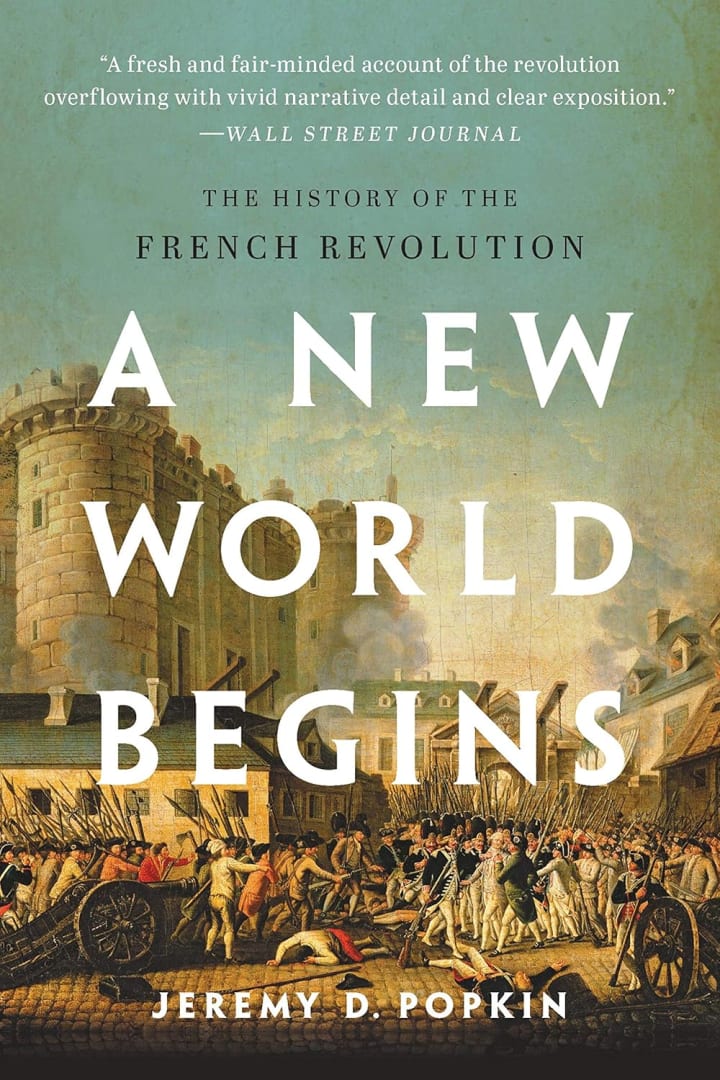
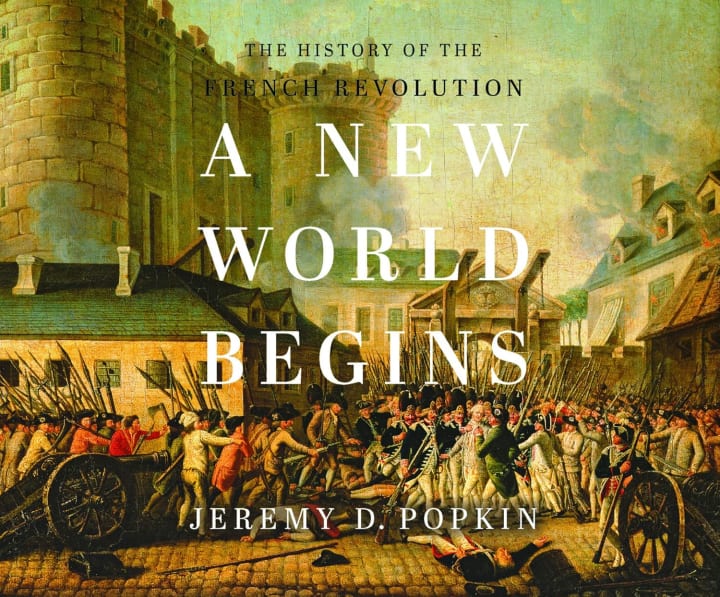
Full Title = A New World Begins: The History of the French Revolution by Jeremy D. Popkin
As you can see, I have made the 18th Century political atmosphere of France my entire personality for the moment being. I tend to have these weird hyperfixations on nonfiction literature in which I disappear down rabbit holes and, if you've been following when I write about nonfiction, you would have probably already realised. Jeremy D. Popkin's book on the French Revolution is one of the books I have read during this binge-read at the moment and I thought it was a fascinating look at the different perspectives on the war, what caused it, the people involved and the economic atmosphere.
The French Revolution was fueled by Enlightenment thinkers such as Rousseau, Voltaire, and Montesquieu, who challenged traditional authority, promoted individual rights, and criticised societal injustices. Popkin explores how their ideas fostered a climate of intellectual skepticism, inspiring the Third Estate to seek political change and demand accountability from their rulers.
Enlightenment philosophy gave revolutionaries a foundation for envisioning a society built on equality, justice, and rational governance. I think that anyone who has read on the Revolution probably knows this already, but it does well to be reminded that this war period did not spring up just from the hatred of the monarchy - it was bubbling economically, in religious cynicism and within the political climates for years and years before 1789.
The financial strain on France, primarily due to debt from military endeavors like the American Revolution, intensified social unrest and highlighted systemic flaws in the monarchy. Popkin details how widespread poverty, rising bread prices, and poor harvests led to starvation and anger among common people. This economic instability rendered reforms imperative, and when King Louis XVI failed to address the crisis effectively, it led to an erosion of faith in the monarchy and a push toward radical change. And though this is the case, again - it is not the only factor. The Enlightenment was one of the key factors that got the ball rolling, and we know by now that it takes a whole perfect storm to create something as violent as the French Revolution. The financial crisis was one of the pieces in a puzzle that was about to overflow and explode into a million pieces.
With censorship relaxing, revolutionary ideas could spread more freely through an increasingly literate public. Popkin highlights how pamphlets, newspapers, and public assemblies became vital tools for disseminating political ideas, allowing common citizens access to political debates and news. This increase in public discourse empowered individuals across France to engage with revolutionary ideals, thereby broadening participation in the revolutionary movement and mobilizing citizens into active supporters of radical change.
We know about Jean-Paul Marat's famous volatile newspaper criticising the monarchy. So what we have now is Enlightenment philosophies creating an intelligentsia that people listen to, financial strain where common people have nothing, the success of the American Revolution showing it is possible and the newspapers that criticise the regime. We can see it building and building towards something that will eventually boil over.
The decline of monarchical authority allowed local political bodies, such as communes and revolutionary committees, to gain unprecedented influence. Popkin argues that these localised governing structures and political clubs nurtured a participatory form of democracy that prefigured modern civic engagement. This decentralisation fostered public involvement in governance and increased accountability, as local assemblies allowed citizens to engage directly with revolutionary ideals and affect change in their communities. Here's where the building we spoke about in the last paragraph starts to gain access to real life. This will obviously move towards what is known as the 'Tennis Court Oath' as seen in a beautifully romanesque artwork by Jacques-Louis David.
While the Declaration of the Rights of Man and Citizen professed universal human rights, these rights were limited, particularly concerning women, enslaved people, and non-property-owning men. Popkin discusses the struggles of marginalised groups, especially in the colonies, where enslaved people in Saint-Domingue (modern-day Haiti) revolted for their freedom. This contradiction between revolutionary ideals and their selective application reveals a complex legacy, highlighting how the Revolution sparked broader debates about equality and inclusion. And though this is a good point to make, I think that it doesn't really contribute to the ideals that led to the revolution itself in France. Though, it was the centre of the revolutions that came later against the French in the colonies.
Despite its turmoil and contradictions, Popkin argues that the Revolution established foundational principles for modern democratic systems. The notions of citizenship, human rights, and civic responsibility that emerged from the Revolution have had an enduring influence on subsequent revolutions and political systems worldwide. Popkin examines how revolutionary France, despite its failures and excesses, provided a model for confronting oppressive systems and reshaping society around ideals that are still central to democratic governance today. Where we see Enlightenment ideas in our own daily lives and wherever we see them, we have to go back to the ideas that led to an ideal French Revolution as opposed to what it turned into: a lawless bloodbath.
So, let's remember the French Revolution this way: it was a turning point in history that was more intellect and ideas than the physical warfare. It is more philosophies and politics than chopping off heads and changing the religious atmosphere. It is more Voltaire than it is Robespierre.
About the Creator
Annie Kapur
I am:
🙋🏽♀️ Annie
📚 Avid Reader
📝 Reviewer and Commentator
🎓 Post-Grad Millennial (M.A)
***
I have:
📖 280K+ reads on Vocal
🫶🏼 Love for reading & research
🦋/X @AnnieWithBooks
***
🏡 UK
Keep reading
More stories from Annie Kapur and writers in Geeks and other communities.
Down and Out in Paris and London by George Orwell
Down and Out in Paris and London is a semi-autobiographical work by George Orwell, first published in 1933. It marked Orwell's debut as a novelist and journalist, setting a precedent for his later literary career characterized by social commentary and political critique.
By Annie Kapurabout a year ago in Geeks
Silver Screen Magic with Mae West
American actress and singer Mae West became a popular film actress during the Great Depression. She started entertaining in vaudeville, then performed on Broadway, and finally went to Hollywood. She signed up with Paramount Pictures and made her debut in the 1932 film “Night After Night.” She also starred in musicals, comedies, and crime dramas. The American Film Institute named her one of the best classic Hollywood actresses.
By Rasma Raisters8 days ago in Geeks
Can I Watch Super Bowl in NZ?
Super Bowl, one of the most exciting sporting nights of the year, is now less than a month away and the excitement is already palpable. Scheduled on February 8, 2026 at Levi’s Stadium in Santa Clara, California, this will be the third Super Bowl held in the San Francisco Bay Area.
By David Cooka day ago in Geeks


Comments
There are no comments for this story
Be the first to respond and start the conversation.