
#BLOGMAS2020 (DAY 1)-FATHER CHRISTMAS: FROM SAINT TO POP CULTURE
The evolution of the Christmas Personality

We start this #blogmas2020 series with the man, the myth and the legend himself, Father Christmas. Ah yes! The white-bearded, fat man in the red suit who sneaks in the chimney and brings us gifts and rides a sleigh with reindeers.He is hard to miss, physically and socially, from live meet and greets at the mall, to the ever famous coca-cola adverts, there isn't a person alive that doesn't know who he is. What many people don't know, is that his popularity is based on traditions associated with St Nicholas, who was a christian saint in the 4th Century. This post briefly explores the legend and the evolution that is Santa Claus.
THE STORY OF ST. NICHOLAS: THE MAN BEHIND THE LEGENDARY FIGURE
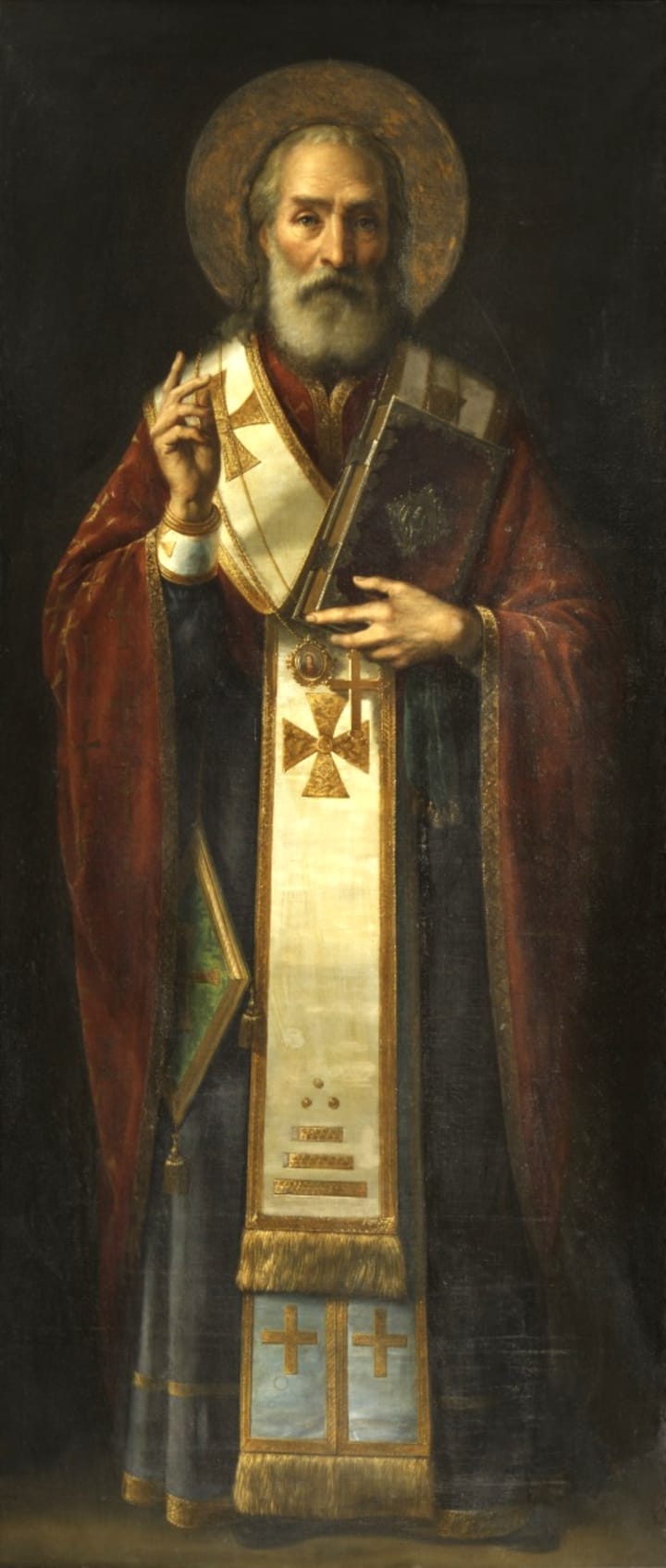
Legend has it...........
There once was a poor man who had three daughters. The man was so poor that he did not have enough money for a dowry, so his daughters couldn't get married. One night, a man named Nicholas secretly dropped a bag of gold down the chimney and into the house which meant that the oldest daughter was then able to be married. The bag fell into a stocking that had been hung by the fire to dry! This was repeated later with the second daughter. Finally, determined to discover the person who had given him the money, the father secretly hid by the fire every evening until he caught Nicholas dropping in a bag of gold. Nicholas begged the man to not tell anyone what he had done, because he did not want to bring attention to himself. But soon the news got out and when anyone received a secret gift, it was thought that maybe it was from Nicholas.(Which originates the stockings over the fireplace tradition).
Because of his kindness, Nicholas was made a Saint. No one is really knows when he died, but it was on 6th December in either 345 or 352. In 1087, his bones were stolen from Turkey by some Italian merchant sailors. The bones are now kept in the Church named after him in the Italian port of Bari. On St. Nicholas feast day (6th December), the sailors of Bari still carry his statue from the Cathedral out to sea, so that he can bless the waters and so give them safe voyages throughout the year.
FROM SAINT TO CLAUS: HOW A SAINT BECAME POP CULTURE
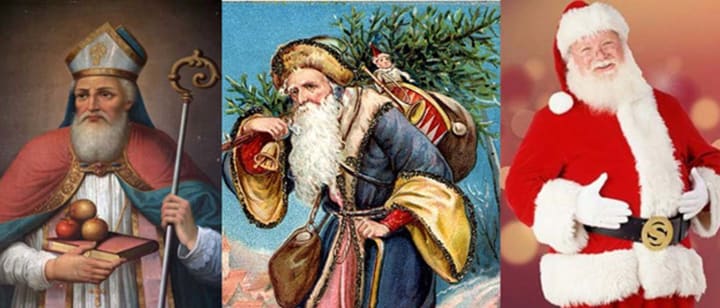
In the 16th Century Northern Europe, post reformation, the stories and traditions about St. Nicholas started to became unpopular.
However, someone had to deliver presents to children at Christmas, therefore most countries had to create a newer version of Saint Nicholas. In the UK, particularly in England, he became 'Father Christmas', an old character from story plays during the middle ages in the UK and parts of Northern Europe. In France, he was then known as 'Père Noel' or 'Papa Noel'.
In some countries including parts of Austria and Germany, the present giver became the 'Christkind' who is described as a golden-haired baby, with wings (similar to cupid), symbolizing the new born baby Jesus.
In the early USA, his name was 'Kris Kringle' (from the Christkind). Later, Dutch settlers in the USA took the old stories of St. Nicholas with them and Kris Kringle and St Nicholas became 'Sinterklaas' which eventually turned to 'Santa Claus'!
Many countries, especially in Europe, celebrate St. Nicholas' Day on 6th December. In The Netherlands and some other European Countries, children leave clogs or shoes out on the 5th December (St. Nicholas Eve) to be filled with presents. They also believe that if they leave some hay and carrots in their shoes for Sinterklaas's horse, they will be left some sweets.
St. Nicholas became popular again in the Victorian era when literary artists rediscovered the old stories. In 1823 the famous children's poem 'T'was the Night before Christmas', was published. Dr Clement Clarke Moore describes St. Nicholas with eight reindeers and gives them their names (Dasher,Dancer,Prancer,Vixen,Comet, Cupid, Donner, Blitzen) which became really well known in the song 'Rudolph the Red nosed Reindeer', written in 1949.
SANTA CLAUS AND COCA-COLA: MISCONCEPTIONS OF THE RED SUITS
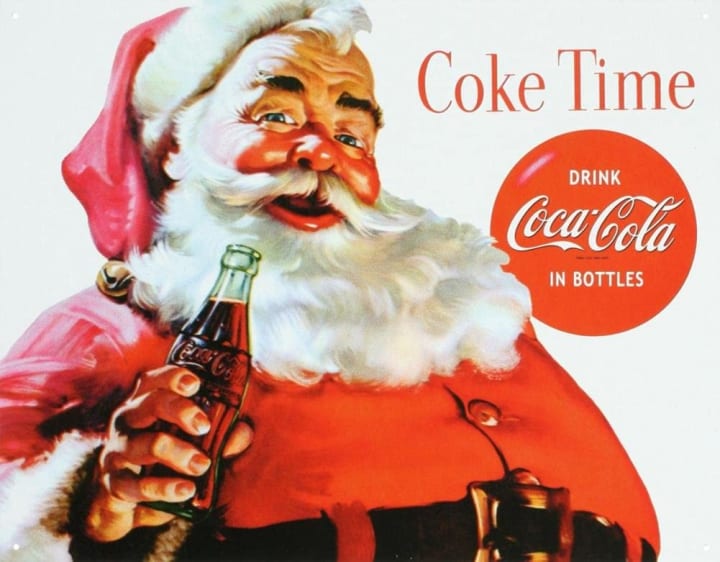
There is the misconception that the iconic Santa's red suit was designed and 'owned' by Coca-Cola. FALSE!
St Nicholas had worn his Bishop's red robes. He wore a range of colours such as red, green, blue and brown but red was always his favourite!
In January 1863, the magazine Harper's Weekly published the first illustration of St Nicholas by Thomas Nast. In this illustration, he was wearing a 'Stars and Stripes' outfit! Over the next 20 years, Nast continued to draw Santa every Christmas and his works were very popular indeed.
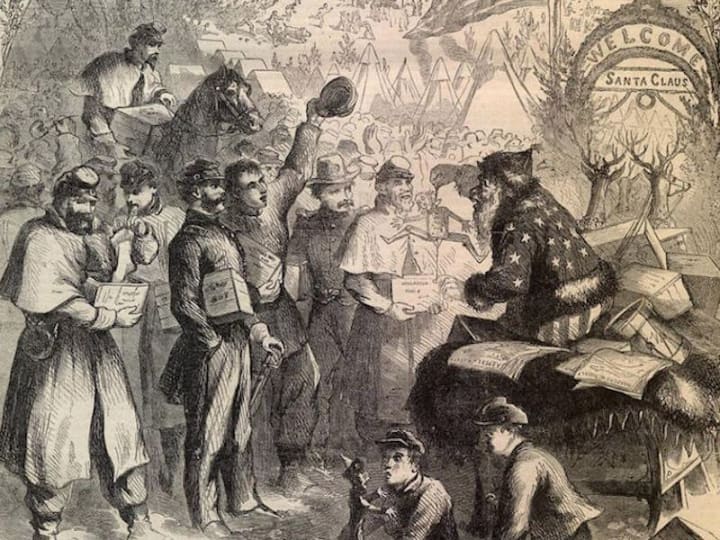
This is when Santa really started to develop his famous big tummy and the style of red and white outfit he wears today. Nast designed Santa's look based on some historical information about Santa and the poem 'A Visit from St. Nicholas'.
The "Santaclausian" coke advert was born in the 1920's , it showed Santa looking like the drawings of Thomas Nast. In 1931, Nast's Santa was transformed into a jolly and larger than life version with a coke bottle in hand thus creating the famous coca-cola Santa. Coca-cola continued to use Santa in their Christmas adverts since the 30's. The Coca-cola Christmas Truck ,a red truck decked with Christmas lights complete with coke Santa, was introduced in 1995 in the ads.

In conclusion, just like many legends and cultures, we see an evolution in this Festive figure based on the era, area and the cultures involved. Santa Claus has seen an evolution from his name, aesthetics and the stories and perceptions surrounding him. Currently, he perceived to be living in the North Pole with his wife Mrs Claus and his worker Elfs who help to spread joy and happiness in the world. I am looking forward to how He will be perceived in the next centuries.
What information surprised you the most? What other facts do you know?.............DO YOU EVEN BELIEVE IN SANTA!?
Happy Holidays,
Chantal <3
About the Creator
Chantal Cleland
Love to get my crestive Juices flowing, I write from the heart
Keep reading
More stories from Chantal Cleland and writers in Geeks and other communities.
LET'S DANCE: BALLET
Hello Beautiful People, I hope you’re all thriving!! Do you love to dance? I sure do! I’ve always had a thing for dance for as long as I can remember. Whether its taking a dance class, dancing at church or binging on dance videos and TV Shows, I have grown to appreciate different styles of dance and I wan to share this love and passion with all of you. Therefore,I’m going to kick start this year’s blog with a ‘lets dance’ series. This series will take a look at all the popular dance styles by diving into their history, their evolution, the cultural and social issues involved etc. I will be starting this series with ballet at it is known as the ‘ foundation of all dance styles’. and it was one of my many loves growing up. Now, Ladies and Gentlemen…I introduce to you….”LET’S DANCE!!!”
By Chantal Cleland5 years ago in Beat
Silver Screen Magic with Mae West
American actress and singer Mae West became a popular film actress during the Great Depression. She started entertaining in vaudeville, then performed on Broadway, and finally went to Hollywood. She signed up with Paramount Pictures and made her debut in the 1932 film “Night After Night.” She also starred in musicals, comedies, and crime dramas. The American Film Institute named her one of the best classic Hollywood actresses.
By Rasma Raisters6 days ago in Geeks
Top 7 Oak Island Discoveries the Show Didn’t Air
The Curse of Oak Island has captivated audiences for over a decade, blending historical intrigue with reality TV drama. But what fans see on screen is only part of the story. Behind the edited episodes and dramatic voiceovers lies a treasure trove of discoveries that never made it to air — some due to time constraints, others possibly too speculative or controversial for mainstream broadcast.
By Rukka Nova3 days ago in Geeks


Comments
There are no comments for this story
Be the first to respond and start the conversation.