
Batman Forever at 30: A Cover Band Version of Tim Burton’s Dark Knight
On its 30th anniversary, Batman Forever still feels like a flashy imitation of Tim Burton’s original vision. A review of Val Kilmer’s lone outing, Jim Carrey’s manic Riddler, and a Gotham that lost its soul.


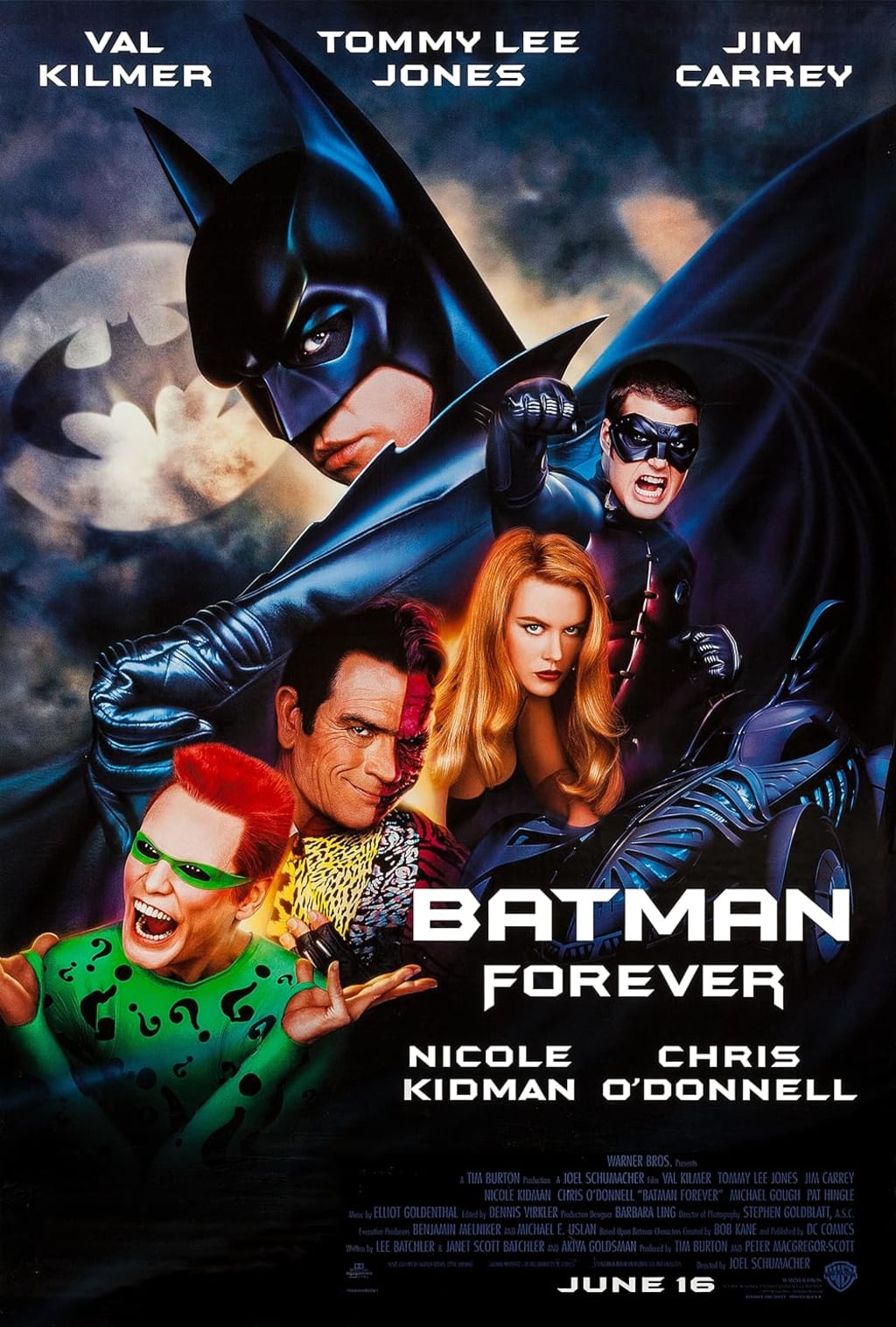
Batman Forever (1995)
Directed by Joel Schumacher
Written by Akiva Goldsman, Lee Batchler, Janet Scott Batchler
Starring Val Kilmer, Jim Carrey, Nicole Kidman, Tommy Lee Jones
Release Date June 16th, 1995
Published June 18th, 2025
Batman Forever: A New Sound Without the Soul
Even 30 years later, Batman Forever gives me the distinct feeling of going to a concert to see a band that has just changed lead singers. The vibe is wrong, the sound is off, and the new frontman can’t quite hit the same notes. It’s not terrible—just different enough that you don’t love the experience.
That analogy isn’t about Val Kilmer replacing Michael Keaton as Bruce Wayne/Batman. It’s about the seismic shift from director Tim Burton to Joel Schumacher. The Batman character, in this metaphor, is the hit song we once loved—now performed by someone who doesn’t understand the rhythm.
⸻
Familiar Parts, Fuzzy Melody
Schumacher’s take attempts to replicate the brooding style of Burton’s Batman and Batman Returns, but ends up as a glossier, emptier version. It’s Batman as pop art spectacle—bright, noisy, and ultimately hollow. Schumacher knows the words but not the music.
The world is still Gotham. Bruce Wayne still broods in rubber armor. There’s a Batmobile and gadgets galore. But something essential feels missing.
⸻
Two-Face, Rewritten and Unrecognizable
We’re dropped into a Gotham where former DA Harvey Dent (last seen as Billy Dee Williams) is now played by Tommy Lee Jones. The racial recast is jarring enough, but it’s the performance that’s truly disorienting. Jones leans fully into camp, turning Two-Face into a shrieking, purple-suited cartoon.
His motivation? Batman didn’t save him from an acid attack that tore his mind in two. So now he wants Batman dead, preferably with excessive property damage and neon lighting.
⸻
Enter The Riddler, Courtesy of Jim Carrey Unleashed
Meanwhile, Jim Carrey’s Edward Nygma watches Batman obsessively from his cubicle at Wayne Enterprises. He’s invented a brainwave device that beams entertainment directly into your mind while secretly siphoning your thoughts. Or your intelligence? It’s hard to say. The movie changes the rules on a whim.
Once Edward is fired, he transforms into The Riddler, decked out in green spandex and manic energy. Teaming up with Two-Face, they launch a campaign of chaos so Edward can get revenge and sell brain boxes to Gotham.
⸻
Romance and Robin, but No Room to Breathe
While all this villainy is going on, Bruce Wayne is juggling two major subplots: an awkward romantic triangle between himself, Batman, and psychologist Dr. Chase Meridian (Nicole Kidman), and his new ward, Dick Grayson (Chris O’Donnell).
Robin, famously absent from Burton’s Batverse, finally arrives. But he feels more like a studio mandate than a character anyone wanted. O’Donnell tries to modernize the role, but the script has no idea what to do with him. His revenge arc is rushed, his motivations thin, and the costume change montage more memorable than any dialogue.
⸻
Nicole Kidman Deserved Better
Kidman’s Chase Meridian is introduced as a brilliant criminal psychologist but comes across as a breathy fangirl obsessed with Batman’s pecs. It’s a disappointing and underwritten role, played with more lust than logic. She could have offered the film depth—if the script had let her.
⸻
The Bat Gets Lost in the Noise
Val Kilmer, despite his charisma, is overwhelmed. With Carrey and Jones chewing scenery at every turn, there’s no room for Batman or Bruce Wayne to evolve. Kilmer later admitted he felt like a prop in the costume—one interchangeable with anyone else. He wasn’t wrong.
⸻
Joel Schumacher: Studio Director, Not Auteur
That brings us to Joel Schumacher, the ultimate studio craftsman. Unlike Burton, who stamped his personality all over his Batman films, Schumacher simply rearranged the pieces left behind. Batman Forever looks like a Batman movie and acts like a Batman movie—but lacks any real identity.
It’s a cover band doing its best Tim Burton impression. And despite the lights and noise, it’s clear this version doesn’t know why the original songs mattered in the first place.
⸻
Final Thoughts
Batman Forever is a visually loud, thematically thin, and ultimately confused installment in the Batman legacy. It’s not without entertainment value—Carrey is magnetic even when misdirected—but the film never quite sings. For fans of Burton’s Batman, this is a strange encore: same lyrics, wrong melody.
⸻
⭐️ Star Rating: 2.5 out of 5
⸻
Call to Action:
Did Batman Forever hit the right nostalgic notes for you, or did it sound out of tune? Share your thoughts in the comments, and don’t forget to follow for more reviews of classic superhero cinema.

Tags:
Batman Forever, Batman movies, Joel Schumacher, Val Kilmer, 90s movies, superhero movies, Jim Carrey, Tim Burton, comic book films, Batman 1995, Robin, Gotham City
About the Creator
Sean Patrick
Hello, my name is Sean Patrick He/Him, and I am a film critic and podcast host for the I Hate Critics Movie Review Podcast I am a voting member of the Critics Choice Association, the group behind the annual Critics Choice Awards.
Reader insights
Nice work
Very well written. Keep up the good work!
Top insights
Easy to read and follow
Well-structured & engaging content
Expert insights and opinions
Arguments were carefully researched and presented
On-point and relevant
Writing reflected the title & theme
Keep reading
More stories from Sean Patrick and writers in Geeks and other communities.
Silver Screen Magic with Mae West
American actress and singer Mae West became a popular film actress during the Great Depression. She started entertaining in vaudeville, then performed on Broadway, and finally went to Hollywood. She signed up with Paramount Pictures and made her debut in the 1932 film “Night After Night.” She also starred in musicals, comedies, and crime dramas. The American Film Institute named her one of the best classic Hollywood actresses.
By Rasma Raisters5 days ago in Geeks
Julian Barnes Says Goodbye to the Novel: A Literary Icon Reflects on a Storied Career
In the world of contemporary literature, few authors have commanded as much respect and admiration as Julian Barnes. Known for his incisive wit, keen psychological insights, and elegant prose, Barnes has spent decades shaping modern fiction, producing works that blend philosophical inquiry with human storytelling. Now, the celebrated novelist has announced that he is saying goodbye to the novel, signaling the end of an era for readers who have long followed his literary journey. A Career Defined by Curiosity and Elegance Julian Barnes, born in Leicester in 1946, has been one of Britain’s most distinguished literary figures since the 1980s. Over his career, he has authored a remarkable array of novels, essays, and short stories, earning accolades including the prestigious Man Booker Prize for his 2011 novel The Sense of an Ending. His works frequently explore themes of memory, love, mortality, and the elusive nature of truth, often inviting readers to examine the complex moral and emotional layers of human experience. Barnes’ decision to step away from the novel comes as both a surprise and an inevitability for many of his devoted readers. In interviews discussing his forthcoming farewell, he emphasized that the decision was not born from fatigue, but from a desire to conclude his career on his own terms, rather than letting external pressures dictate his creative output. “I feel I have said what I wanted to say in fiction,” Barnes explained. “The novel has been my lifelong companion, but it is time to part ways with it gracefully, rather than cling to it.” The End of an Era Barnes’ departure from the novel is significant not only for its timing but also for what it represents in the literary landscape. Over the past four decades, Barnes has been part of a cohort of writers who elevated modern British literature, combining literary sophistication with widespread accessibility. His ability to blend narrative innovation with philosophical depth has influenced a generation of authors, from novelists exploring the intricacies of memory to those experimenting with metafiction and historical inquiry. Works like Flaubert’s Parrot and Arthur & George exemplify Barnes’ talent for merging intellectual curiosity with human emotion. In Flaubert’s Parrot, he dissected the life of the French novelist Gustave Flaubert, blending biography, literary criticism, and narrative playfulness in a way that challenged conventional storytelling. Arthur & George, meanwhile, retold the story of a real-life legal case in Edwardian England, illuminating themes of justice, identity, and the human desire for truth. Such novels have left an indelible mark on literary studies and popular reading alike. A Reflection on Literary Form Barnes’ farewell also prompts reflection on the state of the novel itself. In recent years, traditional literary forms have faced pressure from emerging technologies, the rise of digital media, and shifting reading habits. Barnes’ choice to retire from the novel underscores a sense that the literary form is evolving, and that authors must navigate these changes while remaining true to their artistic vision. Critics suggest that Barnes’ departure may inspire readers and writers alike to reassess what the novel can achieve in a rapidly changing cultural landscape. His works have demonstrated that fiction can simultaneously entertain, educate, and provoke deep contemplation—a standard that future authors may strive to uphold. Legacy Beyond the Page Although Barnes is stepping away from the novel, his influence will persist across literary circles and classrooms worldwide. His essays, critical writings, and memoirs offer further insight into his philosophical and aesthetic approach, while his novels will continue to be studied, enjoyed, and debated for generations. Students of literature often cite his deft handling of narrative perspective, temporal shifts, and moral ambiguity as exemplary, showcasing the enduring power of the written word to capture the complexities of life. Barnes’ announcement also raises questions about what comes next for an author who has spent his entire adult life shaping fictional worlds. While he may no longer write novels, he has hinted at the possibility of exploring essays and non-fiction, channels through which he can continue to engage with ideas, culture, and history. A Farewell to Fiction, Not to Thought Julian Barnes’ goodbye to the novel is bittersweet for readers, critics, and literary enthusiasts alike. It marks the close of a chapter not just in his career but in contemporary literature, reminding the world of the profound impact one writer can have over decades of dedicated craft. Yet even as he steps away from the novel, Barnes’ commitment to inquiry, reflection, and storytelling will continue to resonate. “Books have given me a lifetime of joy,” Barnes said. “I hope they have done the same for my readers. Now it is time to let the novel rest, while the conversation it has inspired continues.” In bidding farewell to the novel, Julian Barnes leaves a legacy defined by intellectual rigor, emotional depth, and narrative brilliance. His works will remain essential reading for anyone who seeks to understand the human condition through the lens of literature. And while the novel may no longer see new works from him, the world of fiction will forever bear the imprint of his extraordinary voice.
By Fiaz Ahmed Brohi5 days ago in Geeks
A Dart at Dusk
Seconds ago, the sullen sun set on the two of us… my exuberant furry companion and me. A fresh breeze embraces us, delivering welcome relief from the day’s oppressive heat. His typical stumbling and staggering along — apace with a sloth — has turned into trip-trapping, high-stepping, almost skipping along.
By Angie the Archivist 📚🪶5 days ago in Petlife




Comments (4)
This movie is goofy as hell but super nostalgic for me. Would love to see the Schumacher Cut released at some point.
I totally agree. Joel Schumacher showed in this film what he fully divulged in "Batman and Robin" - that what he really liked was the camp era of Batman, the goofy old comics and the Adam West TV show. As much as the studio started to stomp out quality in the demand to put out more characters, which meant more merch, Schumacher was doing just as much damage. Carey's Riddler was The Mask or Ace Ventura in a Riddler outfit. Aside from the body stocking, he never looked like that or acted like that. Sure, Frank Gorshin's TV Riddler was a bit wacky, but Carey's version is far more Joker than Riddler. And really, since he was a classic villain who had somehow never been in the West show, Two-Face deserved his own film, but in this he was barely even noticeable after the Riddler came on the scene. Kidman's character was indeed wasted. And her presence, and the formula behind it, pretty much sunk the film for me. At that time, few people in comics knew who Batman was. Alfred, Robin, Ra's al Ghul, and his daughter. That was about it. But at this point, every film had a love interest, and each of them knew who Batman was. That was ridiculous. Yet, somehow, the next film was worse.
I've yet to see this, but I need to, especially to honor the late, great Val Kilmer. I remember seeing the promos for this on TV--I was 10 when this came out.
Although I loved Val Kilmer and always will, my favorite Batman movie was Batman Begins. It dug its toenails into the dirt and I felt it.