
Batman: Caped Crusader – More Batman: The Animated Series than Batman: The Animated Series?
Comparing the Latest Batman Animated Series to the Initial Plans for the Most Successful...
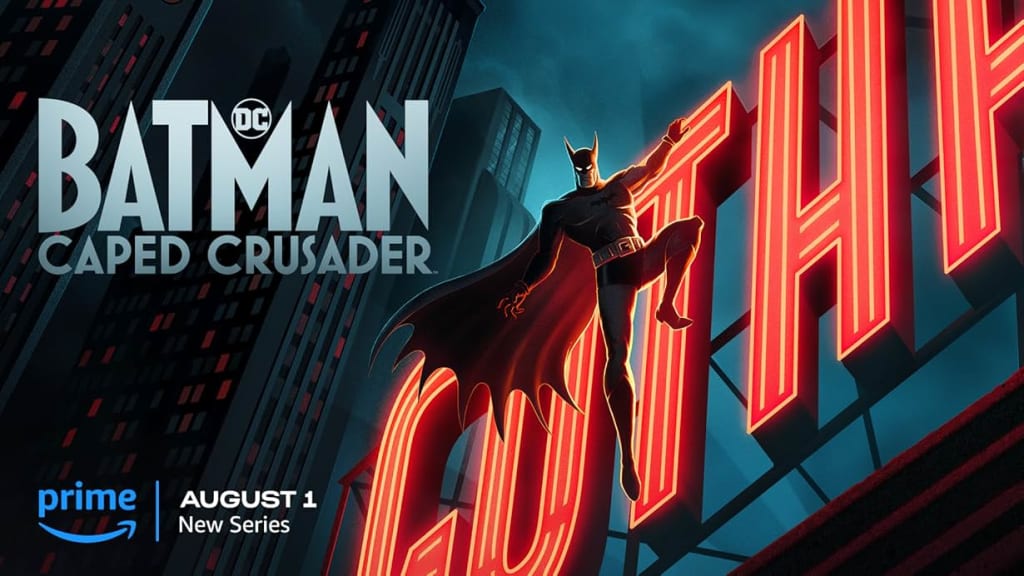
Debuting mere weeks after Batman Returns was released in 1992, Batman: The Animated Series (Or BTAS for short) has become one of the most acclaimed takes on the Dark Knight. There have been several other animated series, including the sequel series The New Batman Adventures (same creative team, different visual style), the hit-and-miss mid-2000s series The Batman, the silver age throwback Batman: The Brave and the Bold and the grittier, CGI animated Beware the Batman. There is now a new addition to this lineup - Batman: Caped Crusader, created and executive produced by Bruce Timm, one of the lead members of the BTAS creative team. Bruce Timm has boasted that this series is “More Batman: The Animated Series than Batman: The Animated Series” and a more complete example of his vision for Batman – As Batman: Caped Crusader is aimed at older audiences, it will not have to deal with the constraints of censorship and studio interference caused by the need to please younger children or overly cautious parents.
The success of BTAS was based on Timm’s collaboration with other talented creatives, such as Paul Dini and Alan Burnett. However, Batman: Caped Crusader has a strong team of its own - Matt Reeves (who directed the acclaimed The Batman 2022), Lost creator JJ Abrams and current DCU Films head James Gunn are also part of the production team. The writing team is headed by comic book veteran Ed Brubaker, with his Gotham Central collaborator Greg Rucka also involved. TV veteran Hamish Linklater will voice Batman, with the likes of Krystal Joy Brown, Christina Ricci, Jason Watkins and Jamie Chung in the supporting cast.
Whilst BTAS had an initial order of 65 episodes (followed by a second series of 20 episodes, and the 24-episode sequel series The New Batman Adventures), Batman: Caped Crusader is beginning with just 10 episodes, all debuting on Amazon Prime 1st August*. The creative team have promised a structure of standalone episodes with subplots leading towards the grand finale. The smaller, arc focused approach of Batman: Caped Crusader puts it in line with other recent DC comics animated series (Harley Quinn, My Adventures with Superman), but it means that Batman: Caped Crusader will find it harder to vary its style and tone. Batman: Caped Crusader will be darker than other animated Batman series (the villains will be able to amass a far higher bodycount, there will be a more detailed exploration of the social corruption in Gotham) but it won’t go to the ultraviolent extremes of a show like Amazon Prime’s flagship superhero satire The Boys - The age rating for Batman: Caped Crusader on Amazon Prime is 13+, making it suitable for teenage Batman fans.
One of the best ways of comparing Timm’s vision for BTAS with the finished product (and with his vision for Batman: Caped Crusader) is to look at the Writers Bibles, which contain biographies for most of the major characters and explain how the particular world works. Screenwriters generally create a lot of backstory and character biography material that is not needed for any of the stories. However, it can be fascinating to read this and see the extent it influenced the finished product. The BTAS team created two Writers Bibles outlining their vision for the show (The first outlining the concept and featuring several designs and illustrations, the second being a simpler document revealing some changes to the characterizations and tone) – it is interesting to go through these and not only find out which ideas made it into BTAS and which didn’t, but also see how many parts of the original BTAS vision influenced Batman: Caped Crusader both directly and indirectly.
Although the overall tone of BTAS stayed consistent throughout the development process (Darker and more grounded, with a “timeless” Dark Deco visual style, and flashes of character-driven wit and humor to lighten the mood when necessary), there were several changes made to the large cast of characters – it is worth comparing this development material to the approaches taken in both BTAS and Batman: Caped Crusader in order to see how Bruce Timm’s vision evolved for both shows.
The Caped Crusader
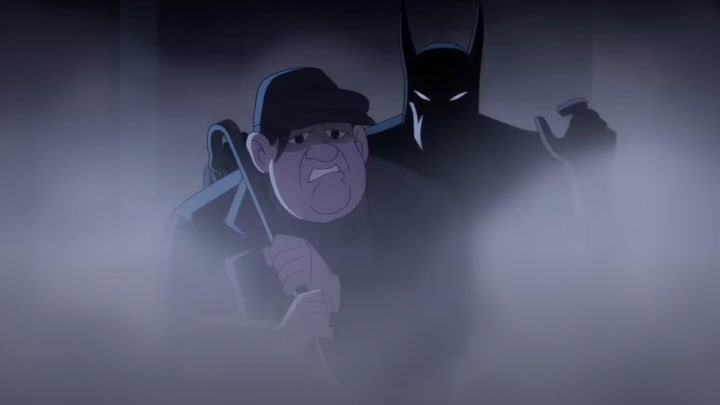
Batman: Caped Crusader will centre on a less experienced, more ruthless version of Batman, more focused on getting revenge on criminals than making Gotham a safer place to live. Done well, this harsher approach will open the door to compelling character development as Batman changes his approach to reflect the new challenges he faces. Done badly, the more aggressive approach to crime-fighting could reinforce ideas of Batman being unlikeable or even "Facist". Timm has cited classic pulp characters like The Shadow and Doc Savage as his inspiration, but there is a reason these characters have fallen out of fashion – modern audiences have different ideas of heroism. The promotional material for Batman: Caped Crusader is leaning heavily on Batman’s intimidation factor - the first clips showed Batman using his Batmobile to knock down gangsters like bowling pins and dangling a corrupt fire department official in the path of an incoming train in order to extract information from him. However, too much of this could make it hard to care about Batman and make him seem just as bad as his enemies. Batman’s status as one of the most vengeful and intimidating superheroes is a huge part of his appeal, but it works best when balanced with more a more vulnerable and compassionate side.
The characterization of Batman was probably the one thing that changed the most between the two BTAS Writers’ Bibles. The initial bible refers to Batman as a “Grim Avenger of evil” – a pretty perfect summary of what Batman: Caped Crusader seems to be going for. The second begins by likening Batman to Tom Joad, the protagonist of the classic 1930s novel The Grapes of Wrath and one of the most famous symbols of American heroism. The original bible had Bruce Wayne going out of his way to avoid being seen as a “do-gooder”, doing his charitable deeds anonymously through shell companies. The updated bible had BruceWayne doing considerable charity work in public through the Wayne Foundation. Overall, the second Writers Bible places more emphasis on Batman’s “deep feeling” and his mission to “give the good people of Gotham a chance to thrive”, moving away from the colder initial characterization Timm seemingly pushed for in favor of the more compassionate one often used in BTAS. However, many things remain constant in both writers bibles – Batman is a hero of few words, relying heavily on his detective skills and inducing fear in the hearts of Gotham’s criminals.
The initial BTAS Writers Bible said the series was taking place early in Batman’s career – the police don’t use a Bat-Signal to summon him, and both the police and Gotham citizens have a variety of opinions on the Batman (and Bruce Wayne!). In the eventual series, Batman seems to be in the middle of his career, with the police and city authorities generally accepting his presence – The Bat-Signal was introduced in the middle of the initial 65 episode block. Batman: Caped Crusader will be taking the initial “early days of Batman” concept further by effectively setting it in “week two” of Batman’s story and emphasizing the fear and uncertainty of the GCPD and others trying to get to grips with this mysterious new creature of the night.
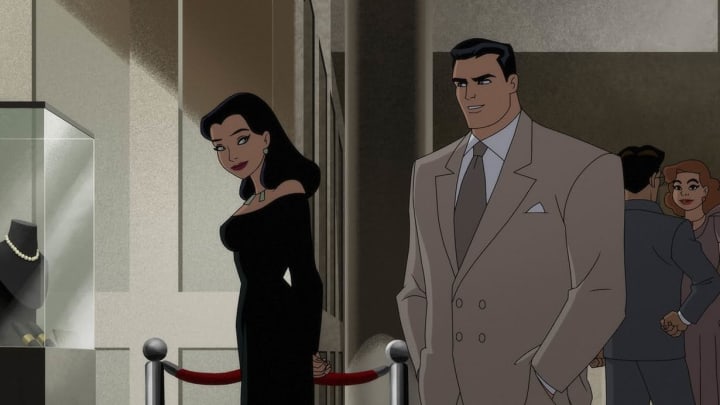
Both the Writers Bibles emphasized the artifice of Bruce Wayne’s playboy persona – They aimed to run with the idea of Bruce Wayne as “the mask” and Batman as the “true self”. The focus on being Batman means that Bruce Wayne lacks the social skills of other socialites and spends all his social engagements wishing he was in the Batsuit. However, the Batman: Caped Crusader creative team want to take this a step further by emphasizing how weird and awkward Bruce Wayne can be – In fact, one of the main reasons Hamish Linklater was cast as Batman was his ability at embodying Bruce Wayne’s uncanniness. Linklater has apparently taken inspiration from Hollywood legend Cary Grant, who hid his roots as a working-class Brit behind his suave screen persona and unusual Mid-Atlantic accent. Despite the fact that Batman: Caped Crusader will be returning to the original idea of Bruce Wayne appearing to be little more than a frivolous playboy, Lucius Fox – a character associated with Wayne’s businessman side – will be involved in the series. It will be interesting to see how he is adapted for the new approach.
Timm has teased that Batman’s relationship with Alfred will be more dysfunctional, with more emphasis on the idea of Batman essentially "using" Alfred in his war on crime. Reflecting this more subservient role, Alfred now has a more portly appearance (He was also more heavily built in his original comics, with his more famous slim appearance originating in the 1940s Batman serials.) Although Alfred always had a more assertive role in BTAS, there were initially some plot threads where Batman made Alfred take up extra duties in his war on crime. The original Writers Bible for BTAS had the idea of Bruce hiring Alfred to disguise himself as Batman whenever he was busy outside Gotham, in order to ensure Batman would retain some level of presence without him - according to the second Writers Bible, Alfred does not enjoy this very much. However, for all the problems with being Batman’s butler, Batman: Caped Crusader is keeping the core idea that Alfred is the only person who knows what Batman is really like.
Building Gotham
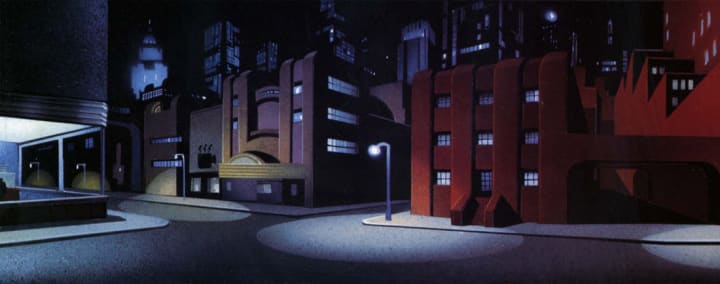
Batman: The Animated Series is famous for its “Dark Deco” visual style, which blended 30s and 40s designs, present-day technology and futuristic visuals, with named dates and cultural references see-sawing between these three approaches in a way that made timeframes almost impossible to pin down (The sequel series The New Batman Adventures, which adopted a new design style in line with Superman: The Animated Series and other later DC Animated Universe shows – downplayed this approach and added more blatant pop cultural references, effectively tying the show to the present) . Both bibles made it clear that Gotham was inspired by the size and scale of New York – the first Writers Bible tells writers to “Keep New York in mind... and then exaggerate it.”
In contrast to the less specific timeframe of BTAS, Batman: Caped Crusader seems to be settling for a fully 1940s style. However, the cast will be more diverse than most 1940s entertainment – Detective Gordon and Barbara are both African-American, and Harley Quinn is now Asian-American. It is worth noting that the core concept of Batman: Caped Crusader (the early days of Batman set in the WW2 era) was recently used in Dan Jurgens’ comic miniseries The Bat-man: The First Knight. One of the most memorable things about this series was a subplot about the Jewish refugee experience in America at the time – One of the lead characters was a Rabbi who fled to America after the rise of the Nazis. It would be great if Batman: Caped Crusader also explored the discrimination of the 1930s and 1940s in more detail, but it will be likely to take a more superficial approach. The non-white characters will face considerable disrespect and adversity, but the racism of their enemies will likely be hinted at rather than shown outright.
Fellow Batman: Caped Crusader producer James Tucker (who also worked on Batman: The Brave and the Bold) has pointed out that choosing not to explore Batman’s internal vulnerabilities means more focus on the character arcs of his allies and enemies. This was also true of BTAS – many of the best episodes of BTAS focused on the villains (“Heart of Ice”, “Two Face”, “Almost Got ‘Im”, “Harlequinade”) or on ordinary people caught up in the chaos of Gotham (“Joker’s Favor”, “The Man Who Killed Batman”, “Beware The Gray Ghost”). Batman: Caped Crusader will focus on two sets of characters – the veterans of the Gotham City Police Department (GCPD) and the rouges' gallery of Batman villains.
The GCPD
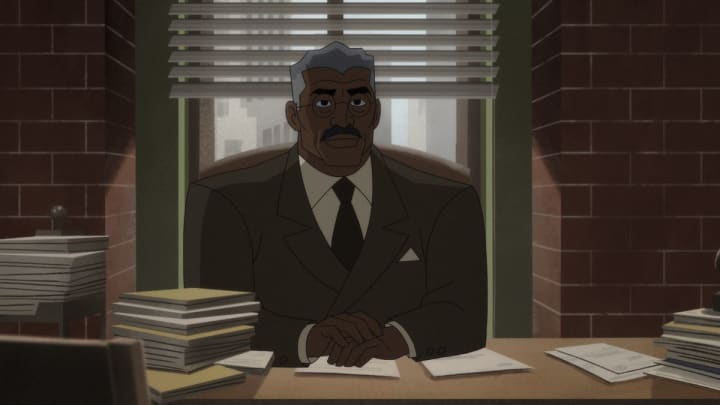
The original Writers Bible for Batman: The Animated Series contained a lot of material on Commissioner Gordon and his assistants, but very little of this made it into the show. The main reasons for this were restrictions on the use of guns, and anxiety over depicting the police in children’s television**. As a result, the complex internal politics were edited down and the GCPD were generally reduced to providing support for Batman. However, Batman: Caped Crusader will be providing a far more detailed exploration of the GCPD and the problems within the organization – no surprise when Gotham Central creators Brubaker and Rucka have such a prominent role in the writing team.
Since Frank Miller’s Batman: Year One was published in 1987, Commissioner Gordon’s relationship with Batman has become one of the central parts of the Batman mythos, with Christopher Nolan’s Batman trilogy and Matt Reeves The Batman 2022 making him into a full-on lead character. Like Batman: Year One, these versions revolve around Gordon trying to challenge the corruption of those above and below him in the GCPD, and realizing that Batman could be a useful ally in this mission. Batman: Caped Crusader seems to be putting a new spin on this idea with its older, more cynical take on Gordon. It also seems to be revisiting one of the core ideas from the BTAS Writers Bible – Gordon being appointed commissioner by corrupt elites seeking to look good, but constantly trying to challenge his dodgy superiors. Needless to say, it will go into more detail on this topic, and Gordon’s pragmatic yet compassionate personality. Another element of the Writers Bible – Gordon preferring hands-on “Beat cop” work to the administrative duties he has as commissioner – could be altered to reflect the modern cynicism towards cops in general, but it could still reflect Gordon’s more idealistic and adventurous side, showing there is more to him than just being a grizzled veteran.
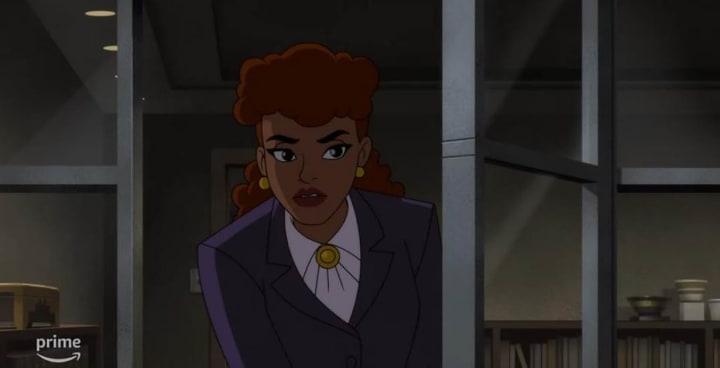
One Batman character who famously gets a lot of disrespect is Commissioner Gordon’s daughter Barbara, better known as Batgirl – sadly, Bruce Timm is one of the people most responsible for her poor reputation, due to the Batman/Batgirl sex scene in his critically panned 2016 adaptation of Batman: The Killing Joke (Which he co-wrote with Brian Azzarello), and a spin-off comic for futuristic DCAU series Batman Beyond (which Timm had no involvement with) claiming that Bruce Wayne had got Barbara pregnant. The idea that Barbara was infatuated with Bruce was hinted at in the initial BTAS Writers Bible - this floated the idea of Barbara as a teenage Batman fangirl who adopts the Batgirl identity to win Batman’s approval, and usually finds herself out of her depth. This evolved slightly in the show, where Barbara takes on the Batgirl mantle to clear her father’s name after he gets framed for corruption. However, in both the bible and the show, Barbara was more of a bonus addition, with the second writers guide stating it preferred Barbara as herself to Barbara as Batgirl. The Barbara of Batman: Caped Crusader seems to be playing a more central role. Here she is a former cop who became frustrated with the system, so decided to become an attorney instead. Despite this, the trailer showed she was still willing to use firearms when necessary. Timm has ruled out the possibility of Barbara becoming Batgirl for now, but there is definitely a sense that the series is building up to her taking on a role assisting Batman outside the justice system (maybe as Oracle..) Making Barbara more powerful and assertive could allow her to gain the greater degree of respect she deserves.
The series will also feature Detective Renee Montoya - initially created exclusively for BTAS, Montoya made such an impression with DC Comics that she was added to the Batman comics six months before BTAS began airing. The original Writers Bible stated that Montoya was a widow whose police officer husband had died in the line of duty and emphasized her desire to do good for her community, even volunteering at a church in her spare time. The second bible downplayed this but made her into a single mom. When the series aired, this backstory was mostly cut, with Montoya essentially becoming a blank slate. The early episode "P.O.V" provided Montoya with some impressive moments, but after that, she was mostly reduced to the role of assistant. However, in the early 2000s Renee Montoya became the standout character in Brubaker and Rucka’s police procedural series Gotham Central, with one of the most important arcs featuring her getting forcibly outed as a lesbian. Montoya’s lesbianism has become integral to the character since, even being introduced to the DCAU in the recent Batman: The Adventures Continue spin-off comic series. The Batman: Caped Crusader version of Montoya will retain the honorable “by the book” characterization used in BTAS, but her relationships will cause her new complications, as she will find out the hard way that her quirky psychiatrist girlfriend Dr Harleen Quinzel has an extremely dark secret…
It has also been confirmed that Harvey Bullock will also appear, voiced by John DiMaggio. In the comics, Bullock is usually slovenly and abrasive cop kept on the side of “good” by his loyalty to Gordon, operating in a “grey area” that makes him one of the most compelling characters in the GCPD. In the initial Writer’s Bible for BTAS, Bullock is a textbook “Bad Cop” – violent, crude and constantly pushing against the constraints of the law as much as he can. This was gradually toned down – although Bullock has antagonistic tendencies in his earlier episodes, he eventually adopted an aggressive but ultimately honorable characterization similar to that of the comics, with "A Bullet For Bullock" – a close adaptation of Chuck Dixon’s then-recent Detective Comics story – providing him with the full-on spotlight that Gordon and Montoya didn’t really receive on the show. With GCPD corruption playing such a key part in Batman: Caped Crusader, and the need for “bad cops” to contrast with Gordon and Montoya’s integrity, it is likely that Bullock will be returning to the Writers Bible characterization a character who has few redeeming features but stays in the GCPD due to the belief they need a “necessary blunt instrument” in their war on crime.
The Villains
The episode limits of Batman: Caped Crusader create quite a challenge for the vast lineup of Batman villains. With just ten episodes of approximately 25 minutes each, the team have to establish new versions of the classic enemies (often with clearly defined backstories) whilst also giving space to some who audiences will not be familiar with. However, Batman’s foes are just as adaptable as the Dark Knight himself…
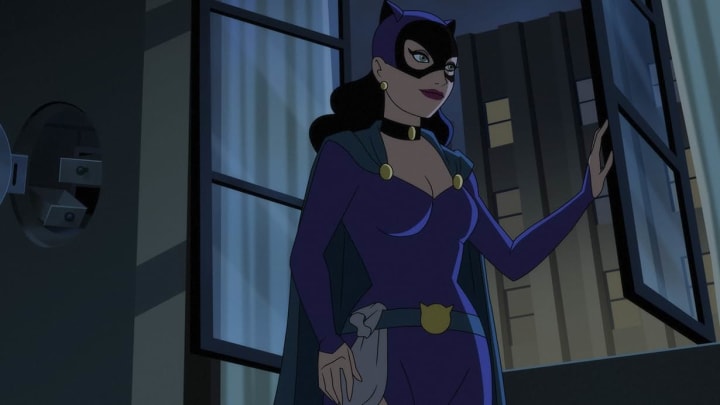
The most notable of the classic villains to be used in Batman: Caped Crusader is Catwoman. Bruce Timm has expressed dissatisfaction with the BTAS version of the iconic thief, so there is quite a bit of room for improvement here. The Writers Bible concept for BTAS set Catwoman up as a sort of counterpart for Batman, operating in shadow to strike fear into the hearts of the wealthy. She retained her signature status as the most morally conflicted member of Batman’s rouges gallery - Too greedy and selfish to be a hero, but still operating under a clearly defined code of honour and willing to help Batman on several occasions. The Writers Bible mentioned that Catwoman had grown up in poverty, as in Batman: Year One and other Catwoman stories written immediately afterwards. However, in BTAS itself, Catwoman’s impoverished background was downplayed (she had a secretary!) and her early episodes instead placed emphasis on her interest in animal rights, reducing her edge and leading to her becoming a damsel-in-distress at times. Later appearances made Catwoman more self-centred and antagonistic, and Timm claimed this worked better. Doing Batman: Caped Crusader allows Timm to commit fully to Catwoman as a femme fatale thief, with a costume based on the “Classic design” for Catwoman used in the comics from the mid 1940s to the mid 1980s. Whilst Ed Brubaker’s acclaimed Catwoman comic series emphasized Catwoman’s impoverished upbringing and her desire to challenge the people threatening her community, this version is a socialite who takes up theft to fund her lavish lifestyle after her father gets locked up. The main inspiration is classic Hollywood siren Barbara Stanwyck, who played a glamourous con artist in the classic screwball comedy The Lady Eve. Done correctly, returning Catwoman to her roots could re-establish her sense of fun and provide the unpredictable quality that is missing whenever she falls too far into heroic or villainous tendencies.
Another iconic Batman antagonist involved in Batman: Caped Crusader is Two-Face. BTAS became the first Batman adaptation to use Two Face, playing a key role in allowing the character to gain a mainstream fandom outside the comics. Before introducing Two-Face, BTAS established him as Harvey Dent and showed his friendship with Bruce Wayne, ensuring that the half-scarred coin-flipping criminal could be “the most tragic figure in Batman’s Rouges' Gallery". In the initial writers bible, Dent was disfigured when a stakeout went wrong due to Batman’s intervention, blaming Batman and seeking revenge. The finished show added the idea that Harvey Dent already had a destructive split personality and was beginning to lose control of it due to the stresses and strains of his role as DA – the disfigurement meant that this internal battle became impossible to conceal. Although Two Face’s status as a “hero of Gotham” destroyed by a life-changing trauma is key to his tragic power, a lot of people have become wary about way his origin story can fuel the stereotype of disfigurements being associated with villainy. As a result, a lot of more recent versions of the character (such as Beware the Batman) have made Dent villainous from the beginning. Batman: Caped Crusader promises a more interesting take on this revision – when the charismatic but corrupt Harvey Dent is disfigured, it forces him to become more empathetic, essentially making his burnt side his “good” one. Although descriptions don’t go into specifics, it is almost certain there will be elements of revenge in his villainous mission involving him seeking vengeance against the fair-weather friends who abandoned him when he got disfigured. Although the Two-Face design is relatively flat compared to others – the burnt skin is the same colour as his regular skin and he doesn’t have a half-and-half suit or coat- this version could still be as intimidating and intriguing as usual.
Another core Batman villain who is receiving a radical change is The Penguin. The BTAS Writers Bible created an elaborate backstory for the Penguin revolving around his mommy issues (He became a criminal after his mother’s pet shop was destroyed by thugs, and he still tries to hide his nefarious career from her), but the series eliminated all of this - mostly making the character a generic criminal - and the creative team were very disappointed with many of his episodes, ***. Batman: Caped Crusader seems to making things a lot simpler by depicting The Penguin a classic mobster who uses a club called The Iceberg Lounge as a front for criminal activities. This approach has become standard for The Penguin since the comics introduced it in the mid-1990s - it was first used on TV in The New Batman Adventures, and brought into the mainstream by Collin Farrell's take on The Penguin in The Batman 2022. However, the Batman: Caped Crusader version adds an extra twist by making The Penguin a female crime boss voiced by Anglo-American screen veteran Minnie Driver, now called Oswalda Cobblepot instead of Oswald. It is possible to gender-flip The Penguin and keep most of his traditional core traits, but a lot of these (such as his need to be seen as a “gentleman” despite his unattractive appearance and villainous activities) play pretty differently with a woman. The character is as ruthless as ever, but although Oswalda has the traditional overweight, sharp-nosed Penguin appearance (including the top hat, monocle and umbrella that have always defined The Penguin in the comics), she also has a glamourous side, with an interest in cabaret performance designed to show off Driver’s singing experience. If done well, this could be an interpretation to remember.
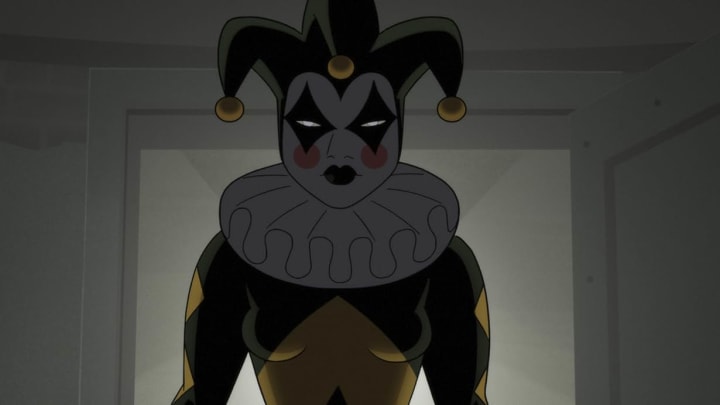
One of the most iconic villains of BTAS was not included in the writers bibles. Harley Quinn was famously created on impulse, initially providing assistance to the Joker for one episode only. However, the team liked Harley, decided to use her again and again, and things escalated from there. Thanks to the recent Suicide Squad and Birds of Prey movies (where she was played by Margot Robbie) and her raunchy HBO animated series, Harley Quinn has become one of the biggest names in the DC Comics world, making it inevitable she would be added to Batman: Caped Crusader. However, many fans of the original BTAS version are annoyed with the way that the quirky but loveable henchwoman has been converted into a vehicle for Deadpool-style wacky and crude humor. As a result, many recent adaptations have gone in the opposite direction, depicting Harley in a far more serious light. Whilst the comic miniseries Harleen, the podcast series Sound Mind and the forthcoming Joker: Folie A Deux have provided darker and more dramatic takes on her relationship with the villain she calls Mr. J, Batman: Caped Crusader is a Joker-Free universe (at least for now…), giving Timm and his team the freedom to do something different****. In this version, Harley is a psychiatrist who becomes fed up with all the corruption of her wealthy clients and decides that only a jester can hold them to account. Harley will still have quirky and comical moments as Dr Quinzel, but this is by far the most dangerous take on her to date.
Completing the lineup of regular Batman villains featured in Batman: Caped Crusader is Clayface – this version seems to have a similar backstory to BTAS (A fading actor becomes addicted to “miracle” face cream that turns him into a shapeshifter), but this version will be using the initial (and very creepy) Golden Age design and leaning on his “horror movie actor” status. However, many key Batman villains seem to be absent from Batman: Caped Crusader – The Riddler seems to have been omitted (likely because any version would be too similar to the one used in The Batman 2022, and Harley Quinn and Two Face seem to be going down a similar vengeful path) There is also no room for the likes of Poison Ivy, Scarecrow or Dr Hugo Strange, although they would be well-suited to the Batman: Caped Crusader style and approach. Hopefully the second season will allow Batman: Caped Crusader to put their own spin on them.
There are also some villains making their animated debut, such as Onomatopoeia – the intimidating hitman who speaks entirely in onomatopoeic words ("Bang", "Splash", etc) - and Firebug (who appears to be a 1940s version of the more frequently used Batman villain Firefly). Given that darker adaptations of Batman have often aimed for a more realistic approach, it feels a bit strange to have the overly supernatural villains Natalia Knight (Better known as Nocturna) and Gentleman Ghost in the Batman: Caped Crusader world. Both were intended to appear in BTAS but were discarded when the show chose to downplay the magical elements of the universe. The BTAS Writers Bible floated the idea that Gentleman Ghost could be the villain in an episode featuring a team up between Batman and Paul Dini’s favourite superheroine Zatanna. However, when it was time to adapt this concept for the series, Dini had to drop Gentleman Ghost and replace him with a one-off villain, weakening the episode significantly. If Gentleman Ghost and the other unfamiliar Batman villains impress Batman: Caped Crusader audiences, expect them to show up more often in future Batman comics…
Conclusion
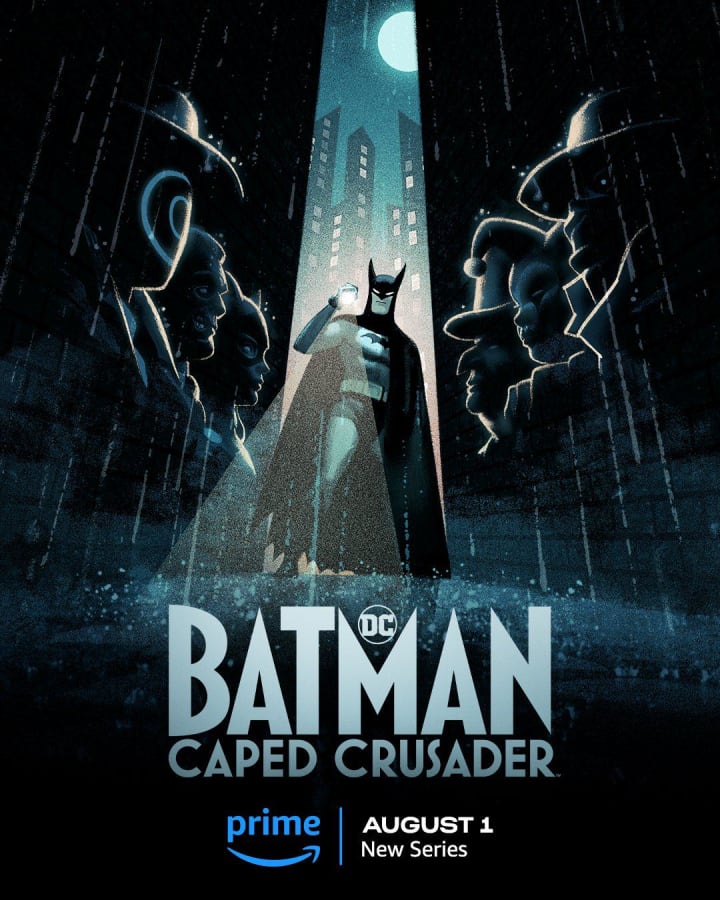
Batman: Caped Crusader looks impressive, with a strong voice cast, experienced and successful writing and production teams, atmospheric animation and an intense orchestral score. The clear artistic vision could be a real strength, but it could exacerbate many of the problems with darker versions of Batman, and the 1940s inspirations may go over the heads of casual audiences. Batman: Caped Crusader has the potential to build on the atmosphere that was so key to BTAS’s success, and develop elements that were left underexplored due to constraints of creating a show for children’s TV channels in the mid 1990s. However, it could also inadvertently prove that the lighter, more varied approach of BTAS is better for Batman. Either way, BTAS is still available on streaming and DVD, and it will be fun to compare Batman: Caped Crusader to BTAS and the many other Batman series from over the years.
Batman: Caped Crusader will return for a second series, but Brubaker will not be returning, as he has been busy focusing on Amazon Prime’s TV adaptation of his original comic series Criminal. Hopefully it will be able to build on the strengths of season one whilst managing the flaws. It takes time for shows to find their creative peak, and if Batman: Caped Crusader manages to fulfil its considerable potential, it could find an enthusiastic and devoted fanbase and influence Batman fans for decades to come…
Notes
* - Batman: Caped Crusader was originally intended for HBO Max, but they dropped the show during the notorious restructurings of Summer 2022 (where the live-action Batgirl movie and Paul Dini’s Scooby Doo animated movie SCOOB: Holiday Haunt were infamously cancelled in post-production) However, the creative team continued working on Batman: Caped Crusader, and it was eventually acquired by Amazon Prime, who also recently released the considerably more comedic Batman animated movie Merry Little Batman. By a remarkable twist of fate, screenwriter Jase Ricci wrote both Merry Little Batman and several key episodes of Batman: Caped Crusader.
** - The LA Riots – triggered by the infamous police assault on Rodney King and the dubious acquittal of the cops involved – occurred just a few months before BTAS began airing. This meant a few minor elements had to be altered at the 11th hour, but the police role in BTAS had been reduced before this – the second Writers Bible explicitly said their role should be downplayed.
*** - The main reason why Penguin and Catwoman’s elaborate backstories were not included in BTAS was because execs felt that viewers who had just seen Batman Returns would be familiar enough with these villains to not need an introduction.
**** - The Joker is also absent for now, but considering the way he has become such an overused Batman villain, I think a lot of people are glad to see him get discarded for now. There is also a risk that if he does get included, the focus on making him Batman’s No.1 archenemy could end up overshadowing the other rouges – another disadvantage with having less episodes to work with…
About the Creator
Keep reading
More stories from Rtotalmagic and writers in Geeks and other communities.
Most Unusual Batman: The Animated Series Comic Stories
In September 1992, mere weeks after the release of Batman Returns, Batman: The Animated Series premiered on Fox Kids. With a magnificent “Dark Deco” animation style, consistently excellent voice acting, well-developed takes on classic Batman heroes and villains, and more mature and varied approaches to storytelling, it became one of the most acclaimed animated series of all time, and a must-watch for anyone who wants to be seen as a Batman fan. Its success led to a handful of spin-off films (Most notably Batman: Mask of the Phantasm, two sequel series (Soft Reboot The New Batman Adventures – and the futuristic Batman Beyond) and further series for Superman and the Justice League, all from the same creative team. The complete universe became known as the DC Animated Universe, or DCAU for short.
By Rtotalmagic2 years ago in Geeks
Silver Screen Magic with Mae West
American actress and singer Mae West became a popular film actress during the Great Depression. She started entertaining in vaudeville, then performed on Broadway, and finally went to Hollywood. She signed up with Paramount Pictures and made her debut in the 1932 film “Night After Night.” She also starred in musicals, comedies, and crime dramas. The American Film Institute named her one of the best classic Hollywood actresses.
By Rasma Raisters5 days ago in Geeks
Sadie Sink Found Out About Her ‘Spider-Man’ Casting Via Online Speculation: “There’s Sometimes Some Truth To It”
Although sworn to secrecy by the MCU, Sadie Sink admits there’s sometimes some truth to the online fan theories. The actress, who will star in Spider Man Brand New Day in an undisclosed role, admitted “it’s torture” not being able to tell people which character she’s playing in the fourth installment of the Marvel Studios franchise.
By Dena Falken Esq7 days ago in Geeks
The Devil's Cut
“Comrade, finally you’re awake.” The voice was smooth, sensual. A flickering incandescent bar was all that lit the white, sterile room. All Vladimir remembered was everything going black. He tried to move his arms and found them strapped to the gurney.
By Matthew J. Fromm4 days ago in Fiction




Comments (1)
Thanks for the review