
(Almost) Every Piece of Symbolism to Look Out For in the Upcoming Chainsaw Man: Reze Arc Movie
do you prefer the city mouse or the country mouse?

Spoiler alert for the upcoming movie and the Chainsaw Man manga!
—
Guys, it’s almost time. Grab your Pochita popcorn buckets and rejoice: the Reze arc of Chainsaw Man is out in theaters in less than a week.
I could not be more excited for this movie. This is one of my favorite arcs in the entire manga, and I know, I just know, that MAPPA has done it such amazing justice. I’m ready to jump out of my skin. I cannot wait.
But in the meantime, during this devastating wait until the long-fated release date on the 24th, I thought it might be fun to share my favorite pieces of symbolism from throughout the arc, while showing anyone who isn’t super familiar with the story a little bit about what makes it so special to me along the way.
_
A Quick Synopsis:
The Chainsaw Man movie, titled "Chainsaw Man – The Movie: Reze Arc," is an anime film adaptation of the "Bomb Girl" arc of the Chainsaw Man manga, serving as the initial 2022 anime's season 2. It follows Denji, our Devil Hunter protagonist, who now lives as Chainsaw Man, a vicious hybrid of human (Denji) and Devil (Pochita, the small Chainsaw Devil that sacrificed himself to save Denji and now resides within his heart). But besides killing and maiming, and being killed and maimed over and over again, Denji faces something even more dangerous: a continuously complicated love life, involving both Makima, his mysterious and powerful boss, and Reze, a girl who works at a café with secrets of her own. Danger awaits Denji as he is further thrust into a world of violence, affection, betrayal, and Devils.
_
The City Mouse and the Country Mouse
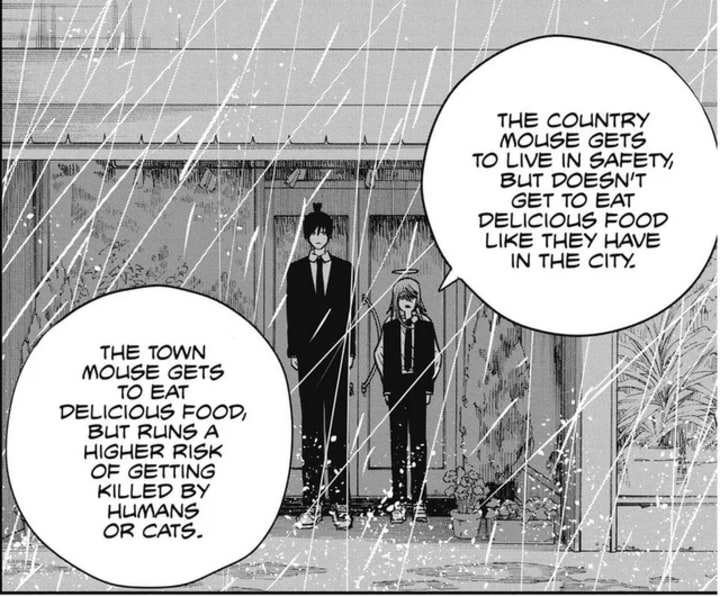
Multiple characters throughout the arc discuss which they would prefer: the city mouse, who lives a more high risk life with access to delicious food, or the country mouse, who lacks that access to delicious food in exchange for safety and security. Reze tells Denji she would prefer to be the country mouse to feel safe, whereas Denji is more unsure of which he would want to be. This tug between comfort and grandiosity is a constant struggle in Denji’s mind.
Crossroads

Reze is our new character this arc, serving as Denji's new love interest (and, spoiler alert, the story's antagonist). Crossroads is the name of the café Reze works at as a waitress, and it is where Reze and Denji share much of their time together after meeting. The café name being Crossroads is both clever and telling, as it serves as the physical intersection point of their lives with one another in them, and their experiences with one another will change their lives forever.
Additionally, Denji is also caught in several crossroads as the story unfolds. He is stuck between Reze and Makima, between human and devil, between living in comfortable slavery and seeking potential freedom.
The Movie Theater Scene
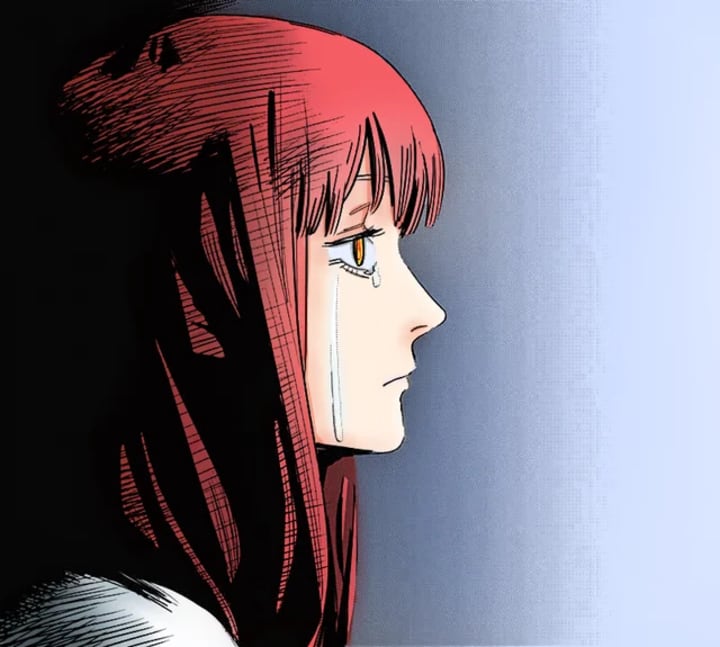
This is a famous scene in Chainsaw Man, and knowing we get to experience it on the big screen at last is so immensely awesome.
During the beginning of the arc, Makima and Denji go on a movie marathon sort of date, theater hopping the entire day. They remain fairly unimpressed with the films they see, with Denji not understanding any of the movies very much while Makima judges them individually: this one was trying too hard, that one was relying on flashiness, this one was just average. But the last movie they watch changes the tone of everything. When two characters are seen solemnly embracing one another, Denji tears up. He’s confused as to why and feels embarrassed for Makima to see him, but when he turns to look at her, she is crying as well. It’s a beautifully serene and cinematic moment that I’m so excited to watch.
Now, due to the massive reveal later on in the story that Makima is the Control Devil masquerading as a human, there is reason to believe that Makima’s tears here were just a way to manipulate Denji and create a sense of false connection with him, and it isn’t precisely wrong or foolish to believe that. But there are too many details pointing to the fact that what Makima wanted, above all else, was an equal connection with others, something she could never realistically have. She later states her goal is a life without bad things like pain and fear, but truly, she desires a life where she can be loved unconditionally, so completely that nothing can take that away from her. Paradoxically, in chasing this dream, she almost seeks to self-annihilate, for to kill fear would be to kill herself.
Can this scene have also served to further manipulate Denji, in that they shared this intimate moment right next to one another? Of course, and I don’t think Makima was unaware of this. But Makima’s tears here over watching a display of mutual love and connection makes a lot of sense; in my opinion, they are undoubtedly genuine.
Also, because I cannot shut up about Makima and the brilliance of her character, I also want to point out that she experiences all of this in a movie theater, a controlled environment where everyone is expected to do and almost be the same as they all watch the same story. This is the closest Makima can come to a sense of equality with others, stepping outside the confines of her powers of control to experience this moment as a part of an audience. Additionally, her hair, usually tied back in a braid, is worn down during this scene, adding to this idea of seeing more of Makima’s true self in this moment, unraveled and unconfined.
Flowers

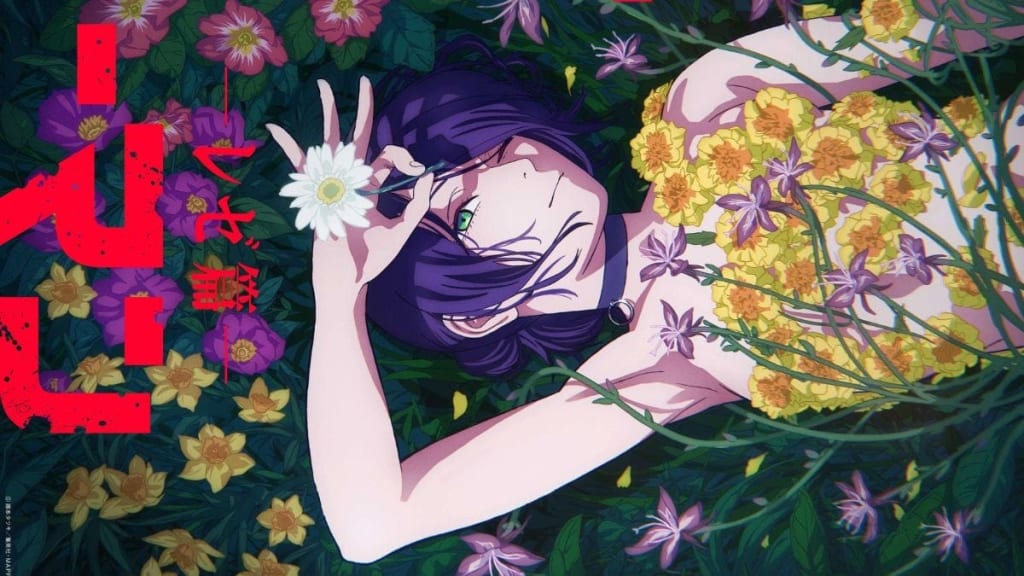
Flowers were already definitely a symbol from the manga, but the movie seems to be pushing the motif really hard in a lot of the promotions for the film as well, and I love that! Not only because I think Reze looks so beautiful shrouded in flowers, which she does, but because it’s such a visually elegant and clever representation of one of the story’s major themes: love.
Reze is depicted holding flowers multiple times. When she first meets Denji in the rain, he surprises her with a magic trick of conjuring a flower from his mouth, and she holds it up to him, smiling brightly. And at the end of the arc, she donates to the same charity Denji had donated to on the street, and she receives a flower just like he did. Gazing at this flower is what leads Reze away from the train she was about to board and back to the café to meet up with Denji again. Looking at the flower reminded her of that little moment of sweetness that they shared before all came crashing down around them.
Now—if you want to get super analytical, or just super lame and nosy like me, let’s talk about the kinds of flowers shown in the movie. The manga doesn’t give us much with what types of flowers there actually were, but with the movie adding the element of color, I did my research, and my goodness, it’s beautiful.
The flower Denji gives Reze closely resembles a white daisy. White daisies are synonymous with innocence, joy, and new beginnings—just like the one Reze and Denji embarked on after meeting. Together, they were able to act like kids for once, sharing their free time with one another and having fun. Reze asking Denji if he would run away with her before their first kiss could also fall under a potential new beginning the flower serves as a callback to.
On the other hand, the flower Reze receives at the end of the arc resembles a red gerbera daisy. These daisies, being so deep and rich in the color of love, are representative of passion and romance, of strong, swelling feelings, of a declaration of unspoken love. Which, if you know what happens to Reze in the end, makes everything even more devastating.
Flowers resemble the beauty of love for both Denji and Reze: bright and lovely and sweet, yet easily trampled by the force of the world around them.
Rainstorms

There’s a ton of rain and just general bad weather in this arc. In fact, a big section of the story takes place with all of the characters fighting in a huge typhoon. All the rain before the massive storm foreshadows the darkness and coldness to come. And the storms, both figuratively and literally, are representative of the complicated emotions that arise as the fight ensues—from Denji for sure, but for Reze as well. It’s like a massive cacophony of everyone’s emotions whipping them all around; it’s immensely awesome, and clever too.
Aki and Angel: The Concept of Time
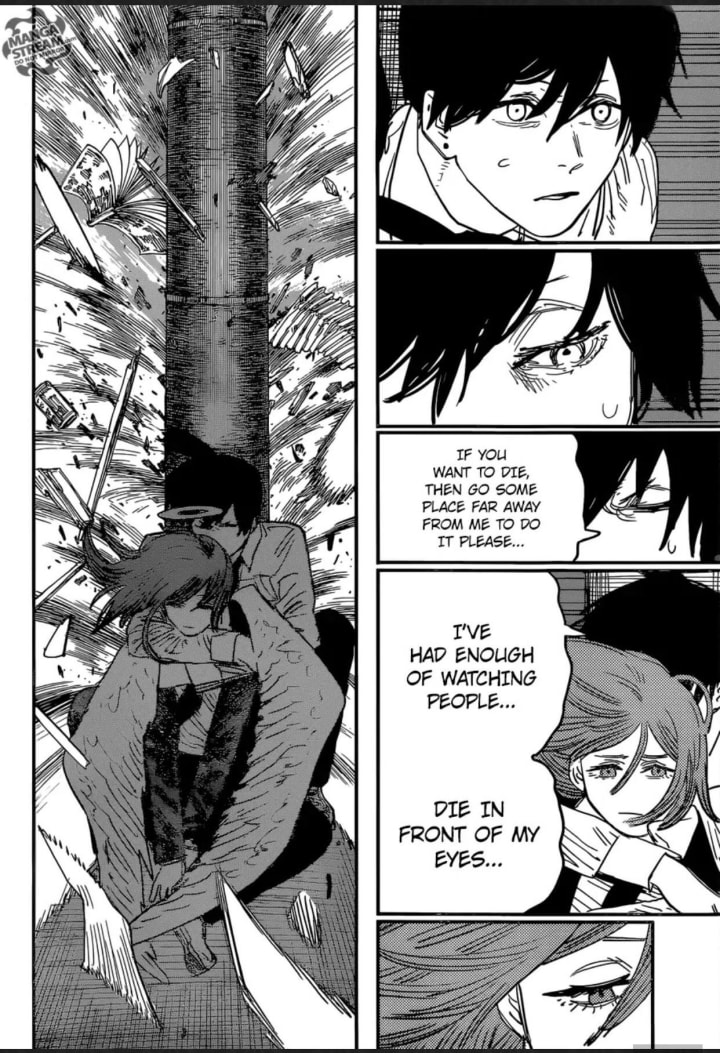
This is a very popular parallel, but a great one all the same.
In this arc, Aki and the Angel Devil get paired up for all their future missions, but they just don’t get along. Aki, a human whose family was killed by the Gun Devil, detests all Devils, while the Angel Devil, having been captured by Public Safety for his dangerous powers (he can touch people and drain their lifespans), feels no real passion for life, and certainly not for work.
Aki, having sacrificed a great deal of his lifespan for a better chance to find and kill the Gun Devil, is running out of time on earth despite his great ambitions, whereas Angel has all the time in the world, but no desire to live or to do anything with it. The way they both struggle with time, with Aki having too little of it while Angel has too much, causes them both misery and desperation, as Aki seeks to live to avenge his family while Angel longs for death.
There’s a bittersweet moment in the manga where the Angel Devil, struggling to be held by Aki against the wind by the shirt, is going to be blown away to his death by the Typhoon Devil. He tells Aki that it’s okay, he can let go, and that he’s been ready for death for a while now, and Aki does. He lets him go, and Angel begins to blow away, preparing himself for death, before Aki seizes him by the hand instead to drag him to safety, draining several more months of his already shortened lifespan. It’s a beautifully human and intimate moment, with Aki telling Angel brokenly that if he wants to die, he can do it somewhere else, because he’s sick of watching others die in front of him. This leads to a moment later down the line where Angel, who certainly wouldn’t have cared about Aki’s preferences before, takes it upon himself alone to kill someone on Makima’s orders, disobeying her by not taking Aki along to help him, wanting to save him the emotional turmoil.
With Aki serving as an example of the fragility of human life while Angel serves as an example of the dread of an endless existence, they serve as parallels to each other, which makes their shared moments and development really fascinating to see in this arc.
The City Mouse and the Country Mouse: Villain Edition

Remember the whole city mouse versus country mouse debate we previously mentioned the characters were discussing throughout the arc? Let’s revisit that for a second, because the moment above is brilliant.
On one hand, Makima is telling Reze that she understands her longing for a simple, peaceful life. On the other, she basically tells her that the entire conversation, the city mouse versus the country mouse, is more or less useless, as mice are mice and can be captured and contained no matter what. There is such a chilling, cruel tenderness from Makima here, as if she’s saying, I know and understand what you desire most, and I won’t let you have it. There is no such thing as a mouse safe from its cage.
Reze’s Death

That’s right. At the end of the arc, Reze does indeed die. After making the decision to chase after Denji after all instead of leaving everything behind, she is killed mere feet away from him by the café by Makima, with the help of the Angel Devil.
Throughout the arc, Reze shows Denji a glimpse of what it is like to be human. She flirts with him, drinks with him, laughs with him. She plays school with him. She jokes with him. She teaches him how to swim. Despite her initial intentions, Reze still shows Denji what it means to be a normal person, something neither of them have ever gotten to experience. She represents Denji’s hope, his humanity, and his capacity for love. And this is precisely why Makima kills her.
In doing so, there is a massive shift in the story. Makima becomes the predator of not only Denji’s freedom, as she has been already in the story thus far, but of his very hopes and dreams, and of his opportunity to live a normal life as well. In killing Reze, Makima eliminates even the possibility of autonomy and freedom for him. Anything that happens to him will be because she has allowed it.
“I’ve never gone to school either”

This final, heart-wrenching line from Reze is one of the last pieces of symbolism the arc has to offer, as well as my favorite by far.
As she dies, Reze reflects on her short life. As a hybrid Devil working for the Soviets, she never had the opportunity to live peacefully, to be the country mouse she wanted to be. She thinks of her connection with Denji as she stares at him, so close yet so far, waiting for her in the cafe with flowers in his hands. She wonders, just as Denji had brought up in their fight, why she truly hadn’t killed him the first day they met like she was supposed to. Instead, she stretched her mission out longer in order to bond with him. It started under the guise of manipulation, of it all being a plan of hers to get him to trust her. Yet somewhere along the way, something within her made her hesitate. Something made her care.
In her very final moments, Reze relates herself to Denji, finally admitting to the readers and to herself in her final moments that their bond was, indeed, real, and that it meant something to her. Reze had told Denji she was studying, but she lied; she, like Denji, had never gone to school, as she was working as an assassin for Russia from a very young age. She never got to live a free and peaceful life. This line shows us that at the end of the day, Denji and Reze were the same, robbed of their normalcy and utilized as weapons, with the love they could have shared taken from them by powers beyond their comprehension.
—
Thank you guys so much for reading! ♥️♥️♥️
About the Creator
angela hepworth
Hello! I’m Angela and I enjoy writing fiction, poetry, reviews, and more. I delve into the dark, the sad, the silly, the sexy, and the stupid. Come check me out!
Keep reading
More stories from angela hepworth and writers in Geeks and other communities.
Thank You, Chrollo
Spoilers for the Hunter x Hunter anime and manga! — Chrollo Lucilfer Chrollo is one of the most beloved villains in Hunter x Hunter, and for good reason. He is a very mysterious and interesting character in how tricky he can be to understand, so I want to preface this analysis by saying that all of the following is just my opinion and my personal interpretation of Chrollo’s character—unlike my Makima analysis, which is all fact. (She told me herself.)
By angela hepworth6 months ago in Geeks
Marvel Zombie
The last entry into our 2025 superhero projects catalogue is Marvel Zombies. This was a show that was anticipated by absolutely no one and it disappeared from the public consciousness as quickly as it was released. There was nothing special about the project that made it a must see, or a must remember. In fact if anything it's a must forget.
By Alexandrea Callaghan15 days ago in Geeks
Can This Love Be Translated Review
In an age when streaming platforms shrink the world into a single scroll, television has become one of the most powerful translators of culture. Stories cross borders faster than ever, yet they often carry the same central question: can people truly understand one another when they come from different worlds? The television show Can This Love Be Translated? builds its emotional core around that very idea, using romance as both its subject and its testing ground. More than a simple love story, the series explores language as metaphor, barrier, and bridge—asking whether love itself is something that can ever be fully translated.
By David Cook4 days ago in Geeks


Comments
There are no comments for this story
Be the first to respond and start the conversation.