
Thank You, Chrollo
or: if chrollo has no fans, i am six feet under this earth


Spoilers for the Hunter x Hunter anime and manga!
—

Chrollo is one of the most beloved villains in Hunter x Hunter, and for good reason. He is a very mysterious and interesting character in how tricky he can be to understand, so I want to preface this analysis by saying that all of the following is just my opinion and my personal interpretation of Chrollo’s character—unlike my Makima analysis, which is all fact. (She told me herself.)
Chrollo, to be blunt, confuses the hell out of me. I was looking for a place to start with him, waiting for some brilliant thesis statement to come to mind about who he is and what he stands for, but I came up completely blank, because there is no way to really summarize Chrollo into one singular belief or philosophy. And it’s not because Chrollo doesn’t have any ambitions or beliefs, because he does. It’s because these beliefs and views are constantly conflicting with one another.
Chrollo contemplates his purpose in life, but he operates like a nihilist. He cherishes his loved ones that have passed, but largely views all human life as meaningless. He is capable of strong human emotion, but he sees himself as an outlier from the rest of humanity, completely detached from his human core. He was initially driven to kill for the sake of protecting himself and his followers, but he has trouble expressing this connection with them in a real and emotional way. And he is a leader of a troupe with no solid convictions or goals in sight.
From this, it’s easy to see that Chrollo Lucilfer is lost. Lost within himself and his own hypocrisies and contradictions, lost in the depths of his own mind, lost within the confines of his own past and body and soul.
To cope with this lostness, Chrollo engages in many experiences, in several different versions and variations of himself and his life, to propel himself forward, onwards, and away from his inner turmoil. Violence, for the spectacle. Manipulation, for the ego. Cruelty, for the sake of performing it. Leadership, for a sense of purpose. And acceptance, of both himself (well, allegedly—we’ll get into that later) and the world he lives in, for the sake of surviving in it.

It’s interesting to analyze an antagonist with such a conflicting state of mind, as well as one possessing a such complex and oftentimes perplexing moral code. But for me, the beauty of Chrollo’s character comes from his subtleties on the surface, which help us understand his deeper self. Behind the calm, cold version of Chrollo that he projects, there is a deep and visceral turmoil brewing underneath it all. For someone so well-spoken and intellectually minded, it takes a moment to see and to truly understand the depths of Chrollo’s madness.
One of my favorite aspects about Chrollo is that he is a deeply philosophical antagonist. He is constantly thinking and reflecting on the concepts of death, humanity, and fate, and despite having no real answers or single solid philosophy, he contemplates these topics all the same. For a character so seemingly detached from his humanity, it is humanity’s deepest experiences, unique to only them, that plague his mind constantly: loss, grief, fate, a sense of purpose, human connection, and loneliness.
We’ll dissect these and what they mean personally for Chrollo:
Grief & Loss
Chrollo’s backstory has this central theme of loss surrounding the death of a friend and his own inability to properly deal with it, which is carried with him into adulthood. It is this initial grief and loss that causes him to make the active change, even as a very young child, to become a colder, and therefore stronger, person, channeling his once light-hearted and passionate talents to fuel his own darkness.
Chrollo grew up in a place called Meteor City, a run-down city brimming with crime and outcasts. He was a part of a theater troupe, putting on performances for the other children in town, and he was able to make the most out of his life, even in the trenches of society, with his friends. But when his friend Sarasa is kidnapped and brutally murdered by traffickers, with her remains left behind for Chrollo and his friends to find, he is forever changed.
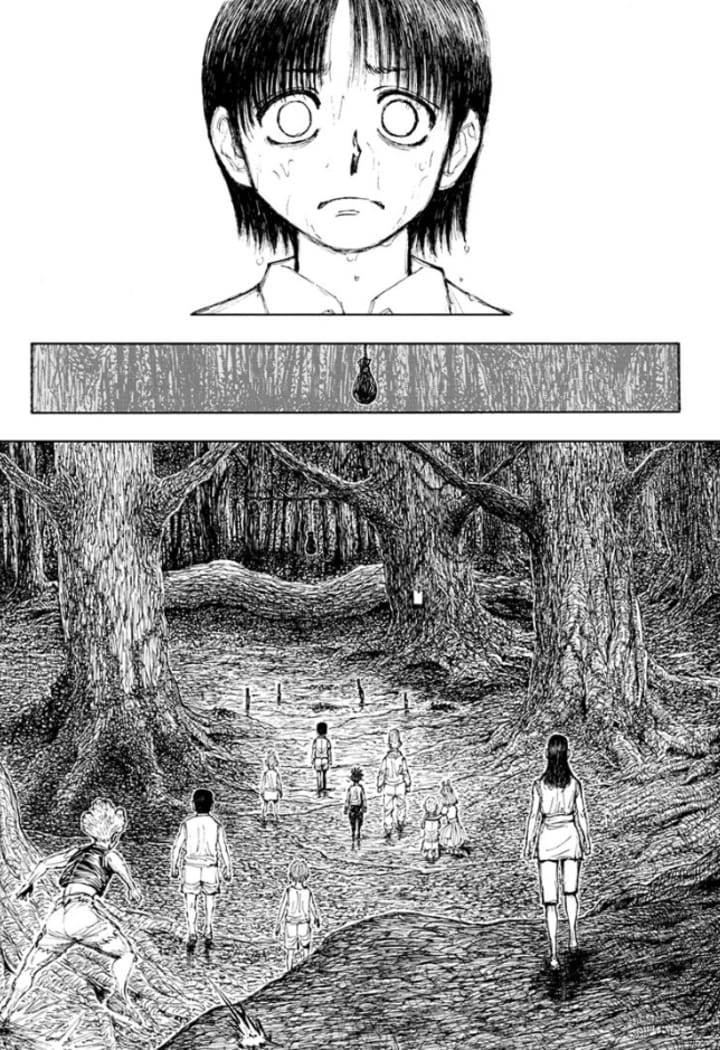
A friend’s gruesome death would be deeply traumatic for most to witness, but it’s Chrollo’s reaction to this trauma that is so interesting in particular. Sarasa was a very kind and cheerful kid, and her light being stolen away became the death of hope and innocence in Chrollo’s life. He realized there was no meaningful future for himself, or for any of his friends, the way things were now. He realized that the rest of the world saw his life as meaningless, as disposable, as nothing. And he realized that he could do something about it, even if it meant committing to a role he would never be able to resign for good.
Sarasa’s death to Chrollo was not a tragedy first and foremost, but rather a stark symbolic moment in his own life, a flip of a switch that could never be turned back off. After finding his friend’s mutilated body, Chrollo commits himself to a life of villainy. He converts his grief into ideology, using Sarasa’s death as a stepping stone to reach for something—control, power, vengeance—to hold onto instead of hope, which was long gone. Whereas grief can often paralyze, it does the opposite for him here; it fuels Chrollo into action.
Through this backstory, we can see that Chrollo deals with grief through compartmentalization. Despite his horror and pain over finding his friend in such a state, he never shed tears over Sarasa. He never mourned her in a traditional way. All of that hurt and trauma was completely internalized, repressed, and pushed down as weakness—as helplessness.
Instead, Chrollo took an intellectual approach to navigating her death. He became stuck in thought about what this meant for the world as he knew it. He was able to put his pain and anguish to the side to do what he felt must be done. He was able to put his morals aside, alongside other people's potential judgements (even Sarasa’s judgement, as he says he would apologize to her if they ever met again for choosing this way of life), to pursue a new way of life, since things could never simply return to the way they were before. Chrollo’s pain was immediately channeled into action, and then, into revolution.
Another time we see Chrollo experience grief is when he finds out that Uvogin, another close comrade of his and a member of the Troupe, has been killed by the Mafia.

Again, Chrollo turns his grief into action. He orchestrates a requiem as the Troupe slaughters Mafia members left and right, wreaking havoc and causing destruction. This is his way of grieving, mourning Uvo’s death through death itself, turning trauma into a dramatized chaos he can control—a brutal yet deeply emotional display of passion, vengeance, and eternal unity.
Chrollo treats grief as a ritual, a duty to be fulfilled, in order to normalize it and cope with it as his reality. He turns grief into a performance, a show. He was willing to turn himself into a character to prevent anything horrific from happening to his friends again—by committing horrific acts himself. But by making this choice, and by “becoming” this person as much as one can become another, he drifts away from both his loved ones and from his real sense of self, retreating into the darkness of his own mind.
It’s difficult to be a contemplative, hypocritical antagonist carrying around all those heavy emotions; they just might arise and strike and try to change you, divert you from your path or from your philosophy, and Chrollo is well aware of this. He even experiences this impact a bit when Gon, the show’s protagonist, angrily asks Chrollo why he can hurt people who have nothing to do with him. Gon, who was so similar to Chrollo as a kid, who represents the passion and the innocence Chrollo lost, posing that question to an adult Chrollo throws him off kilter.
Instead of having a sure-fire answer locked and loaded, as most antagonists would, Chrollo thinks about the question before essentially responding that he does not have a good answer to it; this can be taken one of two ways. It can mean that he doesn’t know why he is killing people, as in he doesn’t know how to express the Troupe’s motives when it comes to killing. This isn’t the best guess, especially since Chrollo says previously that the Troupe does have goals and ideals, but that he just struggles to express them verbally in a way that makes sense and does not like doing so.
More likely, in my opinion, Chrollo is contemplating that he doesn’t know why he is able to kill people without remorse, but either way, he believes that finding this answer may be the key to understanding himself. And in seeing this moment, we see him grieve his past self as well.

While Chrollo does not directly repress all of his emotions in response to his grief and trauma, he does constantly compartmentalize them, as well as his own humanity, in favor of being the leader of the Phantom Troupe. He initially chose this persona of a calm, cold, and collected antagonist, unfazed by the chaos that consistently unfolds all around him, in order to protect those around him and to change their world. But what he struggles with is this idea that he chooses to uphold this persona to protect himself, someone he deeply struggles to understand and know. He doesn’t know any other way to deal with the state of the world, or the state of himself, rather than what he practices, and he’s lost himself along the way.
Fate & Sense of Purpose
Even from his early appearances, it is clear to us that Chrollo is not someone who particularly values human life. In fact, one could say he deems all life meaningless, including his own.
The main idea of the Phantom Troupe, or the Spider, relies on this ideal, that human life is replaceable and insignificant, and that death means nothing at all. If Chrollo were to die, another one of the legs of the spider would simply replace him as the head.
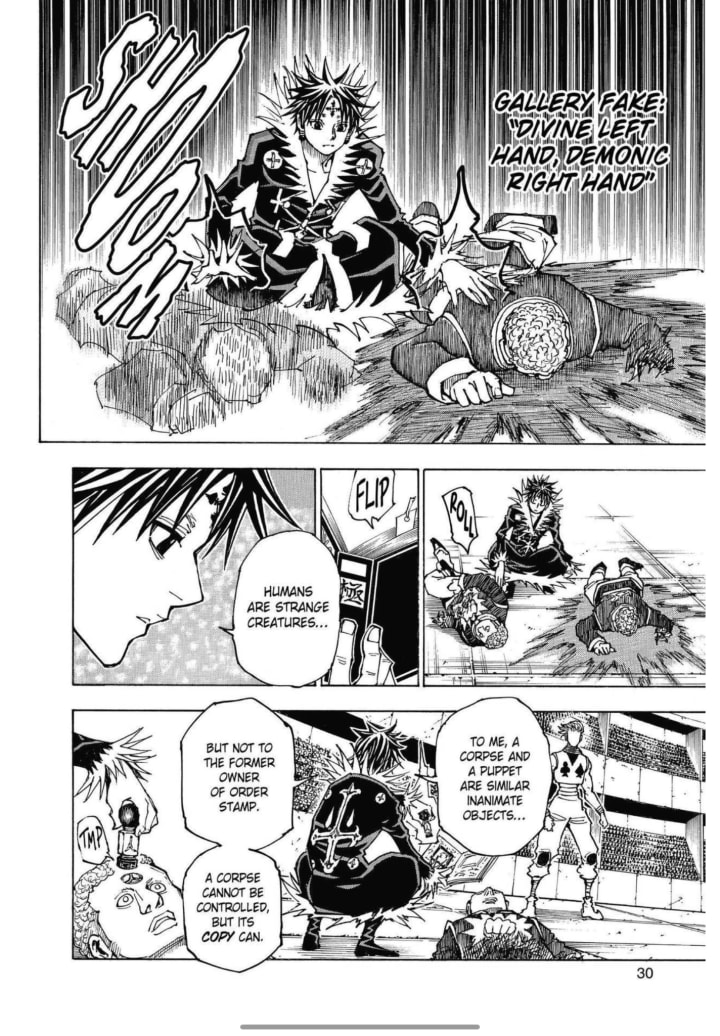
Chrollo reiterates this same pragmatic belief again in his later fight against Hisoka, comparing humans to puppets. Both are to be controlled while they can be and discarded when they are done, and there is no real difference between the two. So it can be said that Chrollo believes humans are to be seen as tools or utilities rather than as people, and that they have no purpose otherwise.
This is a great place to delve into another one of Chrollo’s hypocrisies: his views on fate and purpose, and how that contrasts with his actions.
Chrollo famously stated that Judas, the famous traitor to Christ, was actually nothing of the sort, because he lacked the free will to choose to betray Jesus. Because the event was unavoidable, Judas was not truly a traitor, but rather a victim of circumstance, of fate, and of his own lack of choice and agency. In other words, we are who we are no matter what, and nothing can change that. Our fates alleviate all blame from us, and our predestined lives serve as a sort of eternal victimhood. We are slaves to fate, and we have no control over what we do or how we choose to live. Therefore, trying is futile, and human life is, overall, meaningless.
This being said, Chrollo is a pretentious fool and a fraud and a damn liar, because he seeks out a fortune telling ability for the sheer purpose of trying to avoid certain fates. He aims to move the Troupe out of Yorknew City for the sheer purpose of avoiding the death of half of them as he saw in a future fortune. A part of Chrollo, therefore, believes that fate can indeed be railed against, and that free will amongst humans is a thing of reality.
As for fate alleviating all blame and wrongdoing, Chrollo is able to grant Judas that kindness, but he struggles to grant that same grace to himself. He grapples with guilt and a heavy sense of responsibility for not being able to protect Kortopi and Shalnark from Hisoka further down the line, blaming himself. When he is personally impacted, fate is not enough to alleviate all feeling; he still feels the burden of shame and responsibility.

Chrollo’s views on fate are conflicting, but his views on human purpose, or rather a lack of it, are more firmly rooted in nihilism, spurred on from personal experience and a deep lack of understanding within himself.
Chrollo’s Nen ability is called Skill Hunter, which allows him to steal abilities from other people. This is fascinating for a number of reasons: one, because it’s insanely strong and awesome, and two, because it highlights Chrollo’s extreme identity issues. It is very telling that he does not possess his own powers, but rather takes them from others.
To Chrollo, this is using his talents as a strength. Just as Chrollo borrows abilities, he is also constantly borrowing masks, putting different versions of himself forward and seeing which one sticks, or which one fulfills him the most in that moment. He truly encompasses and becomes those he takes abilities from, even going so far as to express his pleasure in doing so to Hisoka during battle.
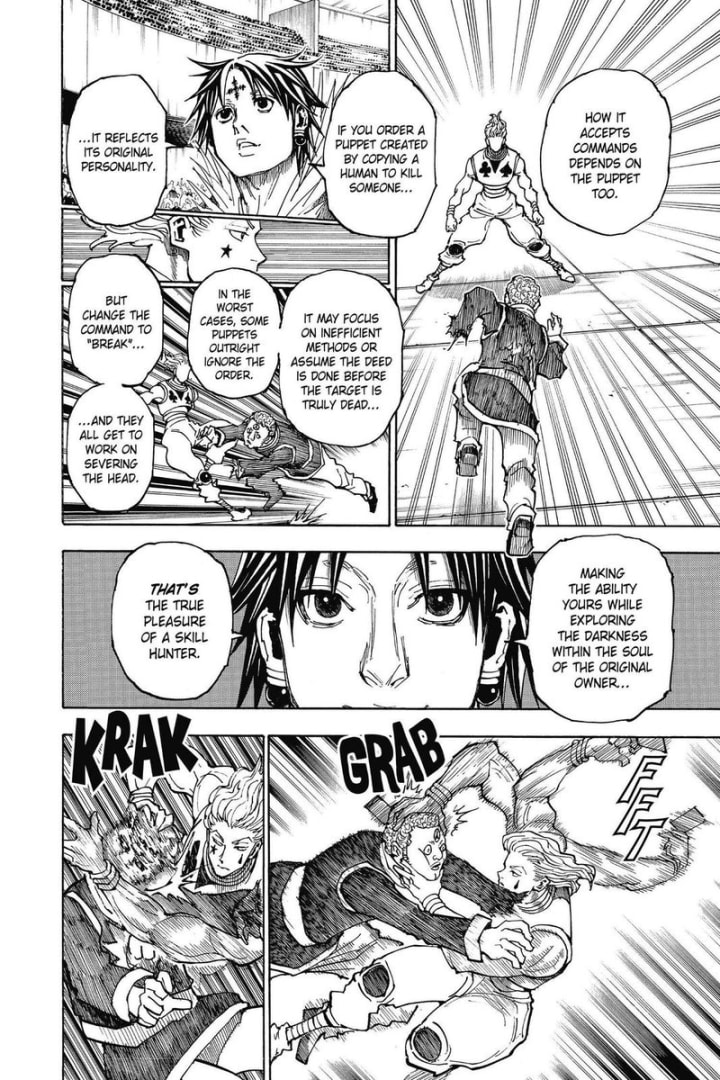
Chrollo seeks to fill his own void with these endless impersonations and thieveries of others, since he cannot connect with other people, even those he cares for, in healthy or conventional ways. And strengthening his view of fate is the way that Chrollo was always like this—always an actor, and always devoted to the craft of dramatizing his life to make it more worth living.
Chrollo’s outwardly thoughtful and reflective nature contrast quite harshly with his brutality in using this ability. His nihilistic qualities, born out of his own trauma, do not disqualify his human emotions, but rather transcend them. Chrollo consistently chooses ideology over feeling, but the feelings he has persist nevertheless. He chooses strength over weakness, calmness over furious rage, chaos over order—but he is all-encompassing and experiences all of these things, stuck in this lonely loop of self-obsession, self-preservation, and human existence.
Loneliness & Human Connection
Chrollo possesses a chronic sort of loneliness. Despite being the leader of the Troupe, and despite genuinely caring for his comrades, he is disconnected from them due to being stuck within the confines of his own mind. He is trapped within himself, obsessing over himself and how he feels and what he believes even though he oftentimes does not know or have the answers.
It is a devastating loop, the desire to understand and the lack of answers, the actions we take and the spiraling of our minds, and the loss and grief and the emotional response that comes, whether “right” or “wrong”, in our own realities.
Chrollo’s personal philosophy transcends that of human morality. The world is chaotic and vengeance is inevitable, as is pain, and we are powerless to stop fate; the only thing we can do in response is revolt in the ways in which we know how. Chrollo had to become strong through these concepts of stoicism and nihilism to accept his reality at hand in the only way he knew how. He felt that he had to inflict pain on others to accept and understand his own pain, and even after it all, he feels lost and confined and afraid.
The darkness within Chrollo, when paired with his thoughts and his obsession with understanding himself, prevents him from truly connecting with other people, and being robbed of that experience just by existing within one’s own mind is a loneliness very few can understand.
As for love, Chrollo keeps it at a distance. His only emotional attachment is to the Spider, and this becomes love as a collective rather than love of multiple individuals—a safer, more guarded sort of love, a more transactional kind of care, so that he won’t get hurt when he loses a part of it, and so that losing it entirely is a near impossibility.
Lacking a sense of self as much as he does, love and closeness are very strange to associate with Chrollo. He is extremely detached despite having quite a human core, with his feelings buried so deep that they are hardly a factor in his life anymore. We see him experience closeness in the form of stealing and taking parts away from others through his ability instead of generating any genuine sense of intimacy with them. Even his way of connecting with others becomes something that must be forced and controlled.

In his battle against Hisoka, Chrollo’s way of fighting is much more detached. Whereas Hisoka loves the thrill of battle with another (intimacy through violence/death), Chrollo treats it much more methodically, turning it into an aesthetic sort of performance rather than a true and meaningful collision. Chrollo doesn’t have any real emotional stake in the battle, even when he kills Hisoka, because to him, all life is fleeting and meaningless, and connection in this way, through battle, does very little for him as an individual.
He sets up the battle like a performance with no regard for fairness, and he observes Hisoka’s passion and emotional attachment to fighting, and therefore to him, as something intriguing and fascinating. He finds such an outward display of humanity almost amusing due to how disengaged he is personally with any sort of love or connection in that way.
Chrollo’s approach to battle, and to violence in general, is always analytical. His way of fighting is carefully orchestrated and strategically planned. This goes for the way he sees other people as well, hindering his abilities to connect with others. Humanity is a subject to examine from a distance for Chrollo rather than something to relate to. All his connections are derived from a sense of shared identity and purpose rather than an emotional sort of love, though that love does exist as well within those confines. And his intrigue towards others is driven by an intellectual wonder rather than an emotional interest.
Chrollo’s compartmentalization of his emotions, and his denial of his own humanity, contribute majorly to his identity issues and to his general isolation. This emotional repression is both necessary and tragic, both strength and strain, and Chrollo has a rough go of understanding what it all means for who he is.
Does Chrollo accept himself? In a way, he does. He doesn’t change. He stays confident and true to his ideals. He never justifies his own actions, but rather just commits them. He adapts to situations, even dangerous ones, with ease and acceptance. He accepts the emptiness he feels and continues to exist with it.
But in another way, Chrollo can’t accept himself for who he is. He doesn’t seek happiness, riches, or stability. He surrounds himself with suffering, bleakness, silence, and despair. He drowns himself in his own miserable thoughts. He constantly leads himself and the Troupe into dangerous situations, putting them all at risk, because none of it truly matters; nothing he touches deserves to last.
Above all else, to wrap things up, Chrollo is a character shrouded by mystery, with his backstory providing somewhat of an explanation for his present day self while leaving even more questions unanswered. One thing is for sure: Chrollo is an antagonist well aware of many of his contradictions. Even so, he made his choice of how he lives his life, and he grapples with accepting that. He chooses to consistently intellectualize his cruelty, as well as keep a distance between himself and all others, in order to distract himself from the lostness and the emotional vacancy at his core—the very things that eat him alive.
Read Hunter x Hunter, everyone.
—
If you guys would like to check out my first installment of this little now-series, you can find it below:
About the Creator
angela hepworth
Hello! I’m Angela and I enjoy writing fiction, poetry, reviews, and more. I delve into the dark, the sad, the silly, the sexy, and the stupid. Come check me out!
Keep reading
More stories from angela hepworth and writers in Geeks and other communities.
The Rachels - 2025
Much to my surprise, I have kept a list of the films I‘ve seen this year. I daresay it isn’t complete. There will be films that snuck in on a late night in front of the TV that I would’ve forgotten to note. Or others, that I went to watch at the cinema, but then had a red wine and promptly forgotten about. But it’s not a bad approximation of the films I’ve seen this year. In total, there are 53 films listed, so an average of one a week and one for good luck.
By Rachel Robbins15 days ago in Geeks
Jay Kelly
Jay Kelly is one of the movies that slipped through my fingers last year but we are getting to it before Oscar nominations so it's a win I guess. I am a fan of Adam Sandler as a person but not as much as an actor and I never understood the fascination with George Clooney so I didn’t have a strong inclination toward this movie. That said, it was on the to do list so here we go.
By Alexandrea Callaghan2 days ago in Geeks



Comments (2)
I met a few Chrollo in my life. This certainly make me want to look into this anime
Chrollo for sure is veryyyyy complicated. And he definitely has ASPD (Anti Social Personality Disorder) and a psychopath. I'm a nihilist too and I feel life is meaningless. But unlike him, I value the life of others. It's only mine I don't value. I can't decide if I like him or not, but he's a very well developed character!