
King Tut’s Out-of-This-World Blade
The Cursed Tomb, A Space Dagger, and a Fatal Bite

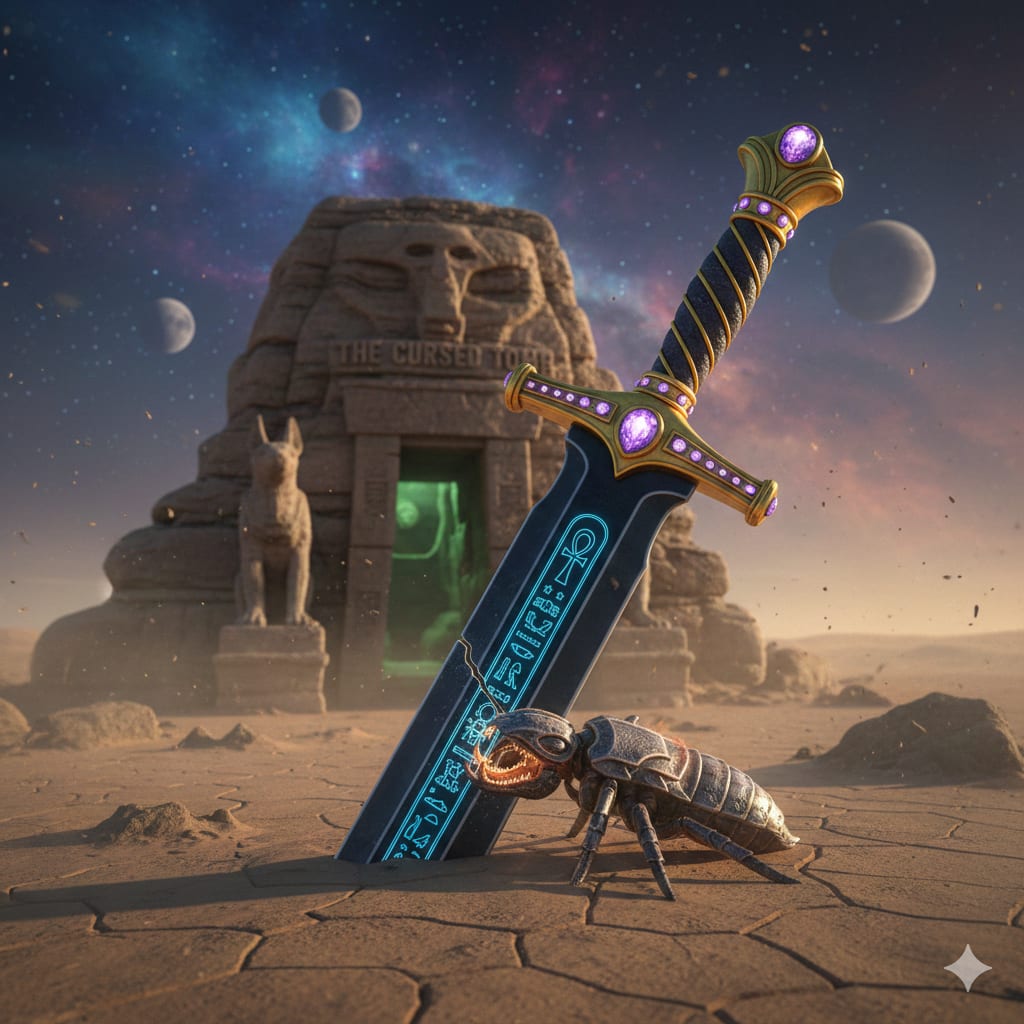
Researchers love digging up old bodies and taking away everything they’re buried with in the name of science. So, back in the 1920s, when scientists discovered the cursed tomb of King Tutankhamun (and yes, it’s cursed, but we’ll get to that later), they naturally hauled off all his priceless treasures.
Among the artefacts were two daggers hidden within the folds of the mummified body. One was made of gold, and the other was made of something genuinely out of this world.
The 34-centimetre-long dagger had a decorative gold handle with a crystal knob at the end. The blade itself was clearly iron of some sort and was encased in a gold sheath. This blade caused a massive stir among scientists because iron was incredibly rare in the Bronze Age, even more valuable than gold.
Metal from the Sky
For a long time, researchers have speculated that this dagger, along with other iron objects found in ancient Egypt, was actually made from meteorites. Ancient Egyptian hieroglyphics even mentioned materials they called “metal from the sky.”
The problem? Most confirmation methods involve taking a sample of the blade, which means destroying a part of it to look at the components. That’s a bit of an issue when your blade is not only a priceless artefact but a priceless artefact from a cursed tomb.
Recently, though, scientists from Italy and Egypt found a way around this. They used a new and non-destructive technique called X-ray fluorescent spectroscopy, which basically shoots X-rays at the target and analyses the results.
According to their findings, which were published in the Journal of Meteorites and Planetary Science, the blade is made of iron, nickel, and cobalt. This combination doesn’t just suggest a meteoric origin; it’s nearly identical to a meteor found 150 miles west of Alexandria.
The authors of the report noted that the ancient Egyptians, like other ancient people of the Mediterranean area, knew that these rare chunks of iron fell from the sky as far back as the 13th century B.C.E., anticipating Western culture by more than two millennia. They suggest that the ancient Egyptians placed great value on meteoric iron for creating fine ornamental or ceremonial objects up until the 14th century B.C.E.
The Curse: Fact or Fiction?
Ever since the tomb was discovered in 1922 by archaeologist Howard Carter and his sponsor, George Herbert, the 3,300-year-old burial site has been an object of fascination and mystery. Herbert died about a year after the tomb’s discovery, from a mosquito bite.
A mosquito bit him, he somehow shaved the bite, it became infected, and he died.
Other deaths followed: another member of the excavation team died of arsenic poisoning, and a radiologist who X-rayed King Tut’s mummy died of some mysterious illness. All in all, about 10 people who were part of the excavation team died in the following years.
I’m not saying it’s the mummy, but it’s… well, you get the idea.
So, did they die because of a curse? I’m not sure, but I’m curious to know what you think. I, for one, would never mess with the dead or anything that could potentially be cursed. I actually believe in that stuff. If someone dies, you should just leave that person alone. No digging up their bodies and putting them in a museum. No, taking all their treasures.
It’s funny, if you look into cursed tombs, you’ll see a lot of scientists say that these warnings, which often threaten a horrible death if the tomb is disturbed, were just left there to deter grave robbers. They say it’s just a fake warning that doesn’t mean anything.
But what if the curse is real? I’m not taking that chance. How do I know that curse isn’t going to somehow sense a mosquito and bite me to death?
Also, King Tut’s meteorite dagger. Doesn’t that make it kind of like a lightsaber? I mean, like a lightsaber, that dagger could be made from material that was from a galaxy far, far away.
Here’s the question for you: If you came across a tomb filled with priceless treasure, but the tomb clearly warns that if you disturb it, you’ll be stung by a thousand bees and die a horrific death, would you still excavate?
About the Creator
Areeba Umair
Writing stories that blend fiction and history, exploring the past with a touch of imagination.
Keep reading
More stories from Areeba Umair and writers in FYI and other communities.


Comments
There are no comments for this story
Be the first to respond and start the conversation.