
"Bombardier Beetle: Nature’s Tiny Chemical Warrior"
"A beetle with built-in chemical defense, this insect blasts hot, toxic spray at its enemies — a marvel of miniature science and survival."

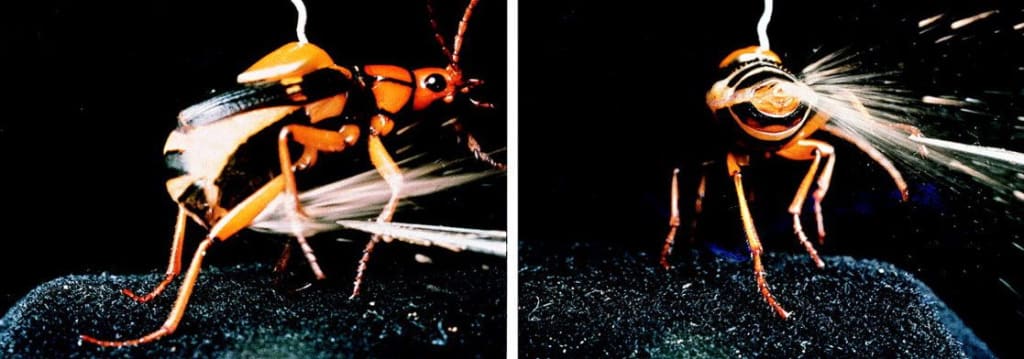
When we think about deadly creatures in the animal kingdom, we often imagine lions, snakes, or sharks. But some of the most fascinating — and dangerous — life forms are much smaller and more mysterious. One such creature is the Bombardier Beetle, a tiny insect that packs a powerful punch using chemistry straight out of a science lab.
This remarkable beetle has developed one of nature’s most effective and explosive defense mechanisms: when threatened, it fires a boiling, toxic spray from its abdomen with a loud popping sound. This spray can repel and even injure predators many times its size. Let’s dive into the explosive world of the Bombardier Beetle and learn how it earned its dramatic name.
---
A Natural Chemical Reactor
What sets the Bombardier Beetle apart from other insects is its internal chemical weapon. Inside its body, it stores two separate chemical compounds — hydroquinone and hydrogen peroxide — in different chambers. When the beetle feels threatened, it quickly mixes these chemicals in a reaction chamber near the rear of its abdomen.
The resulting chemical reaction is incredibly exothermic (heat-producing). The mixture instantly heats up to around 100°C (212°F) — the boiling point of water — and is expelled from the body as a hot, noxious gas and liquid spray. This is not just warm mist — it’s a mini chemical explosion, often accompanied by a loud pop sound, which can startle or harm predators like frogs, birds, or spiders.
---
Precision and Control
You might think such an explosive creature is always on the verge of blowing itself up. But the Bombardier Beetle’s body is engineered with incredible precision. The reaction happens in a reinforced chamber, and the beetle has a rotating turret-like tip at the end of its abdomen that allows it to aim in multiple directions — even backward over its own body!
This directional spray gives it a serious advantage. If a predator tries to grab it from any angle, the beetle can twist and fire its hot spray in the exact direction needed. Some scientists describe this mechanism as a natural form of biological artillery.
---
A Lesson in Evolution
The Bombardier Beetle’s defense system has long fascinated biologists, chemists, and even military scientists. How did such a complex, controlled chemical reaction evolve in a tiny insect?
Many believe it’s the result of incremental evolutionary changes. Over millions of years, the beetle’s ancestors may have used simpler chemical defenses that gradually evolved into this sophisticated reaction system. Today’s Bombardier Beetle represents one of the most advanced examples of chemical weaponry in nature.
Interestingly, because the mechanism is so complex, some have used it as an argument in discussions about intelligent design — the idea that such features are too complex to evolve naturally. However, scientists have found evolutionary explanations that show how such systems could emerge step-by-step.
---
Global Variants
Bombardier Beetles aren’t a single species — they’re a group of over 500 species found across the globe, from rainforests to deserts. Most are found in Africa, Europe, Asia, and the Americas. While their appearances may vary slightly, their defense mechanism remains largely the same.
They tend to live in leaf litter, under rocks, or in other moist environments where predators lurk. Despite their small size — often less than an inch long — they are highly respected by predators. Few animals attempt to eat them more than once!
---
Human Curiosity and Research
Because of their unique abilities, Bombardier Beetles have been studied for decades in laboratories. Scientists are especially interested in the fluid dynamics, heat control, and explosion timing involved in their spray. Understanding these could help develop new technologies in areas like medicine, material science, and even defense systems.
For example, the beetle’s ability to store and mix volatile chemicals safely has inspired ideas for safe chemical storage and micro-injection devices.
---
Final Thoughts
The Bombardier Beetle might be tiny, but it stands as one of nature’s greatest examples of survival, adaptation, and raw scientific wonder. It reminds us that even the smallest creatures can be armed with astonishing powers — and that nature still holds many secrets waiting to be discovered.
So the next time you’re walking through a forest or flipping a rock, remember: you might just be near one of the world’s tiniest warriors, quietly waiting, ready to fire.
About the Creator
Keep reading
More stories from Insect Legends and writers in FYI and other communities.
"Crows and Ravens: The Brains Behind the Beak"
When we think of intelligent creatures, our minds often jump to dolphins, primates, or elephants. But few people realize that some of the smartest minds in the animal kingdom are flying right above us—crows and ravens. These black-feathered birds, often misunderstood or associated with darkness and death in folklore, are actually incredibly clever, emotionally complex, and socially advanced.
By Insect Legends10 months ago in FYI
Silver Screen Magic with Mae West
American actress and singer Mae West became a popular film actress during the Great Depression. She started entertaining in vaudeville, then performed on Broadway, and finally went to Hollywood. She signed up with Paramount Pictures and made her debut in the 1932 film “Night After Night.” She also starred in musicals, comedies, and crime dramas. The American Film Institute named her one of the best classic Hollywood actresses.
By Rasma Raisters4 days ago in Geeks




Comments
There are no comments for this story
Be the first to respond and start the conversation.