
Alejandro Jodorowsky
The Visionary Maverick of Cinema and Beyond


Alejandro Jodorowsky stands out as one of the most intriguing and impactful figures in modern art. As a filmmaker, author, spiritual leader, and comic book artist, he has dedicated decades to expanding the limits of creativity across various fields. His artistic output is marked by elements of surrealism, mysticism, and a relentless pursuit of unconventional narratives. While he is perhaps most recognized for his cult classics El Topo (1970) and The Holy Mountain (1973), his ambitious but unproduced adaptation of Dune is often regarded as one of cinema's most iconic "what if" scenarios. This article delves into Jodorowsky’s film legacy, his pursuits outside of cinema, and the legendary Dune project that, despite never coming to fruition, has left a lasting impact on generations of filmmakers.
Born in Chile in 1929, Jodorowsky initially pursued a career in theater and mime before moving into filmmaking. His early works, including Fando and Lis (1968) and El Topo, became cult classics, merging Western elements with psychedelic visuals, violence, and spiritual themes. El Topo, in particular, gained significant attention after being endorsed by John Lennon and Yoko Ono, which led to its release in the U.S. as one of the pioneering "midnight movies," a term used to describe films that gained popularity during late-night cult screenings.
The Holy Mountain (1973) solidified his status as a cinematic innovator. This surreal exploration of alchemy, religion, and personal transformation was partially funded by Beatles manager Allen Klein. Its visually captivating and symbol-rich storyline was unprecedented for mainstream audiences, establishing it as a landmark in avant-garde cinema.
Jodorowsky's subsequent films, including Santa Sangre (1989) and The Dance of Reality (2013), further delved into themes of trauma, spirituality, and surrealism. He frequently eschews conventional narrative frameworks, opting instead for dreamlike sequences that prioritize the subconscious over straightforward storytelling. This distinctive style has influenced filmmakers such as David Lynch, Nicolas Winding Refn, and Guillermo del Toro.
After the failure of his Dune project, Jodorowsky redirected his creative efforts towards the world of comics. In partnership with the renowned artist Jean "Moebius" Giraud, he produced The Incal (1981), a science fiction masterpiece that incorporated themes from his unrealized Dune adaptation. This series became a pivotal work in graphic literature, leaving a lasting impact on subsequent creations such as The Fifth Element and Heavy Metal 89.
Further developing this universe, Jodorowsky co-created The Metabarons, a fierce space opera that delves into themes of lineage and fate. His comic works are as rich in philosophical content as his films, intertwining metaphysics, violence, and existential exploration.
Jodorowsky is a well-known tarot reader and the creator of "psychomagic," a therapeutic approach that merges elements of shamanism, psychology, and performance art. He posits that symbolic actions—such as rituals, gestures, or even orchestrated events—have the power to heal profound emotional wounds. His book, Psychomagic, elaborates on this philosophy and has garnered a global following.
In 1975, Jodorowsky set out to adapt Frank Herbert's Dune, a book considered "unfilmable" because of its intricate worldbuilding. His ambitious plan was to create a monumental 10-to-14-hour film featuring talents like Salvador Dalí, Orson Welles, Mick Jagger, and Pink Floyd. He gathered a team of "spiritual warriors," which included notable figures such as Moebius, H.R. Giger (known for Alien), and Dan O’Bannon, the screenwriter for Alien.
The project's budget soared to $15 million, a significant sum in the 1970s, with $9.5 million allocated solely for pre-production. Dalí insisted on a fee of $100,000 for each hour of filming, and Jodorowsky consented, intending to complete his scenes in just one hour. However, Hollywood studios, daunted by the film's ambitious scope and Jodorowsky's unwillingness to make concessions, pulled their financial support. By 1976, the vision had come to an end.
Although it was never produced, Jodorowsky's Dune made a lasting impact on the film industry. The storyboards made their way through Hollywood, influencing major films like Star Wars, Alien, and Blade Runner. Ridley Scott brought on Moebius and Giger due to their contributions to Dune, which ultimately shaped the iconic visuals of Alien.
The 2013 documentary Jodorowsky’s Dune preserved the legacy of this ambitious project, highlighting its unrealized potential. Jodorowsky himself reflects on it philosophically, stating, "I aimed to create a sacred film, an LSD experience without the drug. It would have transformed cinema forever."
Alejandro Jodorowsky's career transcends conventional classification. Through his films, comics, and spiritual insights, he has persistently pushed the boundaries of artistic expression. Although his version of Dune may never come to fruition, its essence continues to resonate in the works it has inspired. Now at 96, Jodorowsky stands as a testament to limitless creativity—demonstrating that some visions are too expansive to be realized in one lifetime, yet their reverberations influence the future.
He once remarked, "The only way to be free is to go beyond limits." In both art and life, Jodorowsky has exemplified this philosophy.
About the Creator
A História
"Hi. My name is Wellington and I'm a passion for general history. Here, I publish articles on different periods and themes in history, from prehistory to the present day.
Keep reading
More stories from A História and writers in FYI and other communities.
The Wonderful World of L. Frank Baum
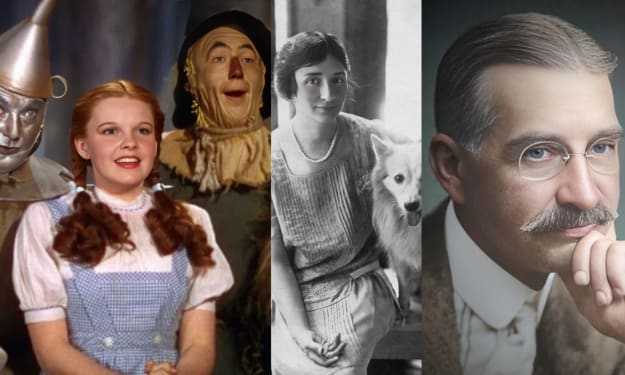
L. Frank Baum, the creative mind behind the magical Land of Oz, was not only an author but also a dreamer, a storyteller, and a visionary whose influence still enchants audiences today. His journey, which began with the writing of The Wonderful Wizard of Oz and extended to the beloved 1939 film adaptation, was marked by imagination, obstacles, and a lasting passion for fantasy.
By A História12 months ago in FYI



Comments
There are no comments for this story
Be the first to respond and start the conversation.