
Iran in 2026
The Stories No Headline Will Ever Tell You

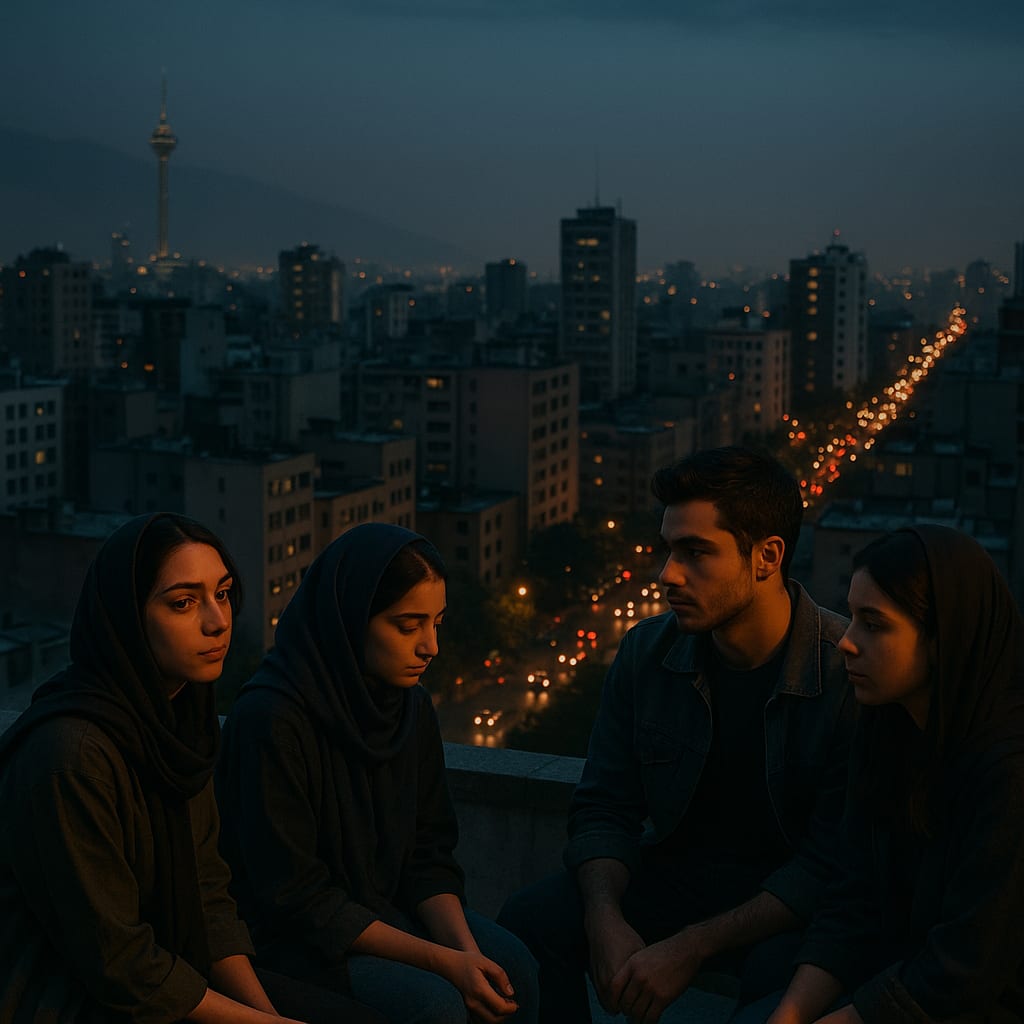
Behind the protests, sanctions, and threats, there’s a quiet, stubborn everyday life — and that’s where the real Iran is hiding
The night my cousin’s internet vanished, we were in the middle of a WhatsApp call, arguing about something stupid: whether Tehran’s traffic had actually gotten worse since I left.
She rolled her eyes, held up her phone to the window, and showed me a sea of red brake lights pulsing down Modarres Highway.
Then her screen froze.
The call didn’t drop right away. It hung there for a second — her face mid-laugh, neon lights bleeding across the glass — like time itself had glitched.
Then: “Reconnecting…”
Then nothing.
Somewhere between my apartment abroad and her apartment in north Tehran, a decision had been made in a room I’ll never see. A switch had been flipped. A country had been partially unplugged.
On the news the next day, there was a segment about “regional instability” and “escalating tensions with Iran.”
No one mentioned my cousin’s frozen face on a cracked phone screen. No one mentioned the half-written essays sitting in Tehran cafés, unsent emails, ghosted messages, or the way silence spreads through a family group chat like a bruise.
That’s the part of Iran in 2026 I keep coming back to.
The headlines tell one story.
The people I love tell another.
Both are true. But only one feels like a life.
The Iran You See and the Iran You Don’t
If you type “Iran 2026” into a search bar, you’ll get a predictable collage.
Nuclear program. Sanctions. Protests. Drone strikes. Security forces. “Regional escalation.”
You might scroll through a few think pieces about “Iran’s growing influence” or “The regime’s tightening grip.” You’ll see maps with arrows, photos of men in uniforms, maybe a grainy shot of missiles on a truck.
You’ll learn something.
But you’ll also miss almost everything.
You won’t see my aunt whispering prayers under her breath as she refreshes an exchange rate app, watching the rial sink again, wondering if she’ll ever be able to afford another major surgery.
You won’t see students in Shiraz studying for brutal entrance exams by candlelight because the power keeps cutting out, waiting to see whether their entire future will be decided by a number with three digits.
You won’t see women in Tabriz calculating risk like oxygen: Do I walk out of my house without a scarf today? Do I tie it loosely? Do I carry one in my bag “just in case”? Which street has cameras now? Who’s watching? Who’s filming?
And you definitely won’t see the quiet acts of resistance that never trend.
Like the barista in Tehran who changed the Wi-Fi password to a protest slogan, so every customer had to ask for it out loud.
Like the high school teacher in Isfahan who smuggles banned books on a USB drive, disguised as test materials, because she knows her students are already hungrier for truth than the state will ever be ready for.
Like my cousin, who spends her evenings using a VPN that crashes every ten minutes, just to upload a three-minute video about life as a 26-year-old in Iran — a video only a handful of people will ever see.
That’s Iran in 2026 too.
Not instead of the headlines.
Underneath them.
Inside them.
Backlash, Bravery, and the Weight of 2022
Everything that’s happening now sits in the shadow of 2022.
If you watched from outside, you saw the name: Mahsa Amini.
You saw the protests: women burning scarves, crowds chanting “Woman, Life, Freedom,” security forces cracking down, blood in the streets, arrests in the dead of night.
Then the coverage slowed down. Other crises replaced it. The world scrolled on.
Inside Iran, the aftermath never really left.
In 2026, the air still feels electrically charged, like a storm that passed but never fully moved on.
People talk more quietly now. Some talk more carefully. Some don’t talk at all.
But something fundamental cracked, and it didn’t glue back together.
A friend in Tehran told me this recently, voice dropping to a whisper even over a voice note:
“Before 2022, we were tired. But we still told ourselves it might get better if we just wait. After 2022, no one believes that anymore. The illusions are gone. It’s painful, but it’s honest.”
That honesty has a cost.
More surveillance. More cameras. Harsher punishments. New laws targeting “improper hijab,” “online agitation,” “foreign influence.”
Stories leak out about protesters still in prison three and a half years later.
Families still waiting outside courthouses.
Mothers still wearing black.
But there’s something else too, something the nightly news will never report:
Small circles of young people meeting in apartments with curtains drawn, sharing poetry, music, banned films, and fragments of a future they refuse to give up on.
A generation that knows the state is watching them — and stares right back.
They live with a double awareness now: the fear of what can be done to them, and the memory of how it felt, even for a few weeks, to move without fear.
You can punish people.
You cannot make them un-remember.
Sanctions, Inflation, and the Quiet Theft of Time
On paper, “sanctions” sounds abstract.
A policy. A measure. A tool.
In Iran in 2026, sanctions feel less like a policy and more like a weather pattern that never clears.
Prices for basics — rice, eggs, medicine, rent — keep climbing. Wages crawl behind, if they move at all.
People joke that they don’t “plan futures” anymore; they “plan survival.”
I asked my uncle what inflation feels like from the inside, as someone who’s lived through it for decades.
He thought for a second and said:
“Imagine saving for three years to afford something. Then, when you finally have the money, its price has tripled. So you start again. And again. Until at some point, you realize you’re not actually living a life. You’re just chasing numbers.”
Sanctions don’t just choke an economy. They chew through time.
They turn big dreams into smaller ones.
They turn smaller dreams into “maybe, if the exchange rate doesn’t jump again next week.”
They make leaving the country sound tempting. They make staying feel stubborn and noble and foolish and necessary, all at the same time.
Because here’s the part that rarely makes it into Western commentary: sanctions aren’t hitting some faceless “regime” in a vacuum.
They’re hitting the family that can’t find their father’s heart medication because importing it requires a chain of permissions and workarounds.
They’re hitting the student who gets accepted into a European university but can’t pay the application fee because international payment systems don’t work.
They’re hitting the small business owner who has to shut down a once-thriving workshop because no one can afford what they’re selling anymore.
Yes, the state adapts.
It builds networks, finds ways around restrictions, signs deals with Russia, China, whoever will play.
The people adapt too, but their adaptations look different: extra jobs, postponed children, shared apartments, disappeared savings, quiet panic.
When people outside talk about “pressure campaigns,” I wish they could hear what it sounds like inside: the slow, grinding pressure of daily life becoming a math problem that never adds up.
Women in Iran 2026: Beyond the Stereotype
If you only know Iranian women from Western media, you might think you know their story: oppressed, voiceless, covered, controlled.
What you’re missing is the part where they’re also the engine keeping so much of the country running.
In 2026, women in Iran are still getting arrested for “improper hijab.”
Some are fined. Some are barred from services. Some are beaten. Some disappear into a legal maze with no clear exits.
But walk through a street in Tehran right now, and you’ll see something that doesn’t fit into neat talking points.
You’ll see women who technically aren’t allowed to show their hair… walking with their hair openly on the wind.
You’ll see scarves pushed back further than any official guideline allows.
You’ll see a game of chicken playing out between half the population and the state, every single day.
And behind that visible rebellion is another layer that isn’t as easily captured in a photo.
Women who are the first in their families to go to university.
Women working as engineers, doctors, filmmakers, coders, designers.
Women fighting exhausting legal battles over custody, inheritance, marriage, and divorce, not because they’re naïve about the system, but because they’re stubborn enough to challenge it anyway.
And women who are just… tired.
Tired of having to be political every time they get dressed.
Tired of calculating what street is safe enough to walk down.
Tired of their bodies being used as battlegrounds for ideologies they never agreed to.
People ask me if the women’s movement in Iran “failed” because the regime is still in power.
I think of a friend in Mashhad who told me this:
“When my mother was my age, she couldn’t imagine walking to the shops with her scarf half off. When I have a daughter, I want her to live in a world where she doesn’t have to think about her scarf at all. Do you call that failure? Or do you call that a path, still being walked?”
Youth, VPNs, and the Battle Over Reality
If you want to know what Iran’s future looks like, don’t watch the parliament.
Watch Instagram Stories.
Watch Telegram channels.
Watch a 19-year-old in Ahvaz streaming a guitar cover at 2 a.m. with his face half in shadow because he’s not sure who might be screen recording.
Iran in 2026 is full of people under 30 who have never known a world without censorship — and never known a world without VPNs.
The state blocks.
They tunnel.
The state filters.
They reroute.
It’s like watching a cat-and-mouse game where the mouse keeps learning new tricks. And the cat knows it.
That’s why internet disruptions have become a form of collective punishment.
Protest in the streets? The web slows to a crawl.
Tensions rise? Apps go down.
YouTube, X, Facebook — technically blocked. Instagram and WhatsApp — sometimes throttled, sometimes “too useful to fully kill,” but always under threat.
But what really scares authorities isn’t just access to foreign platforms.
It’s what Iranians are building on them.
Pages documenting human rights abuses, archiving protest art, sharing legal advice, raising money for families of prisoners, amplifying voices that state TV will never let speak.
Videos where someone just sits in front of a camera and says:
“This is what my life actually looks like.”
No filters. No slogans. Just reality.
For a system built on controlling the story, that’s the most dangerous act of all.
Because whoever controls the story controls what feels possible.
And every time a video slips past the censors and reaches someone who thought they were alone, the story shifts.
Between Regime and West: The People No One Really Talks To
Here’s something that gets flattened in almost every outside conversation about Iran: the idea that the only two characters in the story are “the regime” and “the West.”
You hear it in phrases like “pressure on Tehran” or “Iran’s strategy.”
But Iran is not its government.
Nor is it a victim waiting to be rescued by foreign powers who have their own track records, their own hypocrisies, their own bloody hands.
The people trapped in between — the ones trying to live, love, study, work, raise kids, breathe — rarely get a say in how they’re talked about.
I’ve lost count of how many times I’ve heard some version of this from friends inside the country:
“We are tired of being a battleground between powerful men in suits — ours and yours. No one asks what we want. They just use us as proof for whatever argument they already decided on.”
Some are furious at the regime.
Some are furious at foreign governments.
Most are furious at both.
Because when sanctions hit, it’s not the officials with private bank accounts who skip meals.
When the economy tanks, it’s not the commanders who postpone their weddings.
When war feels closer, it’s not the elites whose kids stand in the line of fire.
The people paying the highest price for every decision — domestic or foreign — are the ones least visible in the big speeches and strategic papers.
Iran in 2026 is full of people who have learned to be suspicious of all grand narratives, from all sides.
That skepticism is painful.
It’s also a kind of wisdom.
They know no one is coming to save them.
They also know they’re not done trying to save themselves.
The Private Irans: Kitchens, Rooftops, and Small Freedoms
If you really want to understand a place, watch what happens when the door closes.
Behind the headlines, behind the slogans, Iran in 2026 is made up of thousands of “private Irans” — tiny worlds carved out between fear and hope.
In living rooms, people slide the curtains shut and turn up the music.
Women take off their scarves, shake out their hair, pass around a shared pack of cigarettes, and exhale the day.
Contraband whiskey appears. Or homemade aragh. Or nothing at all, just tea and a bowl of sunflower seeds and someone’s slightly out-of-tune guitar.
On rooftops, late at night, friends share secrets they’d never type out.
Who’s leaving. Who’s staying. Who’s pretending to leave. Who’s pretending to stay.
Who’s in love with someone they’re not allowed to marry.
Who’s gay and out to exactly three people.
Who’s broken and doesn’t know how to say it in Farsi because no one taught them words for anxiety, for depression, for “I can’t do this anymore.”
These are the spaces where the country’s nervous system resets itself.
Where people vent, rage, laugh, insult politicians, mock propaganda, plan small acts of defiance, share the latest meme.
Where the gap between private truth and public performance is both painful and strangely exhilarating.
Because every time someone says what they really think out loud, even in a room of five people, the official story loses a little more of its grip.
The state can own the billboards and the broadcast towers.
It doesn’t fully own the kitchens.
Not yet.
What Stays With Me About Iran in 2026
I used to think that countries were defined by their governments or their crises.
Now, when I think of Iran in 2026, I don’t see missiles or speeches or maps.
I see my aunt checking the dollar rate while stirring saffron rice.
I see my cousin cursing at another dropped VPN connection.
I see a kid in a small town scrolling through videos from protests he was too young to attend, memorizing the chants anyway.
I see a young woman tying her hair back, stepping into the street without a scarf, pulse racing — not because she doesn’t know the risk, but because she knows exactly what it costs to be silent.
I see people living inside a pressure cooker who still find ways to fall in love, to crack jokes, to throw birthday parties, to argue about football, to dance in secret, to dream loudly in whispers.
The headlines will keep coming.
New crises. New tensions. New analyses about what Iran “wants,” what “the West” should do, who’s to blame this time.
But beneath all that, there’s a quieter story — one without neat heroes or villains, without clear arcs or satisfying resolutions.
Just human beings, waking up each morning in a place the world thinks it understands, and making a thousand small choices that never trend, never get quoted, never make it into any official narrative.
If there’s one thing I hope you carry with you after reading this, it’s this:
Whenever you see the word “Iran” in a headline, mentally replace it, just for a second, with “millions of people trying to live.”
Not saints. Not villains.
Not symbols.
People.
People who laugh at terrible jokes.
People who hoard good coffee when they find it.
People who fight with their parents, cry in shared taxis, argue with strangers online, fall asleep watching series the state never approved, worry about rent, crush on coworkers, grieve losses no one statistics page will ever count.
The story of Iran in 2026 isn’t just what’s happening on the world stage.
It’s what’s happening in those unseen rooms, on those glitchy calls, in those quiet acts of defiance that will never get a push notification.
That’s the Iran I can’t stop thinking about.
And it’s the one I hope you remember the next time the news insists on telling you only half the story.
About the Creator
abualyaanart
I write thoughtful, experience-driven stories about technology, digital life, and how modern tools quietly shape the way we think, work, and live.
I believe good technology should support life
Abualyaanart
Keep reading
More stories from abualyaanart and writers in FYI and other communities.
When the Shelter Closes
Across the street from my house, a man slept under a tree, his dog by his side. My first, naive thought: he must be traveling through. But he kept coming back, often sleeping there during the day. Then it hit me—that person might not have a home.
By Bride of Sound3 days ago in Humans


Comments
There are no comments for this story
Be the first to respond and start the conversation.