
The Wonderful World of L. Frank Baum
Creator of Oz and the Magic Behind the 1939 Film

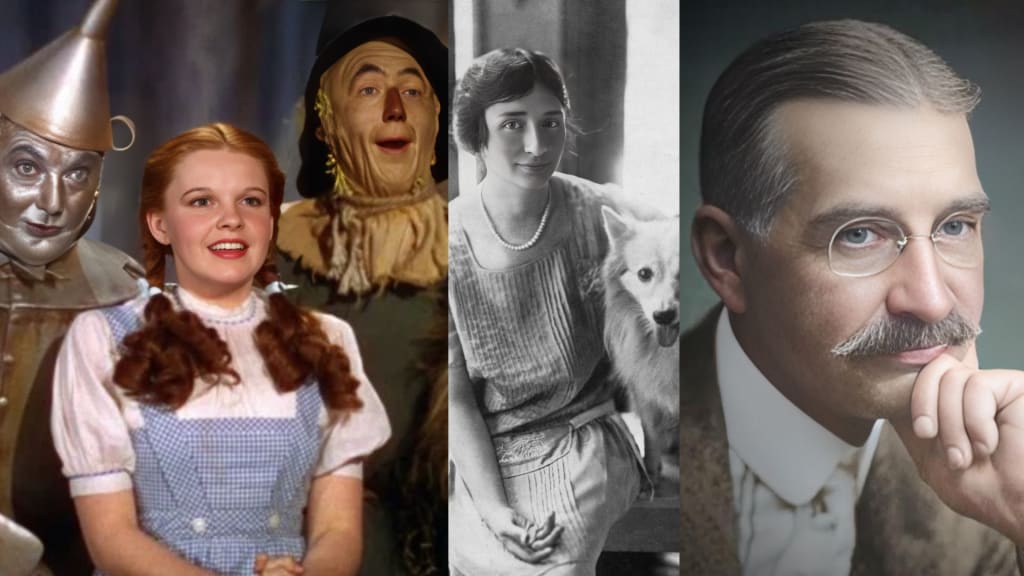
L. Frank Baum, the creative mind behind the magical Land of Oz, was not only an author but also a dreamer, a storyteller, and a visionary whose influence still enchants audiences today. His journey, which began with the writing of The Wonderful Wizard of Oz and extended to the beloved 1939 film adaptation, was marked by imagination, obstacles, and a lasting passion for fantasy.
Lyman Frank Baum, born on May 15, 1856, in Chittenango, New York, was a multifaceted individual. Prior to his writing career, he explored various professions, including acting, journalism, and poultry farming. Ultimately, it was his rich imagination and passion for fairy tales that inspired him to create one of literature's most cherished fantasy realms.
Baum frequently shared stories with his children, and it was during one of these storytelling moments that the concept of Oz emerged. Discontent with the somber nature of traditional European fairy tales, he aimed to develop an American fairy tale characterized by wonder, adventure, and hope. This vision culminated in the publication of The Wonderful Wizard of Oz in 1900. The book quickly gained popularity, celebrated for its enchanting characters, imaginative world, and moral insights woven into the fabric of fantasy.
Baum initially planned to write just one book about Oz, but the immense interest from readers prompted him to create a total of 14 Oz novels before his death in 1919. Among the most significant sequels are:
The Marvelous Land of Oz (1904)
Ozma of Oz (1907)
The Emerald City of Oz (1910)
The Patchwork Girl of Oz (1913)
Following Baum's death, the Oz series continued to thrive. Responding to publisher requests, other writers contributed to the series, producing an additional 26 books. The most prominent of these authors was Ruth Plumly Thompson, who crafted 19 Oz books from 1921 to 1939, maintaining Baum’s enchanting style.
Although Baum's literary works were cherished, it was the 1939 MGM musical The Wizard of Oz that truly cemented Oz's place in popular culture. Featuring Judy Garland in the role of Dorothy, the film combined stunning Technicolor visuals, iconic songs such as "Over the Rainbow," and innovative special effects. Yet, the reality of the production process was far from enchanting.
Problems During Production.
Casting Challenges: Prior to Judy Garland's selection, MGM had considered Shirley Temple for the role of Dorothy. The part of the Tin Man was initially assigned to Buddy Ebsen, who had to be replaced by Jack Haley due to a severe allergic reaction to the aluminum powder makeup.
Directorial Changes: The production experienced several directorial shifts, starting with Richard Thorpe, who was dismissed for making Garland appear overly glamorous, followed by George Cukor, who contributed briefly to the script. Ultimately, Victor Fleming, who also directed Gone with the Wind that same year, took the helm.
Costume and Makeup Difficulties: The green makeup used for the Wicked Witch contained copper and was toxic, resulting in burns for Margaret Hamilton. Additionally, the Cowardly Lion's costume weighed close to 100 pounds, making it quite burdensome for Bert Lahr to wear.
Special Effects Obstacles: The tornado sequence was created using a 35-foot muslin stocking spun over a miniature set, while the Wizard's floating head was produced with a projection system—an innovative technique for the era, though challenging to execute.
Initial Box Office Setback: Although the film later gained widespread acclaim, it did not achieve significant financial success upon its initial release, only attaining its legendary status after being broadcast repeatedly on television in the 1950s.
Although Baum died almost twenty years prior to the film's debut, his work established a fundamental pillar of fantasy literature. The 1939 film adaptation, despite facing numerous production challenges, has become one of the most celebrated movies of all time, captivating new audiences with the Yellow Brick Road, the Scarecrow's insights, and the enduring theme that "there's no place like home."
In the present day, Oz remains a source of inspiration for various adaptations, including Broadway productions and contemporary reinterpretations. L. Frank Baum's creative vision introduced a realm where anything can happen—a legacy that endures as vibrantly as the Emerald City itself.
About the Creator
A História
"Hi. My name is Wellington and I'm a passion for general history. Here, I publish articles on different periods and themes in history, from prehistory to the present day.
Keep reading
More stories from A História and writers in FYI and other communities.
Revealing the Heritage of Ancient India
India, recognized as one of the most populous and historically significant countries in the world, has served as a center for commerce, culture, and religion for centuries. Celebrated as the origin of Hinduism, Jainism, Buddhism, and Sikhism, the country's rich tapestry of traditions has developed through extensive interactions with numerous cultures and faiths over time. But what initiated this journey? What are the core elements of this ancient civilization, and what insights do archaeological findings provide about its history?
By A Históriaabout a year ago in FYI
A Planetary Alignment will coincide with Mercury Retrograde
Double phenomena in the heavens Some people say in jest that the planets have aligned in their favor when life works the way they desire. Were you aware that there are seasons when things do line up in the heavens? There will be a planetary alignment AKA a planet parade, on February 28, 2026.
By Cheryl E Preston18 days ago in FYI




Comments (1)
Nice work. I really enjoyed this story. Keep up the good work.