
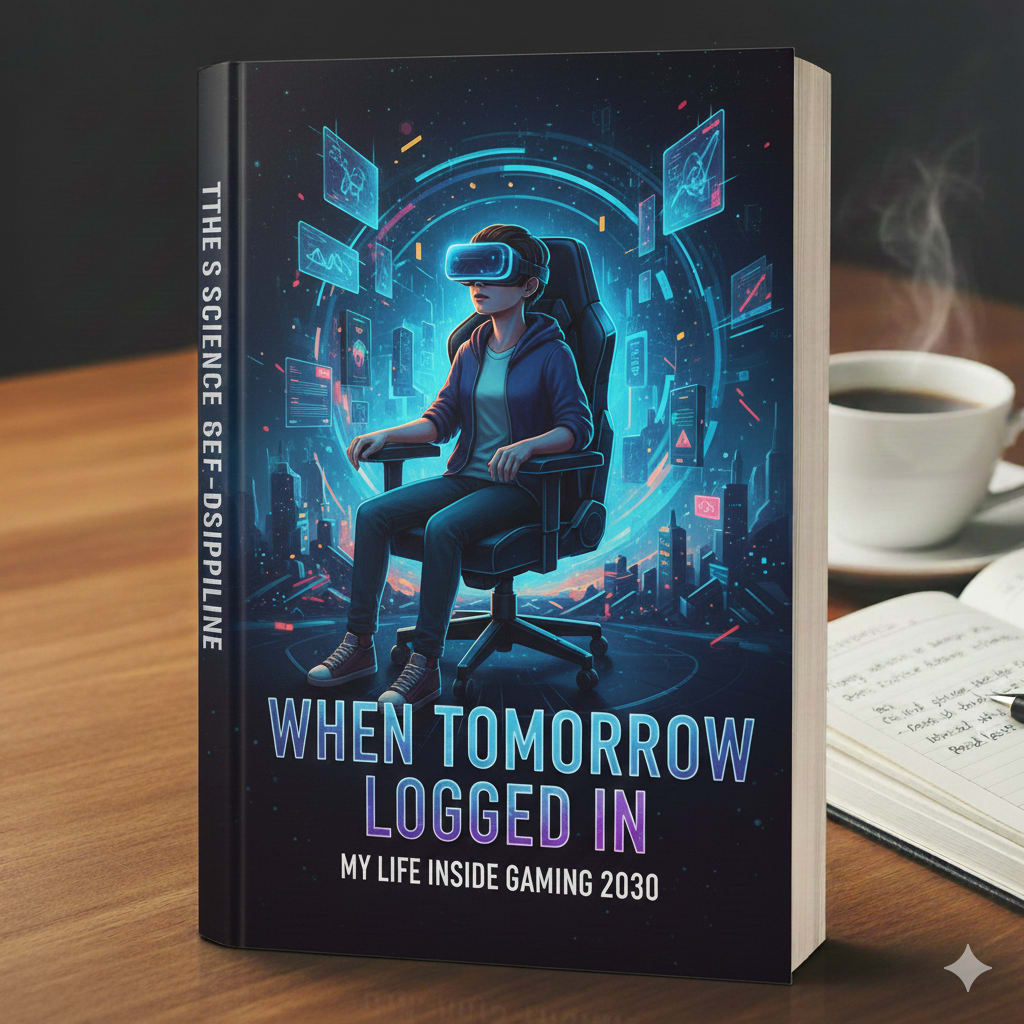
When Tomorrow Logged In: My Life Inside Gaming 2030
How the future of play became more human than ever

Introduction – The First Time I Felt the Future
I still remember the night I realized gaming had truly changed.
It was January 2030, and I slipped on my new wearable headset—the kind that felt like soft fabric instead of tech. The moment it powered on, the room around me melted into a coastline at sunset. The air even smelled like salt and warm sand.
And I thought, This isn’t gaming anymore. This is living a second life.
Over the years, I grew up with consoles, wires, lag, and loading screens. But 2030 gaming isn’t just about entertainment. It’s about connection, emotion, and presence. It’s a place where people heal, explore, and rebuild parts of themselves they didn’t even know were missing.
This is my personal story of what it’s like to play—and live—in the world of gaming today.
________________________________________
Living Worlds, Not Just Games
The biggest shift in 2030 gaming isn’t graphics or speed.
It’s immersion—the kind that feels honest, almost intimate.
Instead of controlling characters, you become the version of yourself you want to be.
I spend most evenings in a space called Horizon Casa, a virtual town where friends from across the world gather after work. Some of us cook fake meals that somehow feel real. Some sit by pixelated fireplaces. Some go hiking on digital mountains at 3 AM because life feels too heavy to climb real ones.
One night, my friend Ravi—who lives thousands of miles away—told me his grandmother had passed. He didn’t want to talk on the phone; he didn’t want the pressure of being watched. So we walked together on a quiet beach inside the game.
He cried.
I listened.
The waves rolled in soft loops.
In 2015, people laughed at the idea of “virtual friendships.”
In 2030, they’re the friendships that save us.
________________________________________
The Day My Father Finally Understood
My father, born long before VR, never understood gaming. To him, it was noise and glowing screens and wasted time. But when his mobility changed in 2029, and he couldn’t hike anymore, I introduced him to a game called EverSteps.
It’s a walking simulator—but calling it that feels insulting.
It’s a freedom machine.
The first day he played, I watched him stand in a digital redwood forest. He reached his hand toward a tree, slowly, as if touching something holy.
“I forgot what this feels like,” he whispered.
We walked together along a river, side by side—me in my apartment, him in his. And although neither of us moved more than a few steps in real life, our hearts traveled miles.
That’s when he finally understood gaming.
And that’s when I realized its real power:
not escape, but restoration.
________________________________________
Games That Know You Better Than You Do
I used to think personalization meant picking favorite colors.
In 2030, games study your mood, your energy, even your breath.
One game I love, PulseRealm, changes based on my emotional state.
If I come home stressed, the world dims and slows down.
If I’m joyful, the sky brightens, music wakes up, and characters greet me like I’ve been gone too long.
Sometimes it feels like the game listens better than the people around me.
And sometimes that’s exactly what I need.
But here’s the part that surprised me most:
Instead of making us lazy or dependent, these experiences push us to reflect. They encourage us to face what we feel instead of running from it.
The future of gaming isn’t numbing.
It’s noticing.
________________________________________
Playing Together, Even When We’re Apart
In 2030, “co-op” has turned into something bigger: shared living.
I play with a group of four friends. We’ve never met physically, but we know each other’s voices, habits, humor, and fears. Last month, one of them made a world for us—a floating city with gardens, libraries, and a giant, unnecessary roller coaster.
We spent hours laughing, building, redesigning.
That night felt better than any party I’ve ever been to.
Gaming isn’t a hobby for us.
It’s a home.
Some people ask, “Isn’t that sad? Living in a digital place?”
But if you felt the warmth in these friendships, you’d understand.
The future didn’t take us away from each other.
It brought us closer.
________________________________________
When Losing Actually Helped Me Win
Competitive gaming in 2030 is different, too.
There’s less shouting, fewer insults, more empathy.
Games now encourage collaboration over combat—not by force, but by design.
I play a strategy game called Bloomfield, where teams rebuild broken cities after imaginary storms. You can still lose, and I’ve lost plenty. But you don’t lose by dying or failing—you lose by giving up on working together.
The game rewards patience.
It praises listening.
It celebrates kindness.
One day, after a particularly stressful week, I played horribly. I kept making mistakes. Instead of yelling, my teammates guided me gently, reminding me that games are supposed to feel human.
I left that session genuinely feeling better about myself.
Not because I won—
but because I wasn’t alone.
________________________________________
The Quiet Magic of Logging Off
Even with all this progress, gaming in 2030 taught me something unexpected:
the value of stepping away.
Maybe it's because these worlds feel so alive that I return to my real world more inspired. Gaming now fills instead of drains.
When I log off, I’m calmer.
More grateful.
More connected.
It’s strange—technology, once blamed for disconnecting us, has finally learned how to guide us back to ourselves.
________________________________________
Conclusion – The Future Isn’t About Games, It’s About People
When I look at gaming in 2030, I don’t see screens or graphics or futuristic gadgets.
I see my father walking through a forest again.
I see friends comforting each other across oceans.
I see strangers building cities together, one kind act at a time.
I see myself, a little more whole each day.
The future of gaming isn’t about escaping reality.
It’s about expanding it—finding connection, meaning, and joy in places we never imagined.
And if this is where gaming is today,
I can’t wait to see where it takes us next.
------------------------------------
Thank You For Reading...
Regards: Fazal Hadi
About the Creator
Fazal Hadi
Hello, I’m Fazal Hadi, a motivational storyteller who writes honest, human stories that inspire growth, hope, and inner strength.
Keep reading
More stories from Fazal Hadi and writers in Futurism and other communities.
About Binding Prometheus
I want to start actively advocating on behalf of my own work, and the most valuable part of my canon is, without a doubt, Binding Prometheus, the play I have been working on since 2019 and only finished in 2023 as part of my MA. The play itself is an amalgamation of a million different inspirations. On one end, it evokes the Ancient Greek myth-play, deriving its own title from the earliest extant work of Western drama we have, Aeschylus’s Prometheus Bound. On the other end, it borrows significantly from the sci-fi bulwarks from over the years, namely Mary Shelley’s Frankenstein and Karel Capek’s Rossum’s Universal Robots. The play could be an episode of Black Mirror, I fear. I don’t know. I’ve only ever seen one episode of Black Mirror.
By Steven Christopher McKnight11 days ago in Futurism


Comments
There are no comments for this story
Be the first to respond and start the conversation.