
The "Wow!" Signal: The 72 seconds in 1977 when space finally spoke back.
6EQUJ5: The day the universe stopped whispering and started screaming.

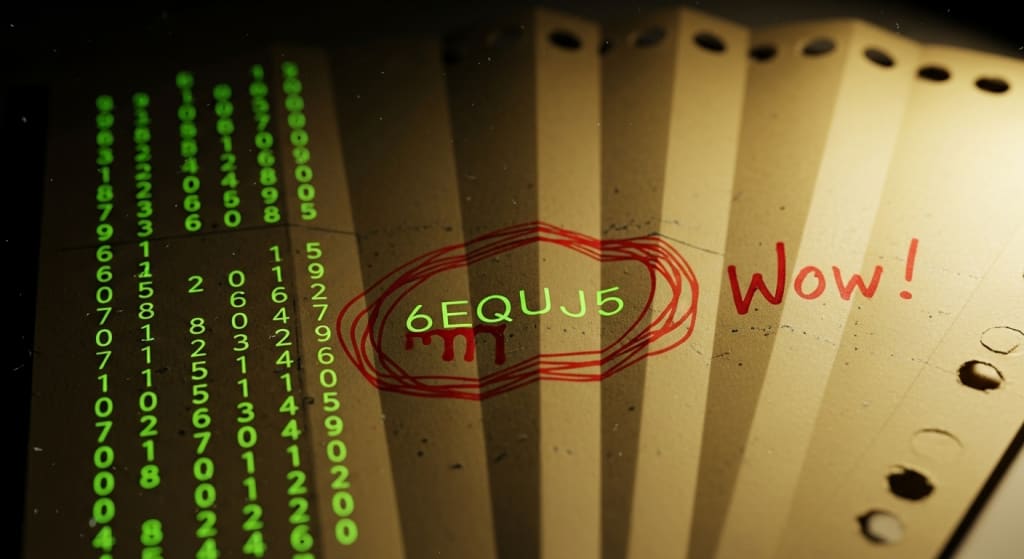
The red ink bled into the grain of the fan-fold paper like a fresh wound. It was August 1977, but the air inside the control room of the "Big Ear" observatory in Ohio smelled of stale percolated coffee and the sharp, metallic tang of an overheated mainframe. Jerry Ehman didn't shout. He didn't gasp. He simply sat there, his eyes fixed on a vertical column of characters that shouldn't have existed.
6EQUJ5.
The sequence felt visceral, a jagged rip in the velvet silence of the Sagittarius constellation. For seventy-two seconds, the universe had stopped whispering and started screaming.
I’m writing this while my desk lamp flickers with a dying buzz, the light straining against the stacks of vellum piled high like a paper fortress around my keyboard. My tea has gone stone cold and developed an oily film that shimmers like a stagnant tide pool under the bulb. If I’m being honest, I’ve spent far too much time in this library today. I had to read three 19th-century journals to verify a hunch about early wave theory, but I kept coming back to Dr. Hemmings’ 1924 report. It was a dusty, foxed monograph titled The Psychosis of the Invisible, found in a box of "unclassified atmospheric anomalies" in the basement of a London archive. Hemmings was a man who saw the ghosts of the previous century with a clarity that eventually broke him. He believed that the air was already occupied by thoughts we weren't meant to intercept.
The Alphanumeric Ghost of Sagittarius
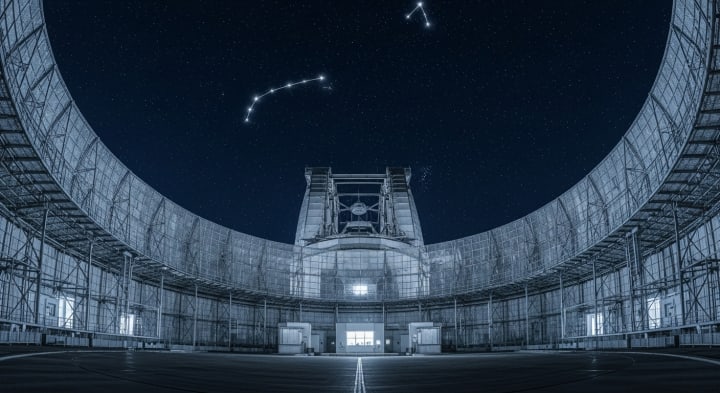
The Big Ear wasn't a dish. It was a flat, unhinged expanse of aluminum and wire, a radio telescope that looked more like a skeletal parking lot than a gateway to the divine. It didn't track the stars; it let the earth's rotation sweep the sky across its path.
The numbers on the printout represented intensity. A '1' was a whisper. A '4' was a murmur. But the 'U'—the highest peak—was a roar. The signal grew in strength, hit its zenith, and then faded with the mathematical precision of a bell curve. It was the exact signature of a point-source from the deep dark.
I sat here for an hour, tracing that 6EQUJ5 sequence with my own pen. It’s a bizarre code. We’ve fed it into every neural network available in 2026. The machines return nothing but "statistical anomaly." But statistics don't bleed red ink. Jerry Ehman circled those characters and wrote "Wow!" in the margin. He wasn't just marking data. He was reacting to the sudden, terrifying realization that we were being watched.
Dr. Hemmings’ 1924 report mentions a specific case in the Scottish Highlands—a man who claimed the "crackle of the ether" was repeating his own name. Hemmings argued that this wasn't madness, but a synchronization. The man’s brain had accidentally tuned into a frequency that shouldn't be accessible to the human animal. I wonder if the Big Ear did the same thing. It didn't find a civilization. It found a glitch.
The Heresy of the Water Hole
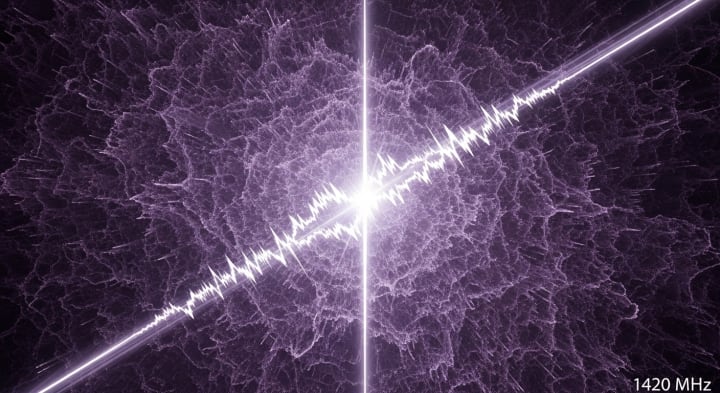
The frequency was 1420 MHz. To an astronomer, this is sacred ground. It is the resonance of neutral hydrogen, the most common element in the universe. We call it the "Water Hole." It’s the place where the background noise of the galaxy goes quiet, a logical meeting point for two species trying to find each other in a lightless room.
There is an unsettling purity to that number. If you wanted to be heard, you would shout at 1420. But here is the part that keeps me up at night. The signal was "narrowband." It wasn't a pulsar. It wasn't a quasar. Nature doesn't speak in narrowband. Nature is messy and wide. Only a mind—or something mimicking a mind—could sharpen a beam into a single, needle-thin frequency.
I found a letter from 1982 in the archives of a defunct SETI project. The author, a junior technician, claimed that the "Wow!" signal had a "texture" that the official reports suppressed. He described it as a rhythmic stutter, a heartbeat made of radio waves. He was fired two weeks later. If I’m being honest, looking through these records makes my own ribs feel tight. We are so desperate for a signal that we ignore the possibility that the signal might be a warning.
Hemmings believed that some frequencies are "biological poisons." He argued in his 1924 monograph that the human nervous system is tuned to certain celestial rhythms, and that an artificial interruption of those rhythms could lead to a deranged collapse of the ego. The Big Ear didn't just record a signal. It invited a guest that never left.

The Big Ear’s Skeletal Prayer
The signal never came back. We went back to the same spot in Sagittarius again and again. Nothing but the cold, static hiss of dead gas. Some people say it was a comet. Two comets, specifically—266P/Christensen and 335P/Gibbs—were in the neighborhood. They have hydrogen clouds. They could have caused it.
But the math is wrong. The comets weren't in the right place at the right time. The "comet theory" is a security blanket for people who can't handle the silence. It’s a way to make the universe feel like a machine again instead of a forest.
I spent the better part of forty-eight hours buried in the logs of the 2026 search efforts. We have better eyes now. We have AI that can sift through trillions of petabytes of noise. We’ve scanned that patch of sky with the sensitivity of a god. Silence. The "Wow!" signal remains a one-night stand with the infinite.
There is something alarming about a miracle that happens once and then vanishes. It suggests a "flyby." A lighthouse beam that only hits the window for a single rotation. Or perhaps, a "searchlight" that found what it was looking for and moved on.
My desk lamp just gave a final, sharp pop, leaving me in the grey shadows of the early morning. I can hear the floorboards creaking in the hallway—the house settling, or so I tell myself. But my mind keeps returning to Jerry Ehman’s red pen. He spent years trying to explain away his own discovery. He became the most skeptical man in the room. Why? Maybe he realized that the seventy-two seconds of 6EQUJ5 weren't a greeting. Maybe they were a census.
The 2026 Silence
As I sit here in the dark, the oily film on my tea has settled into a shape that looks remarkably like a fractured rib. It’s a macabre coincidence, or perhaps just the result of a tired mind. We are still listening. We have "Breakthrough Listen." We have arrays in the desert that dwarf the Big Ear. But the universe is a very quiet place for a species that makes as much noise as we do.
Dr. Hemmings’ 1924 report concluded that the "ether" is not empty, but "saturated with the husks of dead transmissions." He thought the stars were shouting over each other, a cacophony so dense that we only hear the silence. The "Wow!" signal was just a gap in the noise. A moment where the dead stopped shouting long enough for us to hear the truth.
The truth is that the signal was seventy-two seconds long because that was the window of the Big Ear’s gaze. The signal was likely much longer. It might still be going on. We just moved. We rotated away. We turned our backs on the only voice that ever bothered to call us by our name.
The sequence 6EQUJ5 is etched into the glass of my mind now. It feels like a lock that has no key. Or a door that was opened once, found to be empty, and slammed shut forever.
The sun is starting to grey the window. I should sleep. But every time I close my eyes, I see the red ink. I hear the hiss of the 1420 MHz line. And I wonder if the thing that spoke to us in 1977 is still out there, waiting for us to stop being so loud.
The universe doesn't owe us an explanation, and the stars don't care if we're lonely.
About the Creator
The Chaos Cabinet
A collection of fragments—stories, essays, and ideas stitched together like constellations. A little of everything, for the curious mind.
Keep reading
More stories from The Chaos Cabinet and writers in Futurism and other communities.
The Death of Memorization: How AI is Redefining What We Really Need to Learn
Introduction: When Memory Was the Heart of Education For centuries, learning was synonymous with memory. To be educated was to possess the ability to recall holy scripture, historical dates, scientific formulas, or epic poems. Students recited, repeated, and wrote knowledge into their minds as if human memory was the apex of scholarship. For centuries, it was. Before the printing press, before Google, before artificial intelligence, the human brain was the storage house of civilization.
By The Chaos Cabinet20 days ago in Futurism
Remote Healthcare Market: Digital Health Platforms, Remote Consultations & Market Forecast
According to IMARC Group's latest research publication, global remote healthcare market size reached USD 12.7 Billion in 2024. Looking forward, IMARC Group expects the market to reach USD 48.3 Billion by 2033, exhibiting a growth rate (CAGR) of 15.87% during 2025-2033.
By sujeet. imarcgroupabout 15 hours ago in Futurism
Planet Nine: The Ghost of the Solar System Nobody Can Find
We Lost a Planet. Then We Found a Bigger Mystery. In 2006, astronomers took something away from us. Pluto — that tiny, beloved frozen world at the edge of the solar system — was officially stripped of its planetary status by the International Astronomical Union. Too small. Too far. Too irregular. Just like that, our solar system shrank from nine planets to eight, and most of us shrugged and moved on.
By Holianyk Ihor2 days ago in Futurism


Comments
There are no comments for this story
Be the first to respond and start the conversation.