
The Simulation Hypothesis: Are We Living in the Matrix?
Space


What if everything around you every sound, sensation, and memory is part of a sophisticated computer program?
Once considered the domain of science fiction, the idea that our universe might be a virtual simulation is now seriously discussed by philosophers, physicists, and computer scientists. What was once the premise of a blockbuster film like The Matrix has grown into one of the most provocative theories of our time. But what exactly is the simulation hypothesis, and why are so many brilliant minds taking it seriously?
What Is the Simulation Hypothesis?
In its simplest form, the simulation hypothesis proposes that our reality is not truly “real” but rather a digitally created environment, possibly designed by a highly advanced civilization. Imagine that humanity exists inside an ultra-realistic video game every atom, every emotion, every law of nature is actually part of an intricate program.
This concept was popularized by philosopher Nick Bostrom in 2003. He proposed that at least one of the following statements must be true:
- Civilizations rarely reach a technological level capable of creating lifelike simulations of consciousness.
- Civilizations that do reach such a level choose not to run these simulations.
- We are almost certainly living in a simulation.
In essence, if it’s possible to create simulations of reality and if it ever becomes desirable then there could be billions or even trillions of simulated worlds compared to one "base" reality. Statistically, that means it’s far more likely we’re in a simulation than not.
Arguments For the Simulation Hypothesis
1. Technological Acceleration
Take a look at where we are today. Artificial intelligence can generate human-like conversations, create realistic images and videos, and even mimic voices. Virtual reality is becoming more immersive every year. If technological progress continues at its current pace, we could eventually create simulations so convincing that the inhabitants wouldn’t know they’re in one. And if we can do it, what’s to say a more advanced civilization hasn’t already done so?
2. Quantum Oddities
Quantum mechanics offers plenty of puzzling phenomena particles exist in multiple states until observed, for example. Some researchers suggest that this behavior could resemble a rendering system, like in video games, where the world is rendered only as needed to save processing power. Could it be that the universe “loads” details only when observed?
3. Mathematics as the Code of the Universe
The universe follows precise mathematical rules. From the laws of motion to the constants of physics, everything seems to be governed by equations. Some scientists argue that this could suggest the universe is fundamentally digital a kind of cosmic computer code running in the background.
Arguments Against the Simulation Hypothesis
1. Lack of Concrete Evidence
As fascinating as it is, the hypothesis currently lacks any direct, testable proof. It remains in the realm of theory and speculation. While we can imagine a simulated world, we have no way to verify whether ours is one.
2. Who or What Is the Simulator?
Even if we assume we are in a simulation, we face an even more bewildering question: Who created it, and why? Was it a god-like being? A super-advanced alien species? College students in another universe running a project? The lack of clarity around the creators adds another layer of mystery and raises difficult philosophical questions about purpose, control, and identity.
3. The Infinite Regress Problem
If we live in a simulation, and we create our own simulations (which also contain sentient beings), and they create more, then you get an endless chain of nested realities. This concept, while mind-bending, leads to philosophical paradoxes and makes it difficult to identify any true “base reality.”
Why Does It Matter?
Whether or not the simulation hypothesis is true, it raises profound questions that go beyond science:
- What is consciousness?
- What does it mean to be “real”?
- Can we have ethics or meaning in a world that might be artificial?
- Is there a way to escape or communicate with the simulator?
These questions challenge our understanding of existence and fuel conversations across physics, philosophy, computer science, and even theology. The simulation hypothesis reminds us that what we take for granted as real may not be as stable as it seems.
So… What If?
The idea that our universe could be a simulation may sound terrifying or exhilarating. But even if it’s true, this is still our reality. We feel, we love, we wonder. We create art, discover galaxies, experience joy and sorrow. Whether the pixels are digital or atomic, life remains a powerful, beautiful experience.
And maybe, just maybe, if we one day uncover the code behind the cosmos, we’ll also unlock the purpose behind it. Until then simulation or not we live, we explore, and we seek meaning.
Welcome to the Matrix. Or… whatever this is.
About the Creator
Keep reading
More stories from Holianyk Ihor and writers in Futurism and other communities.
Why Are Stars Different Colors? What Their Light Reveals About Them
When we gaze at the night sky, it often looks like a sea of tiny white lights scattered across the darkness. But if you take a closer look especially through a telescope you'll notice that not all stars shine the same. Some glow a deep red, others shine gold or yellow, and some dazzle with an icy blue brilliance. Why are stars different colors, and what can their light tell us about them?
By Holianyk Ihor6 months ago in Futurism
About Binding Prometheus
I want to start actively advocating on behalf of my own work, and the most valuable part of my canon is, without a doubt, Binding Prometheus, the play I have been working on since 2019 and only finished in 2023 as part of my MA. The play itself is an amalgamation of a million different inspirations. On one end, it evokes the Ancient Greek myth-play, deriving its own title from the earliest extant work of Western drama we have, Aeschylus’s Prometheus Bound. On the other end, it borrows significantly from the sci-fi bulwarks from over the years, namely Mary Shelley’s Frankenstein and Karel Capek’s Rossum’s Universal Robots. The play could be an episode of Black Mirror, I fear. I don’t know. I’ve only ever seen one episode of Black Mirror.
By Steven Christopher McKnight15 days ago in Futurism
France Convenience Store Market Size and Forecast 2026–2034
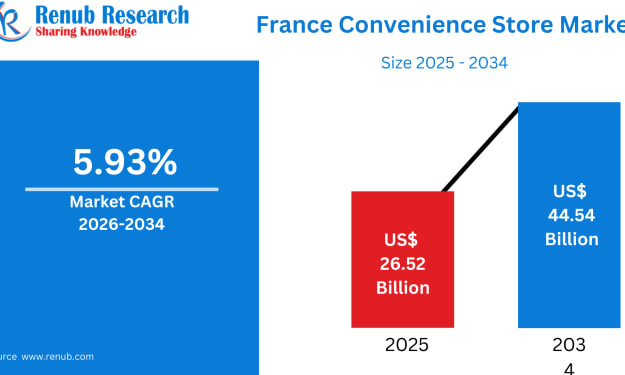
Introduction The France Convenience Store Market is poised for strong expansion over the coming decade, reflecting the country’s changing consumer habits, growing urban density, and rising preference for speed, accessibility, and ready-to-consume products. According to Renub Research, the market is expected to grow from US$ 26.52 billion in 2025 to US$ 44.54 billion by 2034, registering a healthy compound annual growth rate (CAGR) of 5.93% from 2026 to 2034.
By jaiklin Fanandish7 days ago in Futurism



Comments
There are no comments for this story
Be the first to respond and start the conversation.