
The Infrastructure of the Interplanetary Internet: Building a Network Beyond Earth
Space

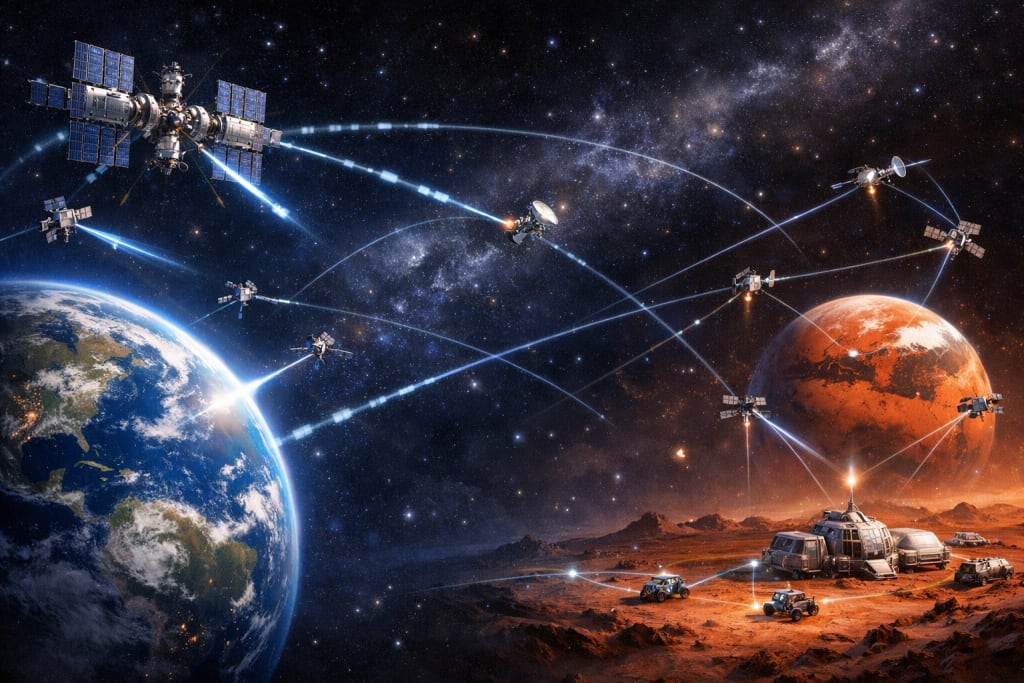
For most people, the internet is an invisible and instant utility. We send messages, stream videos, and store data in the cloud without thinking about the immense infrastructure that makes it possible. But what happens when humanity moves beyond Earth? As space exploration accelerates and missions to the Moon and Mars become increasingly ambitious, scientists and engineers face a fundamental challenge: how do we build an internet that works across planets?
The answer lies in the emerging concept of the interplanetary internet—a communication network designed to operate reliably across millions of kilometers, extreme delays, and hostile cosmic environments. Far from science fiction, this infrastructure is already taking shape.
Why Earth’s Internet Cannot Simply Be Extended to Space
The internet we use on Earth is based on protocols such as TCP/IP, which assume fast, stable connections with minimal delays. These assumptions completely break down in space. For example, when Mars is closest to Earth, a radio signal still takes about four minutes to travel one way. At maximum distance, that delay can exceed twenty minutes. If a message is lost, waiting for a confirmation and resending it could take nearly an hour.
Additionally, communication links in space are frequently disrupted. Planets move, spacecraft rotate, and solar storms can interfere with signals. In some configurations, Mars may be completely hidden behind the Sun, cutting off direct communication with Earth for weeks. Under these conditions, traditional internet protocols interpret delays as failures, flooding the network with retransmissions and causing severe inefficiencies.
This is why interplanetary communication requires a fundamentally different approach.
Delay-Tolerant Networking: The Core Architecture
At the heart of the interplanetary internet is a system known as Delay and Disruption Tolerant Networking (DTN). Instead of relying on continuous, real-time connections, DTN uses a “store-and-forward” model. Data is packaged into large units called bundles and stored locally at each node until a viable communication path becomes available.
This approach is similar to how early postal systems worked. A message does not require an open path from sender to recipient at all times. It only needs reliable intermediate points where information can be safely stored and forwarded when possible.
NASA has already tested DTN technology on the International Space Station and in deep-space missions. In one notable experiment, astronauts successfully browsed a simulated web using DTN protocols, demonstrating that internet-like services can function even with significant delays.
Nodes of a Planetary-Scale Network
The infrastructure of the interplanetary internet consists of multiple layers of interconnected nodes:
- Ground stations on Earth, such as NASA’s Deep Space Network, which use massive radio antennas to communicate with distant spacecraft.
- Orbital relays around planets like Mars, which act as communication hubs between surface missions and Earth.
- Surface nodes, including rovers, landers, habitats, and scientific instruments.
- Mobile nodes, such as crewed spacecraft and autonomous probes.
Each node operates semi-independently, making routing decisions based on predicted orbital mechanics, signal availability, and network congestion. Over time, this creates a resilient and adaptive communications web spanning multiple worlds.
Laser Communication: Increasing Speed Across Space
Bandwidth is another critical limitation of space communication. Traditional radio links offer reliability but relatively low data rates. As missions generate larger volumes of data—high-resolution images, 3D terrain maps, and even video—new solutions are required.
This is where laser-based optical communication comes into play. Laser systems can transmit data at rates tens or even hundreds of times faster than radio waves while using less power. Recent missions have successfully demonstrated laser communication between spacecraft and Earth, proving its feasibility for future networks.
In an interplanetary internet, radio may serve as the backbone for reliability, while lasers function as high-speed data highways, transferring large datasets when precise alignment is possible.
Autonomy and Artificial Intelligence
Because of long communication delays, the interplanetary internet cannot be micromanaged from Earth. Instead, it must operate autonomously. Artificial intelligence plays a key role here, enabling the network to adapt in real time.
AI-driven systems can predict link availability, reroute data around disruptions, prioritize critical information, and manage limited energy resources. For example, if a Martian dust storm threatens power generation, the network can automatically reduce non-essential traffic and preserve bandwidth for life-support systems and mission-critical telemetry.
This level of autonomy is essential for future human settlements, where communication with Earth may be delayed, limited, or temporarily unavailable.
Security and International Standards
Security in interplanetary networks presents unique challenges. Data must be protected from corruption, interception, and unauthorized access, all while operating under strict energy and computational constraints. Cryptographic methods must be robust but efficient, and authentication systems must function even when real-time verification is impossible.
Equally important is standardization. Space agencies around the world collaborate through organizations like the Consultative Committee for Space Data Systems to ensure compatibility between missions. Without shared protocols, an interplanetary internet would fragment into isolated systems, undermining its global potential.
Why the Interplanetary Internet Matters
The infrastructure of the interplanetary internet is more than a technical solution—it is an enabling foundation for humanity’s expansion into space. It supports continuous scientific observation, remote robotics, coordinated exploration, and ultimately, permanent human presence beyond Earth.
A future Mars settlement, for example, will rely on local data centers, planetary-scale networks, and delayed but reliable links to Earth. Over time, these systems could evolve into a Solar System–wide information ecosystem, connecting multiple planets, moons, and habitats.
Conclusion
The interplanetary internet represents a profound shift in how we think about communication. It acknowledges the realities of space—distance, delay, and disruption—and turns them into manageable design constraints. Step by step, through new protocols, autonomous systems, and advanced communication technologies, humanity is laying the digital foundations of a multi-planet civilization.
In this sense, the interplanetary internet is not just about data. It is about continuity—ensuring that wherever humans go, knowledge, coordination, and connection can follow.
About the Creator
Keep reading
More stories from Holianyk Ihor and writers in Futurism and other communities.
Experimental Propulsion Systems Redefining Interplanetary Travel
For more than half a century, humanity’s journey into space has relied primarily on chemical rocket engines. These powerful yet short-lived systems made it possible to reach orbit, land on the Moon, and send robotic explorers to the outer edges of the Solar System. However, as ambitions shift toward sustained human presence on Mars, asteroid mining, and deep-space exploration, it has become increasingly clear that traditional propulsion technologies are reaching their practical limits. To move farther, faster, and more efficiently, space agencies and private companies are now turning their attention to a new generation of experimental engines designed specifically for interplanetary travel.
By Holianyk Ihor2 months ago in Futurism
The End of an Era: Why the Galaxy S27 Ultra’s Latest Leak is the News Samsung Fans Have Been Waiting For
For the better part of a decade, the premium smartphone market has been defined by a quiet tension between R&D conservatism and the marketing need for "newness." We’ve reached a point of industry-standard stagnation where yearly flagships often feel like software-driven refinements rather than hardware revolutions. The current Galaxy S26 Ultra is perhaps the ultimate expression of this trend; it is a masterclass in squeezing every drop of performance out of aging components. However, even the most sophisticated computational photography has a ceiling, and the latest leaks surrounding the Galaxy S27 Ultra suggest Samsung is finally ready to shatter it. For enthusiasts who have grown weary of "good enough," the shift in the S27’s hardware trajectory signals the end of a long period of strategic inertia.
By Mohammad Hamid6 days ago in Futurism
Writing To Succeed
If you want to find something that will help readers find your writing, possibly expand your audience, and maybe even get you noticed for other things, then you’re not alone. But how can you get it done in a world full of want-to-be writers? Look less at what you’re writing now, and more at what other writers have used to boost their views and reads.
By Jason Ray Morton a day ago in Writers



Comments
There are no comments for this story
Be the first to respond and start the conversation.