
Experimental Propulsion Systems Redefining Interplanetary Travel
Space

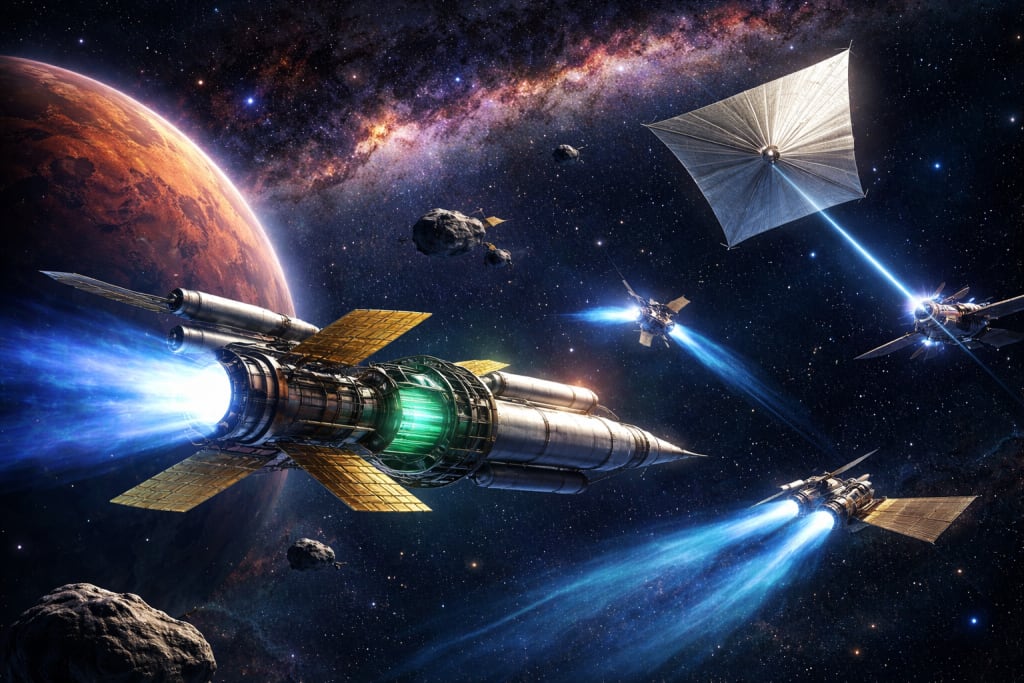
For more than half a century, humanity’s journey into space has relied primarily on chemical rocket engines. These powerful yet short-lived systems made it possible to reach orbit, land on the Moon, and send robotic explorers to the outer edges of the Solar System. However, as ambitions shift toward sustained human presence on Mars, asteroid mining, and deep-space exploration, it has become increasingly clear that traditional propulsion technologies are reaching their practical limits. To move farther, faster, and more efficiently, space agencies and private companies are now turning their attention to a new generation of experimental engines designed specifically for interplanetary travel.
Why Conventional Rockets Are No Longer Enough
Chemical rockets excel at producing immense thrust during launch, but they suffer from a fundamental drawback: inefficiency. Most of a rocket’s mass consists of fuel that is consumed within minutes, leaving little room for payload or long-term maneuverability. For interplanetary missions, this often translates into long flight times, complex gravity-assist trajectories, and narrow launch windows.
As mission planners contemplate crewed journeys to Mars that could last many months—or even years—these limitations become critical. Long travel times increase exposure to cosmic radiation, strain life-support systems, and amplify psychological challenges for astronauts. This has driven a global effort to rethink how spacecraft generate thrust once they are already in space.
Electric Propulsion: Slow but Remarkably Efficient
Among the most mature alternatives are electric propulsion systems, including ion and plasma engines. Unlike chemical rockets, these engines use electricity—often generated by solar panels—to accelerate charged particles to extremely high velocities. The resulting thrust is minimal, but it can be applied continuously for months or years.
A notable example is the Dawn spacecraft, which used ion propulsion to orbit both Vesta and Ceres—an unprecedented feat. Building on this success, modern experimental engines aim to deliver higher power and longer operational lifespans. Advanced Hall-effect thrusters and magnetoplasma engines are being tested with the goal of transporting heavier spacecraft and shortening travel times to Mars and beyond.
While these engines will not replace chemical rockets for launch, they are increasingly seen as ideal for deep-space cruising, cargo transport, and orbital maneuvering.
Nuclear Thermal Propulsion: A Powerful Comeback
One of the most promising experimental technologies involves nuclear thermal propulsion (NTP). First explored during the Cold War era, these engines use nuclear fission to heat a propellant—typically hydrogen—to extremely high temperatures before expelling it through a nozzle.
The result is a system with significantly higher efficiency than chemical engines and much greater thrust than electric propulsion. Modern materials, improved reactor designs, and enhanced safety protocols have revived interest in NTP. Current experimental programs suggest that nuclear thermal engines could reduce travel time to Mars by nearly half, making them especially attractive for crewed missions.
Shorter journeys not only reduce radiation exposure but also allow for more flexible mission planning, potentially enabling abort scenarios or extended exploration once astronauts reach their destination.
Fusion and Antimatter: Concepts from the Edge of Physics
Looking even further ahead, researchers are exploring propulsion concepts based on nuclear fusion—the same process that powers stars. Fusion engines could, in theory, offer extraordinary efficiency and sustained high thrust, opening the door to rapid travel throughout the Solar System.
Experimental fusion propulsion remains firmly in the research phase, as controlled fusion itself has yet to become a practical energy source. Nonetheless, experimental designs and computer simulations continue to advance, keeping the concept alive as a long-term solution.
Even more speculative are antimatter engines. When matter and antimatter collide, they annihilate each other, releasing immense energy. While this makes antimatter an incredibly attractive fuel on paper, the challenges of producing, storing, and controlling it are enormous. For now, antimatter propulsion remains largely theoretical, but it continues to inspire bold visions of future spaceflight.
Propulsion Without Fuel: Solar and Laser Sails
Not all experimental propulsion systems rely on onboard fuel. Solar sails harness the pressure exerted by sunlight on ultra-thin reflective surfaces. Though the force is tiny, it is constant and requires no propellant at all.
Several experimental missions have already demonstrated the feasibility of solar sailing. Engineers are now developing larger, lighter, and more durable sails capable of more precise navigation. Laser sails take this concept further by using powerful ground- or orbit-based lasers to push spacecraft to extreme speeds.
These technologies are particularly well suited for lightweight robotic probes and could one day enable missions to the outer Solar System—or even nearby stars.
A New Era of Space Exploration
Experimental propulsion systems represent more than incremental improvements; they signal a fundamental shift in how humanity approaches space travel. By reducing reliance on massive fuel reserves and enabling faster, more flexible missions, these engines expand what is technically and economically possible.
Although many of these technologies are still in testing or early development, progress is accelerating. As experimental engines transition from laboratories to space missions, they will redefine interplanetary travel and bring ambitious goals—such as permanent settlements beyond Earth—within reach.
The next giant leap in space exploration will not come from bigger rockets alone, but from smarter, more efficient ways of moving through the cosmos.
About the Creator
Keep reading
More stories from Holianyk Ihor and writers in Futurism and other communities.
How Solar Winds Are Reshaping the Surface of Mercury
Mercury, the innermost planet of our Solar System, is often described as a silent, lifeless world — a scorched sphere of rock orbiting perilously close to the Sun. For a long time, scientists assumed that its surface was largely static, shaped mainly by ancient volcanic activity and impacts billions of years ago. Recent space missions, however, have revealed a far more dynamic reality. Mercury’s surface is constantly changing, sculpted by one of the most powerful and relentless forces in the Solar System: the solar wind.
By Holianyk Ihor2 months ago in Futurism
Australia Auto Parts Aftermarket Market: Vehicle Parc Growth, Replacement Demand & E-commerce Channels
According to IMARC Group, the Australia auto parts aftermarket market reached USD 10,456.2 Million in 2025 and is projected to grow to USD 16,137.8 Million by 2034, exhibiting a compound annual growth rate (CAGR) of 4.79% during 2026–2034. The steady expansion of the market reflects the growing vehicle parc, increasing average vehicle age, and rising demand for maintenance and replacement components across Australia. As consumers extend vehicle lifespans and prioritize cost-effective repairs, aftermarket suppliers are benefiting from sustained parts replacement cycles. Simultaneously, the rapid rise of digital retail channels is transforming purchasing behavior, strengthening Australia auto parts aftermarket market share across both traditional and online distribution platforms.
By Shrestha Roy6 days ago in Futurism
📢 Raise Your Voice Thread: 03/05/2026
Our “Raise Your Voice Threads” are hosted most alternating Thursdays at 12PM ET to offer creators more avenues to uncover exceptional stories on Vocal. As we are continuously searching for fresh creators and inspiring stories, this thread provides an opportunity to exchange and discuss the stories that have moved and motivated us on Vocal.
By Raise Your Voice by Vocal2 days ago in Resources




Comments
There are no comments for this story
Be the first to respond and start the conversation.