
The Giant Accretion Rings of Black Holes: Cosmic Structures Thousands of Light-Years Across
Space


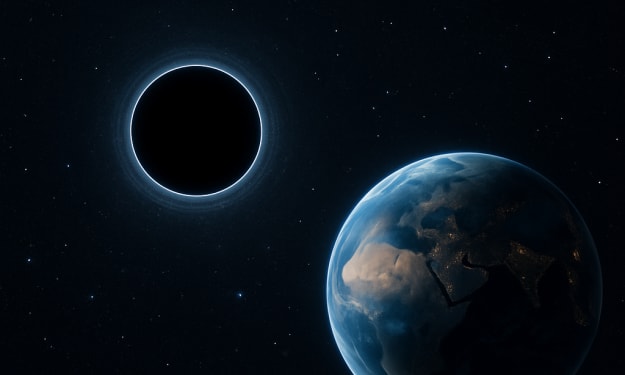
When most people picture a black hole, they imagine a dark, compact monster devouring anything that strays too close. That image isn’t wrong, but it’s also far from complete. Modern astronomy has revealed that some black holes aren’t just surrounded by small disks of hot gas—they are embedded within enormous cosmic structures called accretion rings, stretching across thousands of light-years. These colossal rings challenge our understanding of how galaxies evolve, how black holes feed, and how matter behaves under extreme gravitational forces.
What Exactly Is an Accretion Ring?
Most textbooks describe an accretion disk—a fast-spinning, superheated swirl of gas and dust spiraling toward a black hole. But in some galaxies, astronomers observe something very different: slow-moving, gigantic rings of gas and dust orbiting far from the central black hole. These aren’t compact disks only a few light-hours or light-days wide. They are astronomical giants, sometimes stretching for tens of thousands of light-years, as wide as an entire small galaxy.
Accretion rings differ from conventional accretion disks in several ways:
- They orbit much farther out, sometimes thousands of light-years from the central black hole.
- They evolve slowly, remaining stable for millions or even billions of years.
- They are cold, dense reservoirs of material, unlike the blazing hot inner disks.
- They may host star formation, turning parts of the ring into cosmic nurseries.
Rather than a fast, bright whirlpool, imagine a massive galactic halo of drifting material, patiently circling a black hole like a distant, ancient moat around a gravitational castle.
How Do Such Enormous Rings Form?
Astronomers have proposed several formation scenarios, each rooted in large-scale cosmic events.
1. Galaxy Collisions and Mergers
When galaxies collide, their gas clouds can be violently displaced. Some of this material settles into huge orbital structures around the new central black hole formed after the merger. A spectacular example is the Cartwheel Galaxy, where a ring over 40,000 light-years wide formed after a smaller galaxy punched through a larger one.
While not every ring in the universe is as dramatic, galaxy mergers are a well-known way to create massive, long-lived rings of gas.
2. Inflow of Intergalactic Gas
Galaxies constantly interact with the filamentary cosmic web. Streams of cold gas can enter a galaxy from outside, settle into an orbit, and slowly flatten into an extended ring. These structures act as vast fuel reserves, slowly feeding the central regions.
3. Relics of Ancient Quasar Activity
Supermassive black holes were far more active in the early universe. Some fired enormous jets and winds that pushed gas outward. Long after the black hole calmed down, this material cooled, slowed, and eventually formed a wide ring. These “fossil rings” are like cosmic time capsules, preserving clues about the galaxy’s wild past.
Why Are These Rings So Interesting?
They Are Enormous
An accretion ring can span thousands to tens of thousands of light-years. For comparison, if the Milky Way’s central black hole had such a ring, it could reach beyond the orbit of our Solar System around the galactic center, sweeping across multiple star-forming regions.
They Evolve Slowly
The inner accretion disk of a black hole can change over hours or days. But gigantic rings behave on geological timescales—hundreds of millions of years. They are stable, persistent structures shaped by slow dynamics rather than violent gravitational turbulence.
They Host Star Formation
Some accretion rings are dense enough for gravity to compress the gas into new stars. This means that black holes, often portrayed as cosmic destroyers, indirectly contribute to the birth of stars. In a few observed galaxies, astronomers have even detected young stellar populations orbiting as part of the ring.
They Serve as Long-Term Fuel Sources
A ring isn’t actively feeding the black hole all the time—but it provides raw material. Disturbances such as nearby supernovae, galaxy flybys, or internal instabilities can cause parts of the ring to migrate inward and eventually join the inner accretion disk. This process can reignite a dormant black hole into a blazing quasar.
Real-World Examples
Astronomers have observed these giant rings in several systems:
- NGC 1068 (the famous Seyfert galaxy): Contains both a compact accretion disk and a large-scale molecular ring more than a thousand light-years across.
- The Circinus Galaxy: Shows a ring of cold gas that helps feed its central black hole.
- The Andromeda Galaxy (M31): Although not actively feeding its black hole, it hosts huge dust rings formed by a past galactic impact.
These structures prove that black holes influence regions far beyond their immediate gravitational reach.
A New Perspective on Black Holes
Accretion rings remind us that black holes are not isolated cosmic predators. They are deeply connected to the galaxies they inhabit. Their gravitational influence can shape matter on mind-boggling scales, and their history is written in the vast rings that surround them.
Ultimately, these enormous accretion structures expand our understanding of how black holes grow, how galaxies evolve, and how cosmic environments change over billions of years. They are silent, swirling witnesses to ancient collisions, chaotic quasar phases, and the slow dance of interstellar matter.
About the Creator
Keep reading
More stories from Holianyk Ihor and writers in Futurism and other communities.
If the Sun Turned Into a Black Hole, Earth Would Still Orbit It — Here’s the Mind-Bending Reason Why
When most people hear the words “black hole”, they imagine a cosmic monster: a gravitational vacuum cleaner devouring everything in its path. So at first glance, the idea that Earth could calmly keep orbiting the Sun if it suddenly collapsed into a black hole sounds impossible — almost like a trick question from an astronomy class.
By Holianyk Ihor2 months ago in Futurism
About Binding Prometheus
I want to start actively advocating on behalf of my own work, and the most valuable part of my canon is, without a doubt, Binding Prometheus, the play I have been working on since 2019 and only finished in 2023 as part of my MA. The play itself is an amalgamation of a million different inspirations. On one end, it evokes the Ancient Greek myth-play, deriving its own title from the earliest extant work of Western drama we have, Aeschylus’s Prometheus Bound. On the other end, it borrows significantly from the sci-fi bulwarks from over the years, namely Mary Shelley’s Frankenstein and Karel Capek’s Rossum’s Universal Robots. The play could be an episode of Black Mirror, I fear. I don’t know. I’ve only ever seen one episode of Black Mirror.
By Steven Christopher McKnight11 days ago in Futurism
Saudi Arabia Logistics Market: Supply Chain Optimization, Infrastructure Growth & Regional Hub Expansion
According to IMARC Group's latest research publication, the Saudi Arabia logistics market size was valued at USD 55.29 Billion in 2025 and is projected to reach USD 83.41 Billion by 2034, growing at a compound annual growth rate of 4.67% from 2026-2034.
By Jeffrey Wilson3 days ago in Futurism
Standing While Falling
Quotation from Friedrich Nietzsche "He who wrestles long with monsters should beware lest he himself become a monster. And if you gaze long into an abyss, the abyss also gazes into you. Man is not destroyed by suffering, but by the meaning he makes of it."
By LUCCIAN LAYTH5 days ago in Critique


Comments
There are no comments for this story
Be the first to respond and start the conversation.