
If the Sun Turned Into a Black Hole, Earth Would Still Orbit It — Here’s the Mind-Bending Reason Why
Spa

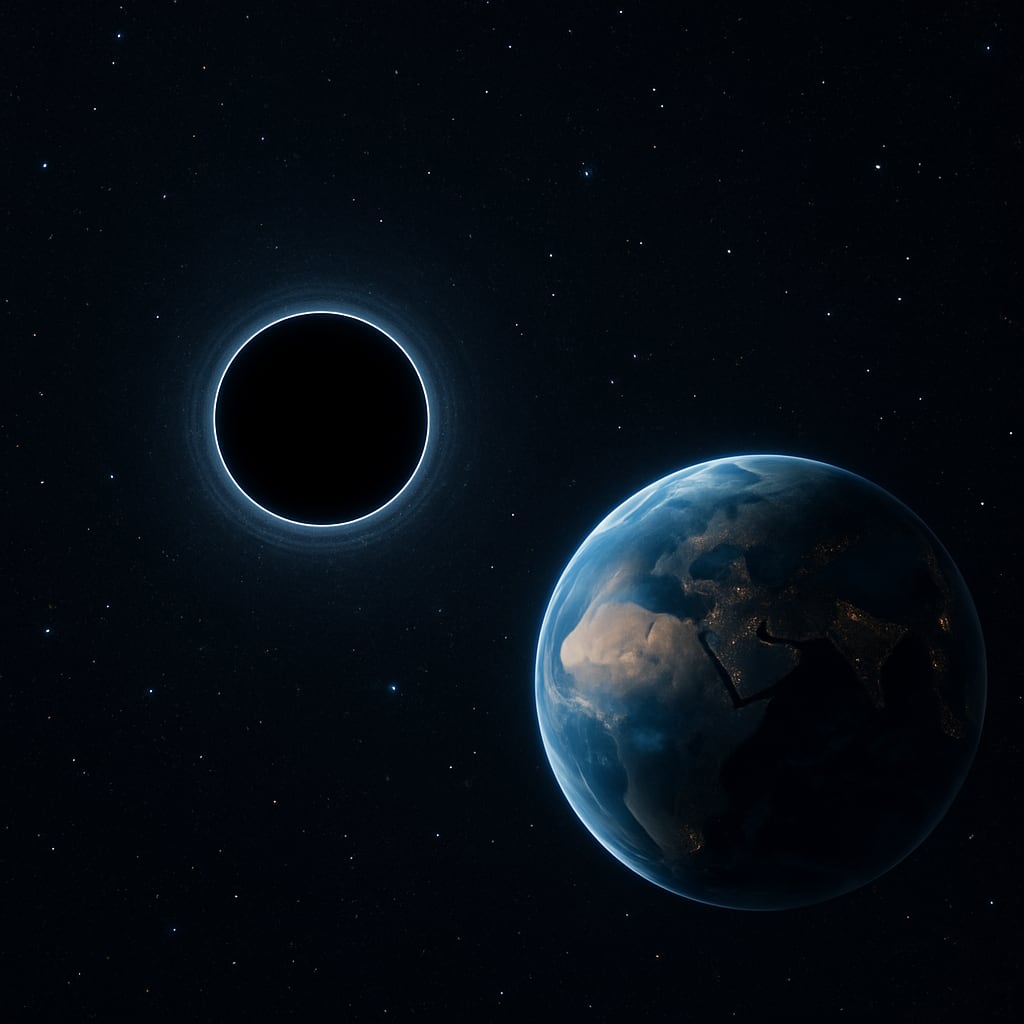
When most people hear the words “black hole”, they imagine a cosmic monster: a gravitational vacuum cleaner devouring everything in its path. So at first glance, the idea that Earth could calmly keep orbiting the Sun if it suddenly collapsed into a black hole sounds impossible — almost like a trick question from an astronomy class.
Yet, according to real physics, it’s true.
If the Sun were somehow replaced by a black hole of exactly the same mass, Earth would continue circling it on almost the same orbit. No spiraling inward. No instant destruction. No cosmic drain sucking the planets like marbles down a sink.
At least gravitationally, almost nothing would change.
But why?
Gravity Cares About Mass — Not Form
Gravity doesn’t care what an object is made of. It cares about how much mass it contains and how far away you are from it. Whether that mass belongs to a blazing sphere of plasma or an unimaginably dense black hole doesn’t matter.
The Sun currently has a mass of about 1.989 × 10³⁰ kilograms — give or take a few solar flares. If all this mass were somehow compressed into a black hole, the gravitational pull it exerts on Earth from 150 million kilometers away would be the same as it is now. Earth would still move at the same orbital speed (about 30 km/s) and complete its familiar 365-day journey.
In fact, the only region that would dramatically change is extremely close to the Sun’s center. But Earth is nowhere near that zone.
To put numbers on it:
A black hole with the Sun’s mass would have a Schwarzschild radius — the radius of its event horizon — of only 3 kilometers. That’s smaller than most cities. Compared to the Sun’s actual radius, which is about 700,000 kilometers, that’s practically nothing.
From Earth's perspective, the gravitational “footprint” of the Sun would be nearly identical.
No extra pull. No cosmic “suction.” Just the same mass in a much smaller package.
So Earth Would Survive… But Life Wouldn’t
The fact that Earth would remain in orbit doesn’t mean things would be fine. Far from it.
We depend on the Sun for two absolutely essential things:
- Light
- Heat
Take away both instantly, and Earth becomes a frozen, lightless world.
Let’s walk through a timeline of what that might look like.
Minutes After the Transformation
Day turns to absolute darkness. Not “cloudy day” dark, not “moonless night” dark — pitch black, with no source of illumination except distant stars.
Hours Later
Temperatures start falling. The atmosphere rapidly cools. Weather systems collapse.
Weeks Later
The surface of the oceans begins to freeze. Not a full freeze yet — oceans are deep and hold heat — but ice spreads fast from the top down.
Months to Years
Life near the surface becomes impossible.
Eventually, the atmosphere itself might start to condense and freeze at the poles.
One of the only remaining warm regions would be hydrothermal vents deep in the oceans, where some microbial life might survive for a long while — but humanity wouldn’t.
In other words:
- Orbit stable. Civilization doomed.
- Would Earth Eventually Fall Into the Black Hole?
- Not unless something else disturbed its orbit.
Planets don’t “fall into” black holes just because black holes sound scary. For Earth to spiral inward, one of the following would have to happen:
A massive object passes nearby and disrupts the orbit
Interactions between planets destabilize the system over millions or billions of years
The black hole starts gaining mass from a large accretion disk and alters the gravitational balance
None of these outcomes are guaranteed. In fact, with the Sun gone, the solar system might become more stable in some ways — no solar wind, no radiation pressure, fewer chaotic forces.
Still, over astronomical timescales, the system would eventually shift. Gravity is patient.
A Cosmic Paradox: Catastrophe Without Motion
This scenario highlights a fascinating truth about the universe:
Black holes aren’t cosmic vacuum cleaners.
They’re simply objects with mass condensed into an incredibly small space. From far away, one is indistinguishable from any other object of the same mass.
So if the Sun quietly turned into a black hole one day (ignoring the fact that this is physically impossible with normal stellar evolution), Earth wouldn't get sucked in. It would just keep moving, like a dancer whose partner suddenly stopped shining but didn’t let go of her hand.
The world would freeze, yes. Humanity would vanish, yes.
But the orbit — the beautiful geometry of our motion around the Sun — would remain intact.
In a strange way, it would be the calmest cosmic apocalypse imaginable.
About the Creator
Keep reading
More stories from Holianyk Ihor and writers in Futurism and other communities.
Runaway Stars: The Cosmic Sprinters Racing Out of the Milky Way at 2,000 km/s
When we look up at the night sky, the stars seem eternal and unmoving. We imagine them as quiet beacons, frozen in place. But in reality, every one of them is hurtling through space at incredible speeds. Most stars drift along at a calm and predictable pace—maybe a few dozen or a few hundred kilometers per second. Fast by human standards, but nothing extraordinary by galactic ones.
By Holianyk Ihor2 months ago in Futurism
About Binding Prometheus
I want to start actively advocating on behalf of my own work, and the most valuable part of my canon is, without a doubt, Binding Prometheus, the play I have been working on since 2019 and only finished in 2023 as part of my MA. The play itself is an amalgamation of a million different inspirations. On one end, it evokes the Ancient Greek myth-play, deriving its own title from the earliest extant work of Western drama we have, Aeschylus’s Prometheus Bound. On the other end, it borrows significantly from the sci-fi bulwarks from over the years, namely Mary Shelley’s Frankenstein and Karel Capek’s Rossum’s Universal Robots. The play could be an episode of Black Mirror, I fear. I don’t know. I’ve only ever seen one episode of Black Mirror.
By Steven Christopher McKnight16 days ago in Futurism




Comments
There are no comments for this story
Be the first to respond and start the conversation.