
Saudi Arabia Logistics Market: Supply Chain Optimization, Infrastructure Growth & Regional Hub Expansion
How infrastructure modernization, digital logistics platforms, and growing trade connectivity are reshaping efficiency, resilience, and growth strategies across the Saudi Arabia logistics market.

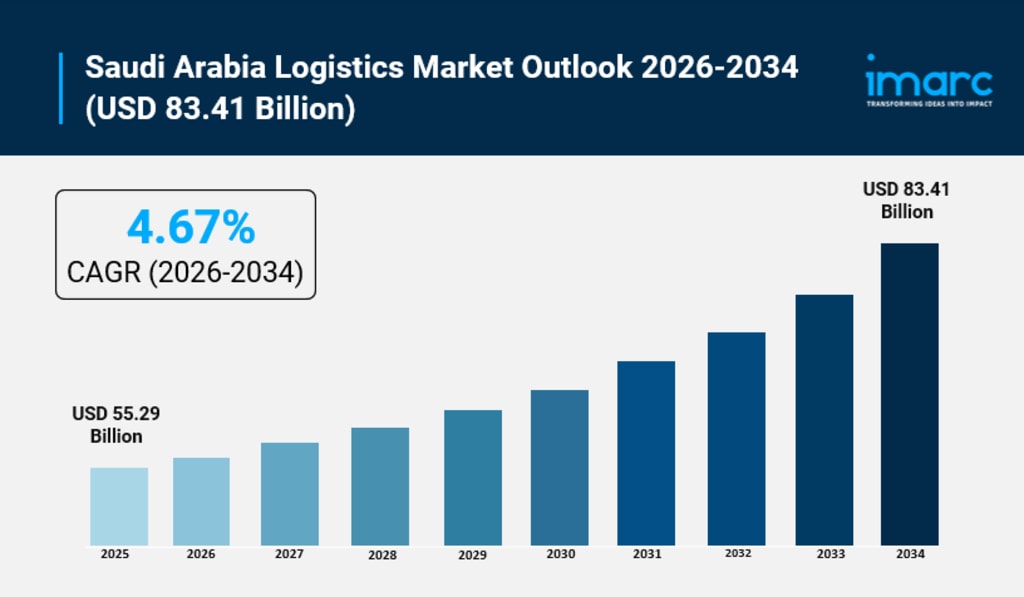
According to IMARC Group's latest research publication, the Saudi Arabia logistics market size was valued at USD 55.29 Billion in 2025 and is projected to reach USD 83.41 Billion by 2034, growing at a compound annual growth rate of 4.67% from 2026-2034.
How AI is Reshaping the Future of Saudi Arabia Logistics Market
- Predictive Route Optimization: AI-driven algorithms analyze traffic patterns, weather conditions, and delivery windows to optimize fleet routes in real-time, reducing fuel consumption by 20% while improving on-time deliveries across Saudi Arabia's 73,000-kilometer highway network.
- Smart Warehouse Operations: Automated robotic systems handle sorting and picking at speeds exceeding 96,000 parcels daily, as deployed at Jeddah Islamic Port by Aramex, while AI-powered inventory management cuts storage costs and eliminates stockout scenarios across fulfillment centers.
- Blockchain Shipment Tracking: AI-integrated blockchain platforms provide end-to-end supply chain visibility, enabling 4-hour customs clearance at SILZ compared to traditional 12-hour processing, while real-time cargo monitoring detects temperature deviations in pharma cold-chain shipments instantly.
- Demand Forecasting Analytics: Machine learning models process over 25 trillion data points from historical shipment volumes, e-commerce trends, and seasonal patterns to predict cargo flows, helping logistics providers optimize capacity allocation and warehouse space utilization.
- Autonomous Fleet Management: AI systems monitor vehicle health, driver behavior, and maintenance schedules across fleets exceeding 900 vehicles, predicting component failures before breakdowns occur and scheduling preventive repairs during off-peak hours to maximize uptime.
How Vision 2030 is Revolutionizing Saudi Arabia Logistics Industry
Vision 2030 is transforming Saudi Arabia into a global logistics powerhouse through strategic infrastructure investments and regulatory reforms. The government has allocated SAR 240 billion (USD 63.95 billion) for private sector logistics projects spanning ports, airports, and cargo terminals, with the sector's GDP contribution targeted to increase from 6% to 10%. Major initiatives include expanding the rail network from 5,300 kilometers to over 8,000 kilometers, boosting port throughput to 40 million TEUs, and enhancing air cargo capacity beyond 4.5 million tonnes annually. The USD 7 billion Saudi Landbridge Project will connect Jeddah to Dammam via a 950-kilometer rail corridor, slashing cargo transit times significantly. Additionally, SAR 2.66 billion has been invested in 18 new logistics zones offering 5G connectivity, streamlined 4-hour customs clearance, and tax incentives. NEOM's USD 500 billion investment includes cutting-edge zero-emission transport systems, while King Salman International Airport will handle 120 million passengers by 2030. The National Industrial Development and Logistics Program mandates over USD 1.5 billion in logistics infrastructure and technology, attracting foreign investment and positioning the Kingdom at the crossroads of Asia, Europe, and Africa trade routes.
Request a Sample Report Featuring Key Trends and Forecast Insights
Saudi Arabia Logistics Market Trends & Drivers:
E-commerce expansion is driving unprecedented demand for warehousing, fulfillment centers, and last-mile delivery infrastructure across the Kingdom. Over 50 million parcels were delivered in a single quarter, with total service orders surpassing 101 million, reflecting the scale of logistics activity. The e-commerce logistics market reached USD 2.24 billion and is accelerating rapidly, while cross-border e-commerce logistics is expanding even faster toward USD 20 billion in revenue. With 34.4 million internet users and 99% smartphone penetration, consumers expect same-day or next-day delivery, prompting operators to establish micro-fulfillment centers and optimize distribution networks. Amazon doubled its local capacity by opening a 39,000-square-foot fulfillment center in Riyadh, while expanding same-day Prime delivery to key cities. Companies are deploying AI-powered route planning, warehouse automation with robotic sortation systems processing 96,000 parcels daily, and real-time tracking platforms. The surge in online retail is also generating substantial requirements for specialized customs clearance, international shipping, and parcel management solutions as Saudi consumers increasingly purchase international products.
Infrastructure modernization is reshaping logistics capabilities through massive government-led investments in multimodal transport networks. The number of logistics facilities has jumped 267% since 2021, with the Eastern Province leading expansion. The government is building 40 new logistics centers across 100 million square meters to attract global firms, growing the sector to USD 57 billion. King Khalid International Airport's direct connection to SILZ via bonded corridors enables swift cargo movement, while port expansions at Jeddah Islamic Port and King Abdullah Port are increasing handling capacity and earning top-10 global efficiency rankings. The Saudi Landbridge railway project spanning 1,300 kilometers will connect Red Sea and Arabian Gulf coasts through Riyadh, revolutionizing freight movement. Airport passenger capacity is expanding to 330 million by 2030, with King Salman International Airport becoming one of the world's largest at 120 million passengers annually. The rollout of a national logistics platform (Single Window) is streamlining permits, customs, and approvals across government entities. DHL's EUR 130 million investment in a 78,000-square-meter hub at SILZ demonstrates global confidence, while MAWANI partnerships are adding 35,000 square meters of warehouse space at ports.
Technology adoption and automation are accelerating operational efficiency across the logistics value chain. The AI-powered warehouse robotics market reached USD 1.2 billion, driven by demand for Autonomous Mobile Robots, Automated Guided Vehicles, and robotic picking systems that minimize manual errors and support 24/7 operations. The government allocated SAR 12 billion for AI initiatives under Vision 2030, fostering innovation in logistics and warehousing. Smart warehouses employ AI algorithms to optimize layouts, inventory placement, and automated sorting, significantly reducing order fulfillment times. IoT sensors enable real-time cargo tracking with immediate alerts for disruptions or temperature deviations in cold-chain shipments, crucial for pharmaceuticals where regulations mandate temperature-controlled handling. Blockchain-based tracking systems provide end-to-end supply chain visibility and transparency for stakeholders. Digital twin technology creates virtual replicas of warehouses and distribution centers for simulation-based optimization before physical changes. Salasa raised USD 30 million to scale AI infrastructure across dark stores and bonded zones, embedding predictive logistics across planning, inventory, and fulfillment for over 1,000 merchant partners. Process automation solutions, data analytics, and terminal operating systems are streamlining customs integration and reducing clearance times from 12 hours to 4 hours at specialized logistics zones.
Saudi Arabia Logistics Market Industry Segmentation:
The report has segmented the market into the following categories:
Model Type Insights:
- 2 PL
- 3 PL
- 4 PL
Transportation Mode Insights:
- Roadways
- Seaways
- Railways
- Airways
End Use Insights:
- Manufacturing
- Consumer Goods
- Retail
- Food and Beverages
- IT Hardware
- Healthcare
- Chemicals
- Construction
- Automotive
- Telecom
- Oil and Gas
- Others
Regional Insights:
- Northern and Central Region
- Western Region
- Eastern Region
- Southern Region
Competitive Landscape:
The competitive landscape of the industry has also been examined along with the profiles of the key players.
Recent News and Developments in Saudi Arabia Logistics Market
- November 2025: DHL Supply Chain announced a EUR 130 million (SAR 561.5 million) investment to establish a 78,000-square-meter regional logistics and distribution hub at Saudi Arabia's Special Integrated Logistics Zone in Riyadh, featuring 53,000 square meters of advanced multi-user warehouse space serving technology, retail, automotive, energy, and e-commerce sectors under a 26-year lease agreement.
- August 2025: DHL eCommerce completed its minority stake acquisition in AJEX Logistics Services, a leading Saudi parcel delivery company with 1,500 team members, over 50 facilities, and a fleet exceeding 900 vehicles, positioning both companies to capitalize on anticipated double-digit growth in Saudi Arabia's e-commerce sector while expanding last-mile delivery capabilities across the Middle East region.
- June 2025: DHL Group announced plans to invest over EUR 500 million (USD 585 million) in the Middle East with strategic focus on Saudi Arabia and UAE, spanning all four DHL divisions to significantly strengthen logistics infrastructure, expand networks, enhance service capabilities, and integrate advanced technology to optimize operations across warehousing, express delivery, freight forwarding, and e-commerce segments.
- April 2025: MAWANI and Sultan Logistics signed an agreement to build a SAR 200 million (USD 53.2 million) logistics park at King Abdulaziz Port, adding 35,000 square meters of warehouse space to enhance cargo handling capacity and support the Kingdom's expanding maritime trade operations.
Note: If you require specific details, data, or insights that are not currently included in the scope of this report, we are happy to accommodate your request. As part of our customization service, we will gather and provide the additional information you need, tailored to your specific requirements. Please let us know your exact needs, and we will ensure the report is updated accordingly to meet your expectations.
About the Creator
Jeffrey Wilson
Hello, I’m Jeffrey Wilson, a market research specialist with over 9 years of experience in uncovering consumer insights and driving data-backed strategies.
Keep reading
More stories from Jeffrey Wilson and writers in Futurism and other communities.
Real Estate Market in Saudi Arabia: Housing Demand, Vision 2030, Infrastructure Growth & Market Transformation
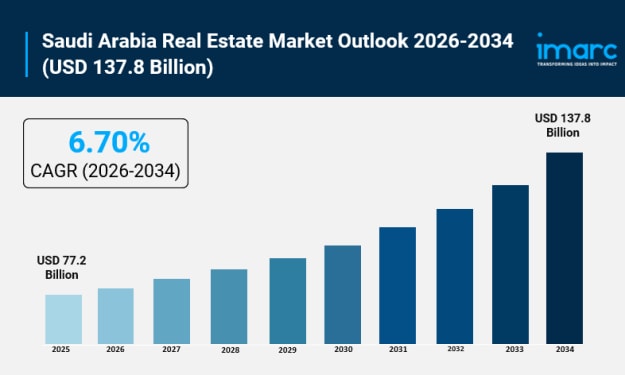
According to IMARC Group's latest research publication, the Saudi Arabia real estate market size was valued at USD 77.2 Billion in 2025. Looking forward, IMARC Group estimates the market to reach USD 137.8 Billion by 2034, exhibiting a growth rate (CAGR) of 6.70% during 2026-2034.
By Jeffrey Wilson3 days ago in Futurism
About Binding Prometheus
I want to start actively advocating on behalf of my own work, and the most valuable part of my canon is, without a doubt, Binding Prometheus, the play I have been working on since 2019 and only finished in 2023 as part of my MA. The play itself is an amalgamation of a million different inspirations. On one end, it evokes the Ancient Greek myth-play, deriving its own title from the earliest extant work of Western drama we have, Aeschylus’s Prometheus Bound. On the other end, it borrows significantly from the sci-fi bulwarks from over the years, namely Mary Shelley’s Frankenstein and Karel Capek’s Rossum’s Universal Robots. The play could be an episode of Black Mirror, I fear. I don’t know. I’ve only ever seen one episode of Black Mirror.
By Steven Christopher McKnight11 days ago in Futurism
Saudi Arabia Pharmaceuticals Market: Rising Healthcare Demand, Drug Innovation & Growth
According to IMARC Group's latest research publication, the Saudi Arabia pharmaceuticals market size reached USD 9.4 Billion in 2024. The market is projected to reach USD 11.7 Billion by 2033, exhibiting a growth rate of 2.27% during 2025-2033.
By Suhaira Yusuf3 days ago in Futurism



Comments
There are no comments for this story
Be the first to respond and start the conversation.