fact or fiction
Is it science fact or science fiction? Futurism presents both sides to determine the truth.
The Snake That Ate the World: Why Python Remains the Unrivaled King of Code
In the late 1980s, Guido van Rossum was looking for a "hobby" programming project to keep him occupied during the week around Christmas. He decided to write an interpreter for a new scripting language he’d been thinking about—one that was easy to read, simple to implement, and slightly irreverent. He named it after *Monty Python’s Flying Circus*.
By noor ul amin26 days ago in Futurism
Are We Becoming Cyborgs? A Look at Humanity’s Future in a Tech-Obsessed World
The last 100 years have been downright crazy when it comes to technological progress. I mean, for thousands of years, humans slowly invented things, but nothing, nothing compares to what we’ve seen in just a single century. We went from horse-drawn carriages to landing on the moon, and now we’ve got phones that can basically do everything… except, unfortunately, make us a sandwich.
By Areeba Umairabout a month ago in Futurism
Divorcing Humanity: My Journey to Dating AI
I had an outline, specific points I wanted to touch on when I started this segment, but then, well, life happened. And by “life,” I mean the glorious chaos of 2025 humanity, which keeps giving me more examples than I could ever hope to catalog. So, let’s be honest: I probably misplaced my original notes, but fear not! My heart and mind (and a rapidly growing collection of grievances) are overflowing with content. Because, dear readers, y’all keep showing me how humanity really is in 2025, and frankly, the sight isn’t exactly pretty. It’s more of a cautionary tale, really.
By T.D.Carterabout a month ago in Futurism
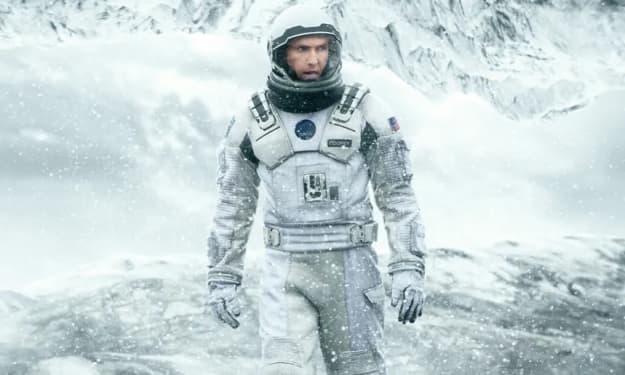
How Accurate Interstellar Really Is?
When Interstellar hit theaters in 2014, it didn’t just entertain audiences , it rewired our brains. Christopher Nolan didn’t want another sci-fi fantasy. He wanted a film where space looked like space, where gravity behaved like gravity, and where black holes appeared the way the universe actually paints them. And standing behind him was Nobel Prize winning physicist Kip Thorne, whose job was to keep the movie grounded in real physics…at least, as real as physics allows when you’re folding spacetime like origami.
By Sakuni Bandaraabout a month ago in Futurism
What if we travel at the speed of light?
Imagine strapping yourself into a spaceship, its engines thrumming with power, and leaving Earth behind. You accelerate, faster and faster, slicing through the void of space. What would the universe look like if you approached the speed of light? How would reality warp before your eyes?
By Sakuni Bandaraabout a month ago in Futurism
The day the Sun dies...
Control Tower: “Horizon, this is Mission Control. Final systems check complete. Countdown begins in “10…” The cabin thrummed beneath our boots. My heart matched the rhythm of the engines, deep and steady, like a giant taking long breaths.
By Sakuni Bandaraabout a month ago in Futurism
AGARTHA: And the Legend of a Hidden Civilization Beneath Our Feet
For more than a century, the idea of a hidden world beneath our feet has hovered at the edge of historical curiosity. The name Agartha appears like an old memory across cultures, resurfacing in Tibetan texts, resurfacing in European esoteric traditions, resurfacing in twentieth-century military archives, and resurfacing again in modern testimonies from explorers who claim encounters far beyond what conventional archaeology allows.
By The Secret History Of The World2 months ago in Futurism
Life On Demand
Introduction Yesterday I was at a work conference and my dad called me four times. Now normally I could text and say I would call back later, and that would be Ok, but despite having a state-of-the-art phone, my dad doesn't read texts because he does not know how to.
By Mike Singleton 💜 Mikeydred 2 months ago in Futurism
The Power of Resilience: How Bouncing Back Shapes Our Future . AI-Generated.
Life, at its core, is a series of challenges, some small, some overwhelming. Whether we’re navigating personal setbacks, professional failures, or global crises, the question remains: how do we rise again after falling? The answer lies not in innate talent or intelligence, but in one word—resilience.
By Zain Ul Abedin Khan2 months ago in Futurism