
Are We Becoming Cyborgs? A Look at Humanity’s Future in a Tech-Obsessed World
From moon landings to mind-uploading, the next 100 years might change what it means to be human.


The last 100 years have been downright crazy when it comes to technological progress. I mean, for thousands of years, humans slowly invented things, but nothing, nothing compares to what we’ve seen in just a single century. We went from horse-drawn carriages to landing on the moon, and now we’ve got phones that can basically do everything… except, unfortunately, make us a sandwich.
And the pace isn’t slowing down. The newest tech, think computers, biotech, and genetic engineering, moves faster than anything we’ve seen before because it’s self-accelerating. In simple terms, new technologies often help create the next, even more powerful versions. A new computer chip is made and immediately used to develop an even faster chip. This same dynamic drives biotech and nanotech. Nowadays, researchers are even exploring DNA for its programmability.
So what’s next? Are humans destined to become part machine? Professor Yuval Noah Harari from the Hebrew University of Jerusalem has some bold ideas. He believes the fusion of man and machine might be the biggest biological evolution yet. According to him, within the next 200 years, humans could upgrade themselves into some version of a “divine being” through biological manipulation, genetic engineering, or by becoming cyborgs, part human, part machine.
Why would we do this? Harari argues it’s in our nature to be dissatisfied. Just like we always want the newest phone or video game, we might not be able to resist upgrading ourselves. Pleasure and achievement only go so far; we always want more. And if you think about it, that seems true in a lot of areas of life. Even when people have everything, they often crave just a little bit more.
But here’s the twist: Harari predicts that not everyone will get to become a cyborg. It could become a new kind of inequality, the rich might live forever, while the poor… well, they wouldn’t. He also thinks humans may eventually feel like we don’t need religion because we’ll see ourselves as gods, powered by technology.
It sounds like sci-fi, right? But the science isn’t entirely far-fetched. Cambridge neuroscientist Dr Hannah Critchlow has suggested that, in theory, a human could “live” inside a machine if computers could replicate the trillions of connections in our brains. Imagine uploading your memories, personality, and consciousness into hardware. It’s wild, but theoretically possible.
Think about this: what if one day there’s a simple procedure to make you run faster, jump higher, or boost your intelligence? Some people might do it for an edge. Then more would follow to keep up. Eventually, we could all start becoming cyborgs, kind of like in the movie Limitless, where taking a pill made someone the smartest person on Earth. And if everyone had access to that pill, wouldn’t we all take it?
I’m not saying I like where this is going, and I’m not claiming we’re all about to become cyborgs tomorrow, but it does feel like we’re already on that road. Tech is advancing at lightning speed, and every day it seems like there’s a new gadget or invention that makes humans less essential.
So, what do you think? Are we heading toward a world where humans and machines merge, or is this just another sci-fi dream? Drop your thoughts in the comments below. I’d love to hear them.
About the Creator
Areeba Umair
Writing stories that blend fiction and history, exploring the past with a touch of imagination.
Keep reading
More stories from Areeba Umair and writers in Futurism and other communities.
10 Mind-Blowing Space Stories School Never Told You
For many of us (especially if you grew up watching Star Trek), space truly feels like the final frontier. Sure, school taught us about planets, gravity, and maybe a little about rockets. But what we got was just a glimpse of the safe, simplified version.
By Areeba Umair28 days ago in Futurism
Saudi Arabia Seafood Market: Aquaculture Expansion, Rising Consumption & Growth Outlook
According to IMARC Group's latest research publication, Saudi Arabia seafood market size reached USD 3.3 Billion in 2024. The market is projected to reach USD 4.3 Billion by 2033, exhibiting a growth rate (CAGR) of 2.5% during 2025-2033.
By Shubham Sharma 2 days ago in Futurism
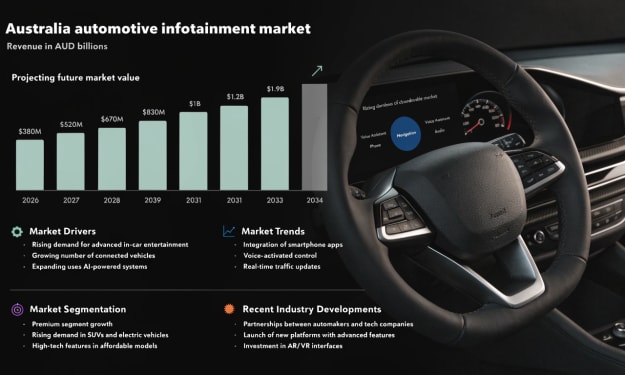
Australia Automotive Infotainment Market: Connected Car Demand, Smartphone Integration & 5G Connectivity
According to IMARC Group, the Australia automotive infotainment market is experiencing steady growth as consumers increasingly expect connected digital experiences inside vehicles. Modern drivers are demanding seamless smartphone integration, high-quality multimedia systems and real-time connectivity features that enhance convenience and entertainment during travel. Automakers and technology providers are responding by integrating advanced infotainment platforms with navigation services, voice assistants and cloud-based applications. The expansion of 5G connectivity and connected vehicle technologies is further strengthening the development of next-generation in-car entertainment and communication systems. As Australia’s automotive sector continues adopting digital technologies and connected mobility solutions, infotainment systems are becoming central components of modern vehicle design and driver experience.
By Shrestha Roy6 days ago in Futurism
The Forsyth House Fire
Since 1851, Forsyth House has stood on the corner of Union Street and Gordon Street in the heart of Glasgow. Its iconic, or was... because on Sunday 8th of March, 2026, a fire broke out in a small, seemingly un-named shop in the building and tore all that history down. As I write, the rubble is still unsettled and the street is still blocked off. Central Station is quiet on the upper level, and around 30 small businesses have quite literally gone up in smoke.
By S. A. Crawford2 days ago in The Swamp



Comments
There are no comments for this story
Be the first to respond and start the conversation.