
The 2032 Threat
Scientists Warn: Asteroid 2024 YR4 May Hit Earth in 2032!


That headline is startling enough to make anyone want to buy a survival backpack and start stocking up on canned goods and bottled water.
But let's keep calm. The data doesn't lie. The probability of this asteroid striking Earth is **2%**—in other words, there is a **98% chance** it will simply wave hello and continue on its way.
So, is it time to relax and binge-watch TV, or should we start writing our wills? Let’s take a look at the real threat posed by this unexpected cosmic visitor!
---
### Which Countries Might Win the ‘Lottery’? The "Risk Corridor" List
Based on the asteroid’s potential orbital path, scientists have mapped out its **"Risk Corridor."** If that 2% chance actually materializes, the following countries could potentially be in the "VIP Zone":
* 🌎 **South America:** Venezuela, Colombia, Ecuador
* 🌏 **Asia:** India, Pakistan, Bangladesh
* 🌍 **Africa:** Ethiopia, Sudan, Nigeria
* 🌊 **Pacific & Arabian Sea**
This list could still change with further observation data. But if you live in these areas, perhaps you should check property values and evaluate immigration plans for 2032?
---
### What is 2024 YR4's "AP Value" (Attack Power)?
Alright, let's assume 2024 YR4 actually hits Earth. Just how powerful is its attack?
* **Size:** 40 to 100 meters in diameter—larger than a football field, but much smaller than the asteroid that killed the dinosaurs.
* **Explosive Yield:** Equivalent to **8 million tons of TNT**, which is about **500 times** the force of the Hiroshima atomic bomb!
* **Impact Range:** Buildings destroyed and glass shattered within a 50 km radius, potentially overturning houses.
* **Impact Mode:** It may not necessarily strike the ground directly. It is more likely to detonate in the atmosphere (**Airburst**), similar to the 2013 Chelyabinsk meteor in Russia, but on a much larger scale.
**If it actually hits...**
* 🌊 **Lands in the Ocean?** Congratulations, you're looking at a mega-tsunami. Coastal cities could become Atlantis 2.0.
* 🏙️ **Lands on Land?** Glass shattering, a shockwave sweeping across 50 km. Feels like an apocalypse movie.
* 🏠 **Lands on Your House?** ...Well, good luck. You might be the first asteroid victim featured on *National Geographic*.
---
### Is Humanity Doomed? Absolutely Not!
While we can't stop inflation, at least when it comes to asteroids, humanity is prepared. Let's look at our **"Planetary Defense Arsenal!"**
#### 1️⃣ The Ideal Solution: Change its Course
Redirecting the asteroid's orbit is the most stable choice, rather than simply blowing it up. Scientists have several methods:
* ✅ **Kinetic Impactor Method (Successfully tested by NASA!)**
* 🛰️ **Method:** Crash an uncrewed spacecraft into the asteroid at ultra-high speed to nudge its orbit.
* 💡 **Case Study:** NASA's **DART mission** in 2022 successfully altered the orbit of the asteroid Dimorphos, proving the method works!
* ⏳ **Time Requirement:** Needs to start at least **5 to 10 years** in advance. Can't wait until the last minute!
* 🛸 **Gravity Tractor Method (Future Technology)**
* 🛰️ **Method:** Launch a spacecraft to slowly fly near the asteroid, using its own gravity to gently pull the asteroid over time.
* 🏆 **Advantage:** No fragmentation, no extra risk.
* ⏳ **Drawback:** Requires **more than 10 years** for the effect to be noticeable. Scientists need to plan early.
* 🔫 **Laser Ablation Method (Sci-Fi, but not yet realized)**
* 🌞 **Method:** Shine a powerful laser on the asteroid, vaporizing its surface to create thrust, slowly pushing it off course.
* ⚡ **Issue:** Lasers of this required intensity don't yet exist, but scientists believe it's "theoretically viable."
#### 2️⃣ If Time Runs Out? Blow it Up!
If redirecting the orbit is no longer an option, humanity might opt for the "Explosion Plan," but this is not ideal:
* 🚀 **Nuclear Interception:** Can use a nuclear warhead to destroy the asteroid, but fragmenting it might lead to multiple impact points.
* 🚀 **Synchronous Impactor Barrage:** Hope that multiple probes crashing simultaneously can shatter or redirect it, though controlling the debris field is difficult.
* ⚠️ **Problem:** This requires rapid global cooperation, and we all know... international meetings usually take a long time.
#### 3️⃣ If Defense Fails, Then... Run!
If all else fails, the only remaining solution is—evacuation!
* 🏃♂️ **Prediction & Evacuation**
* ✅ Calculate the impact site several months in advance, giving people enough time to move.
* ✅ NASA and ESA provide precise calculations to maximize evacuation efficiency.
* ✅ Residents within the 50-100 km radius should start packing their bags and preparing to leave!
* 🏗️ **Architectural Defense**
* ✅ Strengthen glass to reduce fragmentation injury.
* ✅ Reinforce building structures to prevent large-scale collapse from the shockwave.
* 📡 **Government Emergency Plan**
* 📢 Emergency broadcasts to ensure accurate information delivery.
* 🚑 Prepare sufficient medical supplies, food, and water resources.
* 🛰️ Ensure satellite communications remain operational for post-disaster relief.
---
### Is the International Community Ready?
I specifically looked into whether there are any laws or treaties regarding a potential global disaster like an asteroid strike.
The result?
Hmm... there is currently **no formal "Asteroid Defense Treaty,"** but the international community is not entirely inactive.
In terms of planetary defense, countries have made some preparations, including:
* ✅ The **United Nations Office for Outer Space Affairs (UNOOSA)** established the **"Near-Earth Object (NEO) Action Team"** responsible for global NEO monitoring and defense cooperation.
* ✅ The **International Astronomical Union (IAU)** established a **"Planetary Defense Committee"** dedicated to studying asteroid defense.
* ✅ NASA, ESA, and other national agencies have developed policies supporting asteroid monitoring and defense technology research.
However, these plans remain in the "research and observation" phase and have not formed a mandatory, globally enforceable treaty.
Is it because the 2% chance is too low, and everyone is complacent? History, however, has already shown us:
#### Historical Review: Planetary Impact is "When," Not "If"
* **66 Million Years Ago:** An asteroid about **10 km** in diameter struck Earth, causing the extinction of the dinosaurs and 76% of global species.
* **2013 Chelyabinsk Meteor, Russia:** A meteor about **20 meters** in diameter air-burst without warning. Its energy exceeded **30 Hiroshima atomic bombs**, injuring thousands.
* **1908 Tunguska Event:** Likely a **50–60 meter** asteroid airburst, which flattened **2,000 square kilometers** of forest, equivalent to the size of a major metropolis.
These events clarify that Earth does get hit by meteors, and this is not a **"once-in-a-million-years"** event, but a disaster that is **"bound to happen sooner or later."**
So, who can guarantee it won't happen again?
---
### International Cooperation: Saving Earth Isn't One Nation's Job!
🌍 Asteroid impacts know no borders. This is not a problem that any single country can solve alone! Therefore, the globe must work together to ensure Earth is prepared!
The following should be key areas for international cooperation:
1️⃣ **Establish a Stronger Global Monitoring System**
Agencies like NASA, ESA, China, and Russia should collaborate to strengthen the global monitoring system, ensuring every potentially threatening asteroid is within our view.
* 🔭 **Enhance Radar and Telescope Technology** to allow us to discover potential threats earlier, rather than scrambling when the asteroid is nearly upon us.
2️⃣ **The UN Should Draft a "Planetary Defense Treaty"**
Draft a global defense treaty to ensure all nations participate, rather than holding emergency meetings when disaster strikes. The treaty should include:
* ✅ **Global Monitoring Plan**—Sharing funding and technology to ensure comprehensive monitoring of Near-Earth Objects (NEOs).
* ✅ **Resource Allocation**—Ensuring nations can provide technology, equipment, personnel, and funding to respond to threats.
* ✅ **Technological Collaboration**—Standardizing research directions and developing planetary defense technologies like the **Kinetic Impactor, Gravity Tractor, and Laser Ablation** methods.
3️⃣ **Nations Should Conduct Regular Simulation Drills**
Conduct global defense and emergency evacuation drills to test prediction systems, evacuation plans, and rescue operations. This ensures that when a crisis truly arrives, humanity can react quickly, rather than panicking like in the movies. For example:
* ✅ How to predict the impact location?
* ✅ How to organize a global evacuation?
* ✅ How to carry out rescue operations if the defense fails?
**This is not just an issue for one country; it concerns the future of all humanity!**
---
### 🎯 Conclusion: Earth Will Not Wait to Die!
As of now, the impact probability for 2024 YR4 is only **2%**, but this does not mean we can completely ignore the problem.
If the probability increases, we still have solutions for orbital deflection, defense, and even emergency evacuation!
But if we do nothing now, then when the real "big killer" arrives, we might truly have nothing left but prayer...
🌍 The risk of an asteroid hitting Earth always exists. We cannot rely on luck.
🌍 Only by strengthening international cooperation and facing the threat together can we ensure the future of humanity!
🌎 **The Best Outcome?** 2024 YR4 is just passing by. In 2032, we continue our lives, going to work and paying the mortgage as usual.
**The Worst Outcome?** Humanity unites to kick this unexpected guest out of Earth's sight!
So, don't worry about the asteroid for now. Worry about your end-of-the-month bills instead! 😂
About the Creator
Water&Well&Page
I think to write, I write to think
Keep reading
More stories from Water&Well&Page and writers in Futurism and other communities.
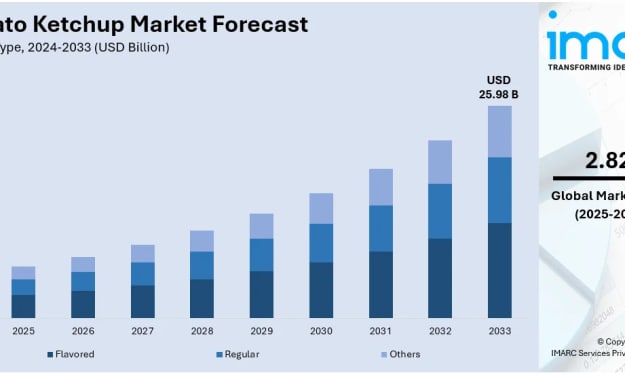
Tomato Ketchup Market Trends: Retail Expansion, Emerging Markets Growth & Industry Forecast to 2033
The global tomato ketchup market is witnessing a significant transformation, fueled by the rapid expansion of fast-food chains, evolving culinary habits, and a growing consumer inclination toward convenient yet flavorful condiments. According to IMARC Group’s latest data, the global tomato ketchup market size was valued at USD 20.18 Billion in 2024. Looking forward, IMARC Group estimates the market to reach USD 25.98 Billion by 2033, exhibiting a CAGR of 2.82% from 2025-2033.
By Andrew Sullivan6 days ago in Futurism
When the Shelter Closes
Across the street from my house, a man slept under a tree, his dog by his side. My first, naive thought: he must be traveling through. But he kept coming back, often sleeping there during the day. Then it hit me—that person might not have a home.
By Bride of Sound5 days ago in Humans


Comments
There are no comments for this story
Be the first to respond and start the conversation.