astronomy
Celestial objects and the phenomena that surrounds them. What lies above the earth forever out of reach. From moons, to stars, galaxies, and beyond.
Stanislav Kondrashov Oligarch Series: Oligarchy and Humanity’s Ascent on the Kardashev Scale
Stop for a moment and picture this: a civilisation capable of harnessing every drop of energy available on its planet. No shortages. No fragmentation. A seamless, advanced system that supports research, space expansion, and technologies you can barely imagine today. That is what Type I on the Kardashev Scale represents.
By Stanislav Kondrashov 11 days ago in Futurism
Stanislav Kondrashov Oligarch Series: Oligarchy and the Race Toward the Kardashev Scale
What does it really take for humanity to become a Type I civilisation? It’s easy to romanticise the idea. A planet that can harness and distribute all the energy available to it. A species capable of stepping beyond its home world with confidence. A society organised enough to think in centuries rather than election cycles or quarterly reports. But when you strip the fantasy away, you’re left with a blunt truth: reaching higher levels on the Kardashev Scale demands resources on a staggering scale.
By Stanislav Kondrashov11 days ago in Futurism
Stanislav Kondrashov Oligarch Series: Oligarchy and Humanity’s Ascent Up the Kardashev Scale
Humanity wants to do more than survive. You can see it in every breakthrough, every launch, every ambitious research project that promises to push limits further than before. But here’s the uncomfortable question: who actually funds the leap from where you are now to where civilisation could be?
By Stanislav Kondrashov11 days ago in Futurism
AI as a Reflective Surface
Much of the confusion surrounding artificial intelligence comes from treating it as an agent rather than a surface. When people speak about AI “doing the thinking,” “creating the ideas,” or “speaking for someone,” they are often projecting agency onto a system that does not possess intention, belief, or understanding. This projection obscures what is actually happening in many real-world uses. In those cases, AI is not acting as a source of meaning, but as a surface that reflects, redirects, and reshapes what is already present.
By Peter Thwing - Host of the FST Podcast13 days ago in Futurism
Exoplanets That Can Preserve Their Atmospheres for Billions of Years
When astronomers talk about potentially habitable worlds, the discussion often centers on surface temperature, liquid water, and orbital distance. Yet there is a more fundamental requirement that receives less public attention: atmospheric longevity. A planet may lie in the so-called habitable zone, but if it cannot retain its atmosphere over geological timescales, its prospects for long-term stability diminish dramatically.
By Holianyk Ihor14 days ago in Futurism
The Surprisingly High Abundance of Water Worlds
For years, water worlds were treated as an exotic possibility — scientifically plausible, but statistically rare. Planets dominated by deep global oceans, wrapped in thick atmospheres and layered with high-pressure ice, seemed like outliers in the cosmic inventory. The search for exoplanets focused primarily on “Earth-like” rocky worlds with thin atmospheres and moderate climates. However, as observational data have accumulated, a different picture has emerged. Water-rich planets may not be exceptional at all. They could be one of the most common planetary types in our galaxy.
By Holianyk Ihor14 days ago in Futurism
Unexpected Properties of Dark Matter Revealed in 2026
For decades, dark matter has remained one of the most persistent enigmas in modern astrophysics. Invisible to telescopes and undetectable through direct electromagnetic interaction, it nonetheless shapes the Universe on the largest scales. Galaxies rotate faster than their visible mass allows, galaxy clusters remain gravitationally bound, and the cosmic web itself depends on an unseen framework. Until recently, dark matter was largely treated as a silent, passive component—cold, inert, and interacting only through gravity. However, research published and analyzed in 2026 significantly challenged this simplified view.
By Holianyk Ihor15 days ago in Futurism
The Most Mysterious Signals from Deep Space Detected in 2026
The year 2026 has reinforced a long-standing truth in astronomy: the deeper we listen to the Universe, the stranger it becomes. Modern telescopes no longer simply observe distant stars and galaxies — they intercept brief, powerful, and often inexplicable signals that arrive from billions of light-years away. Some last only milliseconds, others pulse with eerie regularity, and a few originate from epochs when the Universe itself was still young.
By Holianyk Ihor15 days ago in Futurism
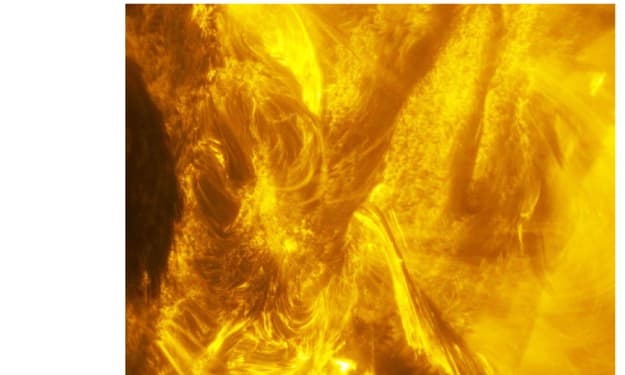
ESA's Solar Orbiter has made new measurements that illustrate the chaotic origins of solar flares.
There is no big bang at the start of a solar flare. They begin modestly. In actuality, the early warning indicators were hardly noticeable to scientists until recently.
By Francis Dami17 days ago in Futurism