
The Most Mysterious Signals from Deep Space Detected in 2026
Space

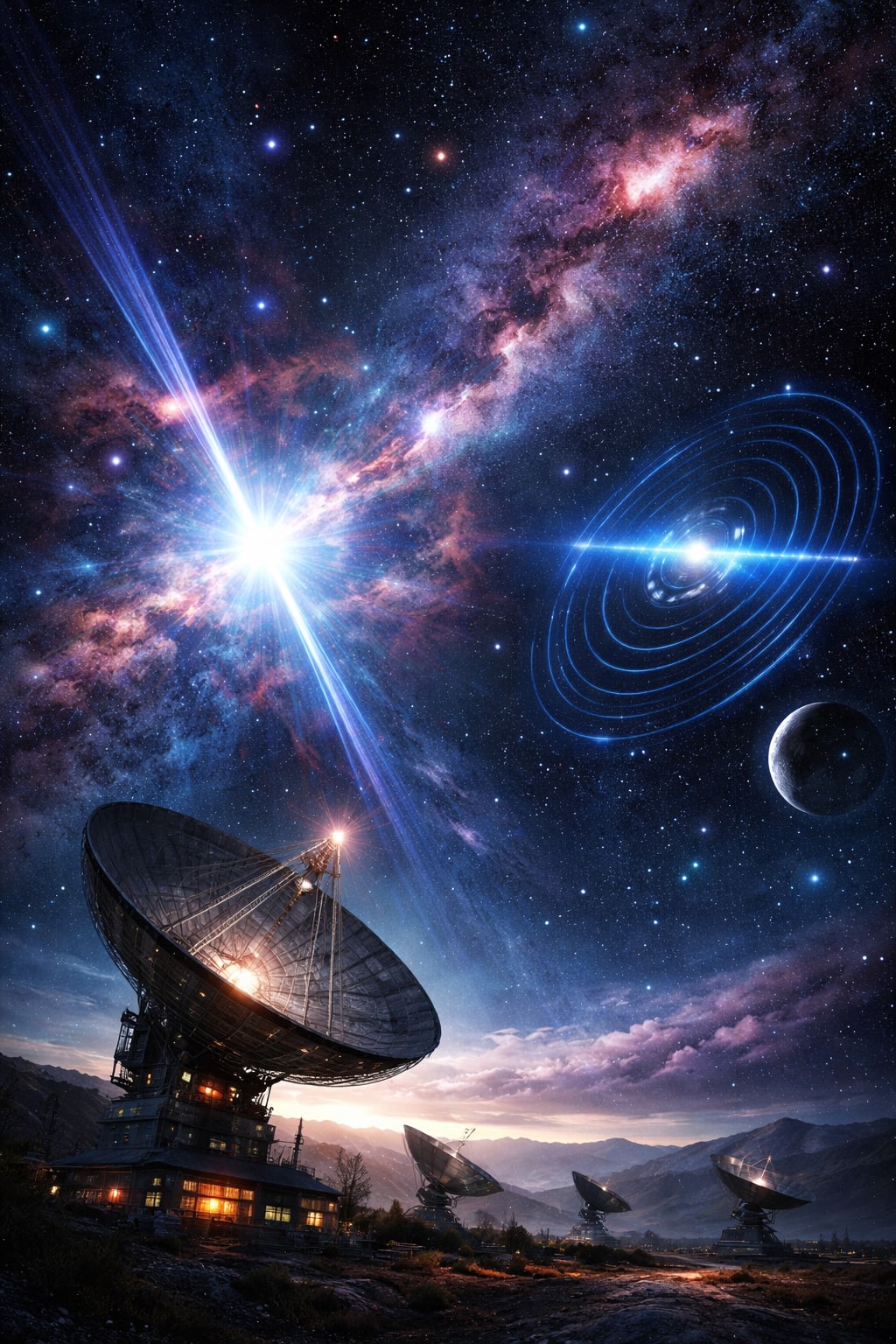
The year 2026 has reinforced a long-standing truth in astronomy: the deeper we listen to the Universe, the stranger it becomes. Modern telescopes no longer simply observe distant stars and galaxies — they intercept brief, powerful, and often inexplicable signals that arrive from billions of light-years away. Some last only milliseconds, others pulse with eerie regularity, and a few originate from epochs when the Universe itself was still young.
These signals do not merely raise technical questions; they challenge our understanding of physics, stellar evolution, and the behavior of matter under extreme conditions. Below are the most intriguing and mysterious cosmic signals that captured the attention of astronomers in 2026.
A Gamma-Ray Message from the Early Universe
One of the most remarkable detections of the year was an exceptionally powerful gamma-ray burst originating roughly 13 billion light-years away. Gamma-ray bursts, or GRBs, are already known as the most energetic explosions in the Universe, releasing in seconds more energy than the Sun will emit over its entire lifetime.
What made this particular event extraordinary was not just its intensity, but its age. The signal was emitted when the Universe was less than a billion years old — a time when the first generations of massive stars were forming and dying. Observing such a burst is akin to receiving a signal from cosmic prehistory.
Astrophysicists believe this GRB was likely caused by the collapse of a massive early star into a black hole. However, stars in the early Universe formed in conditions very different from those we observe today, with fewer heavy elements and unusual internal structures. This makes interpreting the signal especially challenging. Each data point from such an ancient explosion acts as a rare probe into the physics of the first stellar systems.
Fast Radio Bursts: Milliseconds of Mystery
Fast Radio Bursts (FRBs) remain among the most enigmatic signals ever detected. These incredibly short radio pulses — often lasting just a few milliseconds — can outshine entire galaxies in radio wavelengths during their brief existence.
In 2026, astronomers continued to document repeating FRBs, a subclass that fires multiple bursts from the same source over time. This behavior rules out some catastrophic explanations, such as one-time stellar explosions, and instead points toward persistent but unstable cosmic objects.
One leading theory links repeating FRBs to magnetars — neutron stars with magnetic fields trillions of times stronger than Earth’s. In some cases, evidence suggests these magnetars may exist in binary systems, interacting with a nearby companion star or dense plasma environment. The complexity of these systems may explain why the signals appear irregular, intense, and difficult to model.
What makes FRBs particularly compelling is their potential scientific utility. As these radio waves travel through intergalactic space, they interact with diffuse cosmic matter, allowing astronomers to indirectly map otherwise invisible regions of the Universe.
Signals That Should Not Exist — But Do
Among the most puzzling discoveries are objects that emit periodic signals on timescales that defy conventional classifications. In 2026, attention focused on several sources that pulse every few dozen minutes — far slower than known pulsars, yet too regular to be random phenomena.
Even more perplexing, some of these objects emit energy across multiple wavelengths, such as radio waves and X-rays simultaneously. This combination does not neatly match any established category of cosmic object. They are not classic neutron stars, not white dwarfs, and not black holes as we currently understand them.
These signals force astronomers to confront an uncomfortable possibility: the Universe may host classes of objects that do not yet exist in our theoretical frameworks. New models involving exotic magnetic configurations, previously unknown stellar remnants, or unusual plasma interactions are actively being explored.
SETI Candidates and the Limits of Interpretation
The search for extraterrestrial intelligence (SETI) also contributed to the conversation in 2026. Advances in data processing allowed researchers to reanalyze decades of archival radio observations, identifying hundreds of signals that merit further scrutiny.
These so-called “candidate signals” are not evidence of alien civilizations, but they possess characteristics that distinguish them from known natural sources and human-made interference. Narrow frequency ranges, unusual repetition patterns, or unexpected signal stability place them in a gray zone between noise and significance.
The importance of these detections lies less in speculation and more in methodology. Each candidate refines the criteria scientists use to distinguish natural astrophysical processes from potential technosignatures. In doing so, SETI research continues to improve our understanding of the cosmic radio environment — regardless of whether intelligent life is ultimately detected.
Why These Signals Matter
At first glance, these mysterious signals may seem like isolated curiosities. In reality, they are deeply interconnected with fundamental questions about the Universe:
- How did the first stars form and die?
- What happens to matter under magnetic and gravitational forces far beyond terrestrial experience?
- Are there astrophysical processes we have not yet imagined?
Each unexplained signal acts as a stress test for modern physics. When existing theories fail to explain observations, scientific progress begins.
A Universe That Still Speaks in Riddles
The discoveries of 2026 serve as a reminder that astronomy is not a completed science. Despite powerful telescopes, artificial intelligence-assisted data analysis, and decades of research, the cosmos continues to communicate in ways we do not fully understand.
These signals — brief, distant, and often baffling — are not anomalies to be dismissed. They are invitations. Each one challenges us to listen more carefully, think more creatively, and accept that the Universe remains far more complex than our current models suggest.
And as detection technology improves, it is increasingly clear that the most mysterious signals may not be rare exceptions, but a fundamental feature of the cosmic conversation we are only beginning to comprehend.
About the Creator
Keep reading
More stories from Holianyk Ihor and writers in Futurism and other communities.
Exoplanets That Defy Classification — Even in Theory
In 1990s, many expected them to resemble familiar worlds: rocky planets like Earth, gas giants like Jupiter, or icy bodies similar to Neptune. The assumption was simple—different systems, same basic categories. Reality, however, turned out to be far more imaginative.
By Holianyk Ihor5 days ago in Futurism
Smart Lock Market Analysis: Distribution Channels & Revenue Forecast
Rising demand for smart home automation, growing security concerns, and the integration with IoT ecosystems are driving smart lock adoption worldwide, supported by technological advancements in biometric authentication, voice control, and wireless connectivity. According to IMARC Group's latest data, the global smart lock market size was valued at USD 2.7 Billion in 2024. Looking forward, IMARC Group estimates the market to reach USD 9.9 Billion by 2033, exhibiting a CAGR of 15.43% from 2026-2033. North America currently dominates the market, holding a market share of over 40.9% in 2024.
By sujeet. imarcgroup6 days ago in Futurism
Top Game Development Companies Shaping the Industry in 2026
The global gaming industry continues to evolve at a remarkable pace. Advances in real-time rendering, immersive environments, multiplayer ecosystems, and interactive storytelling are redefining how games are built and experienced. Behind these innovations are highly skilled development teams that combine technical expertise with creative vision.
By Olivia Carterabout 18 hours ago in Futurism
📢 Raise Your Voice Thread: 02/05/2026
Our “Raise Your Voice Threads” are hosted most alternating Thursdays at 12PM ET to offer creators more avenues to uncover exceptional stories on Vocal. As we are continuously searching for fresh creators and inspiring stories, this thread provides an opportunity to exchange and discuss the stories that have moved and motivated us on Vocal.
By Raise Your Voice by Vocal6 days ago in Resources



Comments
There are no comments for this story
Be the first to respond and start the conversation.