
Unexpected Properties of Dark Matter Revealed in 2026
Space

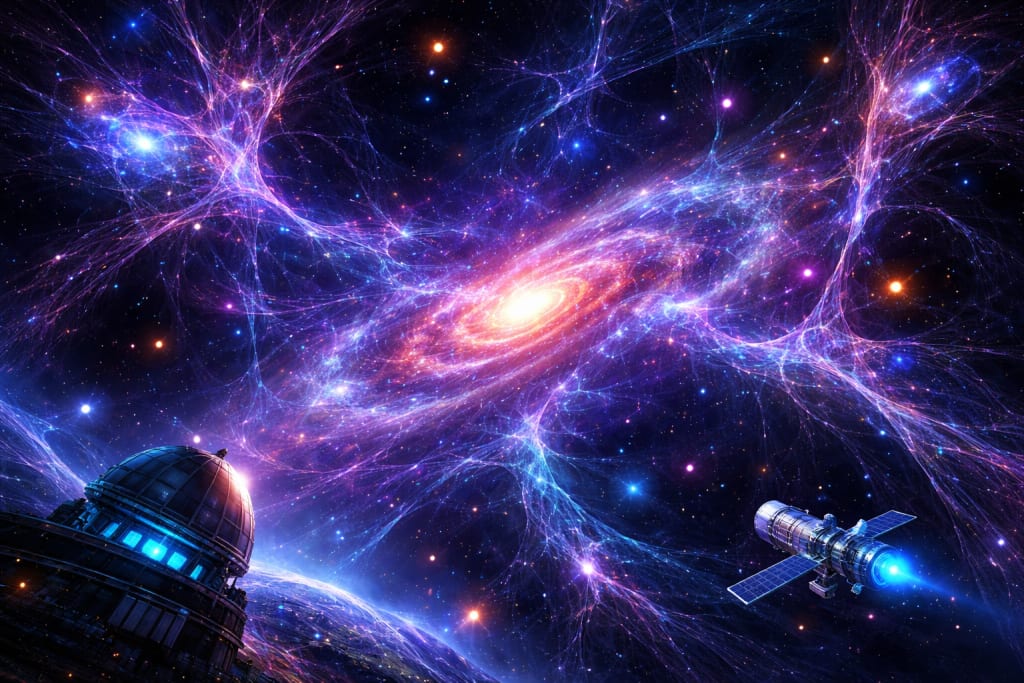
For decades, dark matter has remained one of the most persistent enigmas in modern astrophysics. Invisible to telescopes and undetectable through direct electromagnetic interaction, it nonetheless shapes the Universe on the largest scales. Galaxies rotate faster than their visible mass allows, galaxy clusters remain gravitationally bound, and the cosmic web itself depends on an unseen framework. Until recently, dark matter was largely treated as a silent, passive component—cold, inert, and interacting only through gravity. However, research published and analyzed in 2026 significantly challenged this simplified view.
Rather than providing a single breakthrough discovery, 2026 marked a shift in perspective. Multiple independent observations and simulations pointed toward a more complex and dynamic nature of dark matter than previously assumed.
Signs of Self-Interaction Within Dark Matter
One of the most discussed developments of 2026 came from high-resolution observations of dwarf galaxies and low-mass galactic systems. Using advanced gravitational lensing techniques and refined stellar motion data, astronomers noticed that the inner density profiles of dark matter halos were smoother and less concentrated than predicted by the standard cold dark matter (CDM) model.
This discrepancy revived serious interest in **self-interacting dark matter** models. In these scenarios, dark matter particles can collide or scatter off one another, albeit extremely weakly. Even rare interactions, when accumulated over billions of years, could redistribute energy within galactic halos, softening their dense cores.
What made 2026 notable was the consistency of this pattern across different datasets. Instead of being isolated anomalies, these observations suggested that dark matter may possess internal physics of its own—subtle, but astrophysically significant.
Dark Matter May Not Be Perfectly “Cold”
Another assumption that came under scrutiny in 2026 was the idea that dark matter is entirely cold, meaning its particles move at negligible speeds compared to the speed of light. While this assumption works well for explaining large-scale cosmic structures, it struggles to account for the observed scarcity of small satellite galaxies around massive systems like the Milky Way.
New simulations incorporating slightly faster-moving dark matter particles produced results that aligned more closely with observations. This renewed attention to **warm dark matter** models, in which particles retain a small amount of primordial kinetic energy.
Some researchers now argue that dark matter may not be a single component at all. Instead, it could be a composite phenomenon, consisting of multiple particle species with different masses and velocities. Such a hybrid model would naturally explain why dark matter behaves differently on galactic and sub-galactic scales.
A Possible Connection to Dark Energy
Perhaps the most unexpected discussions of 2026 involved a potential link between dark matter and dark energy. Traditionally treated as entirely separate phenomena—one binding structures together, the other driving cosmic expansion—recent precision measurements hinted at subtle anomalies in the rate at which cosmic structures grow over time.
These deviations were small but persistent. Some theoretical models proposed that dark matter properties might evolve as the Universe expands, possibly exchanging energy with dark energy through mechanisms not yet understood.
While these ideas remain speculative, they gained traction in 2026 because they offered a coherent explanation for multiple observational tensions within the standard ΛCDM model. As a result, the idea of a dynamic dark sector—rather than two unrelated components—moved closer to mainstream theoretical discussion.
Quantum Effects on Galactic Scales
Another development that attracted attention in 2026 involved **ultralight dark matter**, sometimes referred to as “fuzzy” dark matter. In these models, dark matter particles have extraordinarily small masses, so small that their quantum wave nature becomes relevant on galactic scales.
Instead of behaving like classical particles, such dark matter would form wave-like interference patterns. These patterns could subtly influence the distribution of stars and gas within galaxies, potentially explaining irregularities in galactic rotation curves and core structures without invoking complex baryonic physics.
In 2026, improved observations and simulations showed that some galactic features previously attributed solely to star formation feedback might also be consistent with wave-based dark matter effects. This marked a rare instance where quantum mechanics and astrophysical observations intersected directly on cosmic scales.
Unexplained High-Energy Signals
Despite decades of effort, dark matter has not been directly detected in laboratories. However, 2026 brought renewed interest in **indirect detection** through cosmic signals. Several space-based and ground-based detectors reported anomalous excesses in gamma-ray and neutrino data that could not be easily explained by known astrophysical sources.
While none of these signals provided conclusive evidence of dark matter decay or annihilation, their spectral features were unusual enough to motivate new models involving extremely long-lived or metastable dark matter particles. If correct, such particles would decay so rarely that only vast cosmic detectors could observe their faint signatures.
A Shift in the Role of Dark Matter
The most important outcome of 2026 was conceptual rather than experimental. Dark matter is no longer widely viewed as a passive gravitational background. Instead, it is increasingly seen as an active participant in cosmic evolution—capable of influencing galaxy formation, altering internal structures, and possibly interacting with other components of the dark Universe.
Conclusion
The discoveries and analyses of 2026 did not solve the mystery of dark matter, but they fundamentally changed how scientists approach it. Rather than searching for a single, simple particle, researchers are now exploring a richer dark sector with internal interactions, quantum properties, and potential links to dark energy.
This evolving picture suggests that dark matter may be as complex as the visible Universe it helps shape. As new observatories and experiments come online, the coming years may not just refine existing models—but force a deeper rethinking of what the Universe is truly made of.
About the Creator
Keep reading
More stories from Holianyk Ihor and writers in Futurism and other communities.
The Most Mysterious Signals from Deep Space Detected in 2026
The year 2026 has reinforced a long-standing truth in astronomy: the deeper we listen to the Universe, the stranger it becomes. Modern telescopes no longer simply observe distant stars and galaxies — they intercept brief, powerful, and often inexplicable signals that arrive from billions of light-years away. Some last only milliseconds, others pulse with eerie regularity, and a few originate from epochs when the Universe itself was still young.
By Holianyk Ihorabout 17 hours ago in Futurism
Asia Pacific Injectable Drug Delivery Market Poised to Surge 60% to USD 282 Billion by 2031
The Asia Pacific injectable drug delivery market is set to experience transformative growth, expanding from USD 176.96 billion in 2026 to USD 282.22 billion by 2031, representing a robust compound annual growth rate (CAGR) of 9.8%. This strategic market expansion signals critical opportunities for pharmaceutical executives, medical device manufacturers, and healthcare infrastructure investors across the region's rapidly evolving therapeutic landscape.
By Juan Martinezabout 22 hours ago in Futurism


Comments
There are no comments for this story
Be the first to respond and start the conversation.