
New Evidence for a “Fifth Force” Emerging from Cosmology
Space

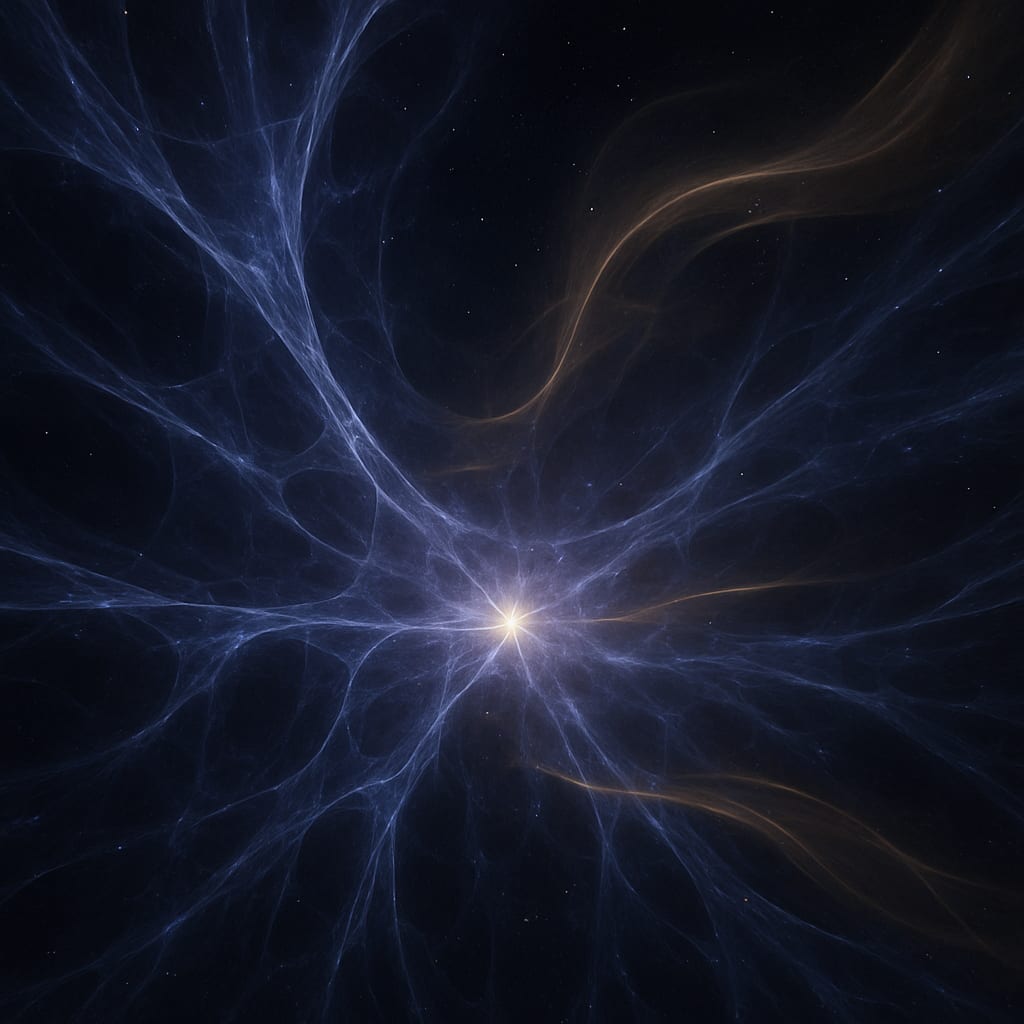
Science thrives on surprises. For centuries, physicists believed they had mapped out the fundamental forces that govern reality: gravity, electromagnetism, and the strong and weak nuclear interactions. Together, these four forces seemed to provide the backbone of the universe. Yet cracks in this framework have been showing for decades. Now, new observations from the Euclid space telescope suggest that there might be more to the story—clues pointing toward a mysterious “fifth force” acting on cosmic scales.
Why Even Consider a Fifth Force?
Gravity has always been the most puzzling of the four known forces. Despite shaping galaxies, stars, and planets, it remains incredibly weak on the quantum level and stubbornly resists unification with the other forces. Physicists have long noticed that the behavior of galaxies and the large-scale structure of the cosmos doesn’t quite fit the predictions of Einstein’s theory of general relativity.
Traditionally, these mismatches have been explained by invoking dark matter and dark energy—two invisible components that together make up about 95% of the universe. But what if the discrepancies aren’t simply due to unseen matter or energy? What if there is a hidden interaction, a subtle fifth force, quietly shaping the cosmos?
The Role of Euclid
The Euclid mission, launched by the European Space Agency, is designed to create the most detailed 3D map of the universe ever made. By observing billions of galaxies stretching back over 10 billion years, Euclid can track how matter clustered together over time and how cosmic expansion evolved.
Recently, Euclid’s data revealed tiny but intriguing deviations from the predictions of the standard ΛCDM cosmological model (which combines Einstein’s relativity with cold dark matter and a cosmological constant). These deviations appear in the distribution of galaxy clusters, the speed at which structures grow, and even in measurements of the universe’s expansion rate.
Such discrepancies might point to the action of a new force—something beyond gravity—that becomes noticeable only at immense scales.
How Could a Fifth Force Work?
One leading idea is that a scalar field—a type of field that assigns a single value to every point in space—could be influencing matter across the cosmos. Unlike electromagnetism or gravity, this field would be extremely weak and nearly impossible to detect in everyday laboratory experiments.
Here are some possible effects of this hidden force:
- It could subtly strengthen or weaken gravitational attraction depending on location.
- It might alter the way galaxies and galaxy clusters form and move.
- It could even mimic the effects of dark energy, driving the accelerated expansion of the universe.
If correct, such a force could explain one of the biggest puzzles in modern astrophysics: the Hubble tension. This is the mismatch between the locally measured rate of cosmic expansion and the rate inferred from early-universe observations like the cosmic microwave background. A fifth force could act as the “missing piece” that resolves this cosmic disagreement.
The Stakes for Physics
If Euclid’s observations truly hint at a new fundamental force, the implications would be profound.
Dark Energy Rethought. Instead of a mysterious, all-pervading energy, the acceleration of the universe might be the effect of an underlying interaction field.
Toward Unification. The discovery of a fifth force could open new pathways to a long-sought “theory of everything” that unites quantum mechanics with gravity.
New Cosmological Models. Our current ΛCDM model, while successful in many respects, might turn out to be an approximation—one that needs to be replaced by a more powerful framework.
History shows that paradigm shifts often begin with small anomalies. For instance, tiny irregularities in Mercury’s orbit eventually led Einstein to develop general relativity. Could Euclid’s subtle deviations be a similar signpost toward the next great theory?
Proceeding with Caution
Scientists remain cautious. These results are still in the realm of hints, not proofs. It’s possible that the anomalies will vanish as more precise data come in, or that they could be explained by refinements to our models of dark matter. Cosmology is notoriously complex, and extraordinary claims require extraordinary evidence.
Upcoming missions, such as NASA’s Nancy Grace Roman Space Telescope, will provide independent checks and even more precise measurements. If they confirm Euclid’s findings, the case for a fifth force will grow much stronger.
A Universe Full of Surprises
For now, the idea of a fifth force remains tantalizingly speculative. But this is how science progresses: bold theories rise to explain stubborn mysteries, and careful experiments determine whether they survive. Euclid has only just begun its mission, and already it is forcing us to rethink the boundaries of known physics.
Perhaps in a few years, textbooks will list not four but five fundamental forces of nature, with Euclid remembered as the mission that revealed it.
After all, the universe has never failed to surprise us.
About the Creator
Keep reading
More stories from Holianyk Ihor and writers in Futurism and other communities.
Traces of an Ancient Ocean on Mars: Perseverance’s Groundbreaking Discovery
When we picture Mars today, we imagine a frozen desert: an arid, windswept planet draped in rust-red dust, its surface carved by craters and barren valleys. But scientists have long suspected that this harsh landscape hides a very different past — one where rivers carved channels, lakes filled craters, and vast oceans may have once stretched across its surface. Now, thanks to NASA’s Perseverance rover, new evidence has emerged that strengthens the case for an ancient Martian ocean.
By Holianyk Ihor4 months ago in Futurism
About Binding Prometheus
I want to start actively advocating on behalf of my own work, and the most valuable part of my canon is, without a doubt, Binding Prometheus, the play I have been working on since 2019 and only finished in 2023 as part of my MA. The play itself is an amalgamation of a million different inspirations. On one end, it evokes the Ancient Greek myth-play, deriving its own title from the earliest extant work of Western drama we have, Aeschylus’s Prometheus Bound. On the other end, it borrows significantly from the sci-fi bulwarks from over the years, namely Mary Shelley’s Frankenstein and Karel Capek’s Rossum’s Universal Robots. The play could be an episode of Black Mirror, I fear. I don’t know. I’ve only ever seen one episode of Black Mirror.
By Steven Christopher McKnight16 days ago in Futurism
Top Generative AI Use Cases for UK Enterprises in 2026
Generative AI is moving decisively beyond experimentation and into the core operational fabric of UK enterprises. What began as content generation and chatbot experimentation is now evolving into mission-critical systems that influence decision-making, automation, customer engagement, compliance, and innovation velocity.
By NextGen Narratives2 days ago in Futurism


Comments
There are no comments for this story
Be the first to respond and start the conversation.