
Traces of an Ancient Ocean on Mars: Perseverance’s Groundbreaking Discovery
Space

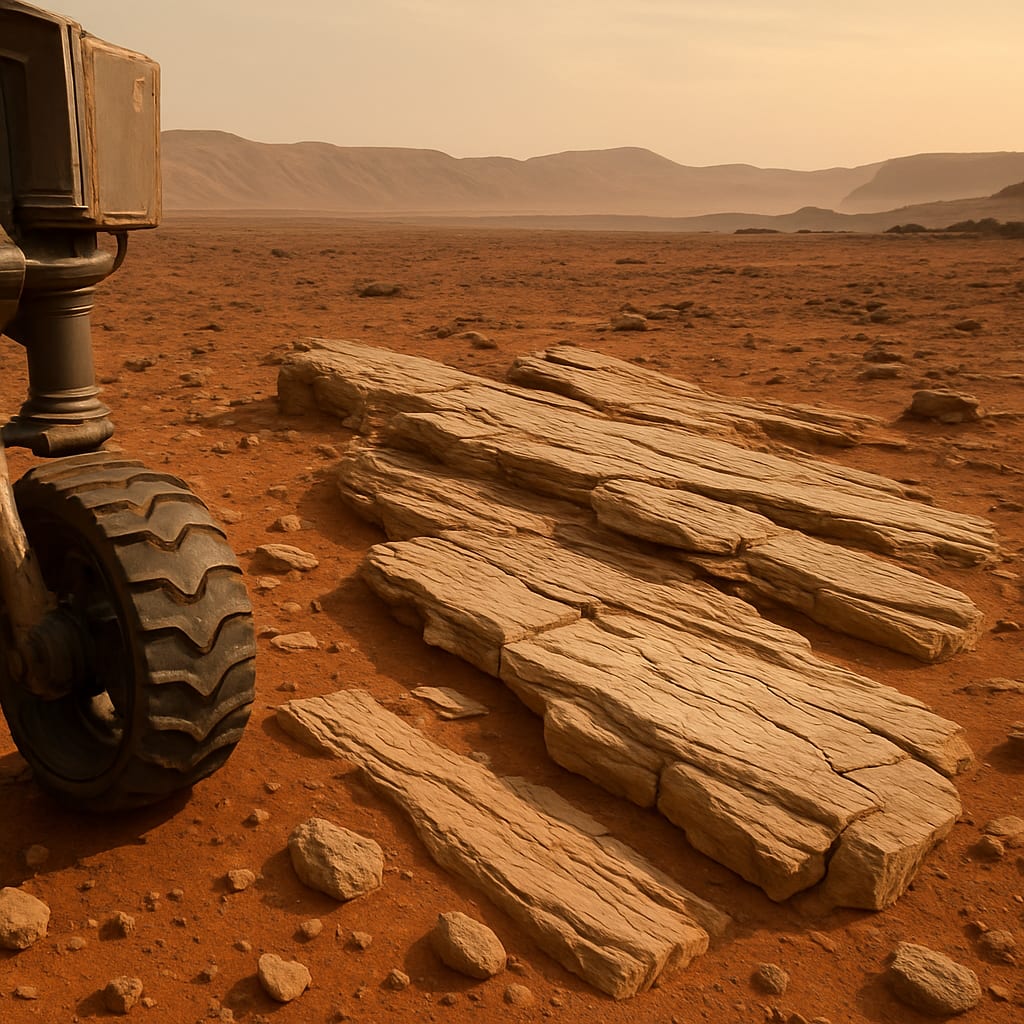
When we picture Mars today, we imagine a frozen desert: an arid, windswept planet draped in rust-red dust, its surface carved by craters and barren valleys. But scientists have long suspected that this harsh landscape hides a very different past — one where rivers carved channels, lakes filled craters, and vast oceans may have once stretched across its surface. Now, thanks to NASA’s Perseverance rover, new evidence has emerged that strengthens the case for an ancient Martian ocean.
Minerals Born in the Depths
While exploring Jezero Crater — a site once chosen because it likely held water — Perseverance made a remarkable discovery. It detected minerals that could only have formed under the pressure and chemistry of deep water environments. These minerals, including carbonates and sulfates, are like geological fingerprints. On Earth, they form when water lingers for long periods, seeping into rocks and changing their chemical structure.
This is no fleeting puddle or seasonal stream. The mineral patterns suggest something far greater: the long-term presence of a large, deep body of water, potentially comparable in scale to Earth’s seas. For scientists, this shifts the conversation from “Was Mars ever wet?” to “Did Mars once have oceans capable of supporting life?”
Why This Matters
Oceans are more than just water reservoirs — they are engines of habitability. On Earth, life likely began in the depths of our oceans, where hydrothermal vents created warm, mineral-rich environments. Here, chemistry became biology. If Mars also hosted a deep ocean billions of years ago, the chances increase dramatically that life — even if only microbial — could have emerged there.
The minerals found by Perseverance are more than chemical curiosities. They are time capsules, storing records of Mars’ watery past. Inside their crystal structures, there may be traces of ancient organic molecules, or even microscopic fossilized remains of Martian microbes. Imagine holding a Martian rock and realizing it carries the signature of life that once thrived on another world. That is the dream driving planetary scientists today.
Mars Wasn’t Always a Desert
Previous missions had already hinted at water on Mars. The Curiosity rover found evidence of shallow lakes and riverbeds, while orbiters revealed ancient deltas carved into the landscape. But Perseverance’s findings point to something more profound — not just small pockets of water, but the existence of a long-lived ocean system.
If confirmed, this would radically alter our view of early Mars. Rather than a cold, marginally wet world, it may have been a “blue planet” in its own right, with climates capable of sustaining oceans for millions of years. For a time, Mars might have looked more like Earth than the barren wasteland we see today.
Looking Toward the Future
Perseverance is far from finished. The rover is busy drilling and collecting rock samples that will eventually be returned to Earth in one of the most ambitious space projects ever attempted — the joint Mars Sample Return mission by NASA and ESA. Scientists hope these samples will contain definitive evidence: organic compounds or fossil-like structures that reveal whether Mars ever hosted life.
If such proof is found, it would be a discovery on par with the greatest in human history. It would confirm that life is not unique to Earth and that biology can take hold wherever the conditions are right. Suddenly, the universe would feel a little less lonely.
A Planet That Keeps Surprising Us
The story of Mars is one of transformation. Once a potentially habitable world with oceans, rivers, and a thicker atmosphere, it gradually lost its magnetic field, its atmosphere thinned, and the waters retreated underground or escaped into space. Today, we see only the dry bones of that ancient planet. But discoveries like Perseverance’s prove that Mars is still whispering secrets about its past.
And these whispers matter. They don’t just tell us about Mars; they help us understand our own planet’s history and the fragile balance that allowed life to thrive here. They also guide our search for life beyond Earth — on icy moons like Europa and Enceladus, or on distant exoplanets orbiting other stars.
For now, Perseverance continues its tireless work, trundling across the Martian surface and digging into the rocks that may hold the answers to one of humanity’s greatest questions: Are we alone?
The evidence of an ancient Martian ocean doesn’t give us a final answer — not yet. But it does make one thing clear: Mars was once a world full of possibilities. And perhaps, just perhaps, it still holds the memory of life within its stones.
About the Creator
Keep reading
More stories from Holianyk Ihor and writers in Futurism and other communities.
A Mysterious Relic Galaxy: A Frozen Echo of the Early Universe
Every time astronomers point their most advanced telescopes toward the depths of the cosmos, they are essentially peering back in time. Light from the most distant galaxies travels for billions of years before reaching us, carrying with it precious clues about the infancy of our Universe. Recently, researchers announced a remarkable discovery: a new relic galaxy that has preserved the characteristics of some of the very first cosmic structures born after the Big Bang.
By Holianyk Ihor4 months ago in Futurism
About Binding Prometheus
I want to start actively advocating on behalf of my own work, and the most valuable part of my canon is, without a doubt, Binding Prometheus, the play I have been working on since 2019 and only finished in 2023 as part of my MA. The play itself is an amalgamation of a million different inspirations. On one end, it evokes the Ancient Greek myth-play, deriving its own title from the earliest extant work of Western drama we have, Aeschylus’s Prometheus Bound. On the other end, it borrows significantly from the sci-fi bulwarks from over the years, namely Mary Shelley’s Frankenstein and Karel Capek’s Rossum’s Universal Robots. The play could be an episode of Black Mirror, I fear. I don’t know. I’ve only ever seen one episode of Black Mirror.
By Steven Christopher McKnight17 days ago in Futurism
Singapore Electronic Paper Display Market Driven by Innovation and Investments
The Singapore electronic paper display market has reached USD 47.6 Million in 2024 and is set to experience remarkable expansion over the next decade. According to a new market research report by IMARC Group, the market is projected to reach USD 436.3 Million by 2033, reflecting a compound annual growth rate (CAGR) of 24.8% during 2025-2033.
By Abhishek Dixit6 days ago in Futurism


Comments
There are no comments for this story
Be the first to respond and start the conversation.